
Arrowhead’s ARO-DIMER-PA reduced PCSK9 by 72% and APOC3 by 88% in a Phase 1/2a trial, with significant reductions in LDL-C and triglycerides.
Written By: Khushi Patel, PharmD
Reviewed By: Pharmacally Editorial Team
Arrowhead Pharmaceuticals reported interim topline results from the Phase 1/2a ARODIMER-PA-1001 study of ARO-DIMER-PA, an investigational RNA interference (RNAi) therapy for atherosclerotic cardiovascular disease (ASCVD) associated with mixed hyperlipidemia. Single doses produced mean maximal serum reductions of 72% in PCSK9 and 88% in APOC3, with corresponding improvements across several atherogenic lipid measures.
Dual-gene silencing targets two drivers of residual cardiovascular risk
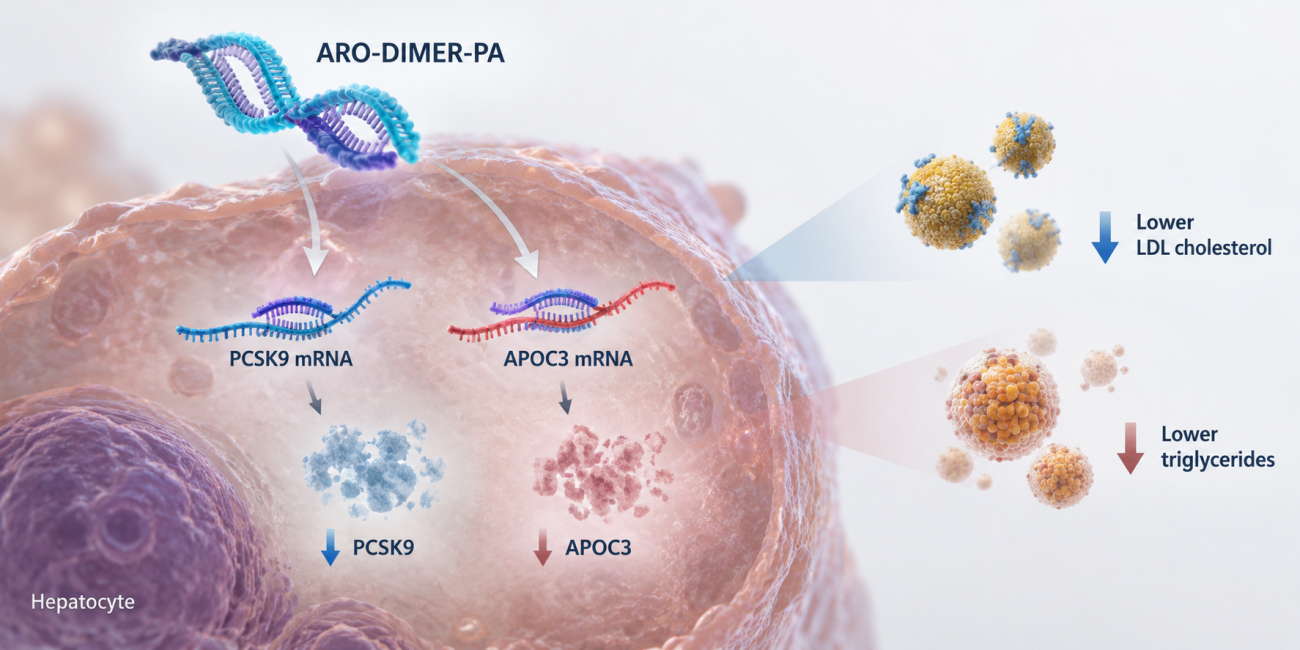
ARO-DIMER-PA is the first clinical candidate from Arrowhead’s RNAi platform to selectively silence two genes with a single RNAi molecule. The therapy targets PCSK9 and APOC3 in hepatocytes.
PCSK9 inhibition increases hepatic clearance of LDL cholesterol, while APOC3 inhibition affects triglyceride-rich lipoprotein metabolism. Simultaneously suppressing both pathways could therefore address LDL cholesterol and triglyceride-related abnormalities that persist despite conventional lipid-lowering treatment.
That approach is particularly relevant in mixed hyperlipidemia, where patients have elevated LDL-C and triglycerides and may retain substantial ASCVD risk even with intensive LDL-C lowering.
Single-dose data show broad lipid reductions
In participants with mixed hyperlipidemia, ARO-DIMER-PA produced dose-dependent mean maximal reductions of 72% in serum PCSK9 and 88% in APOC3.
The dual target engagement translated into substantial changes in circulating lipids and lipoproteins:
- LDL-C: 54% mean maximal reduction
- Triglycerides: 73% reduction
- Non-HDL cholesterol: 61% reduction
- Apolipoprotein B: 50% reduction
The reductions in LDL-C and ApoB are particularly relevant because both measures are established markers of atherogenic particle burden and cardiovascular risk. The triglyceride and remnant-lipoprotein effects could provide an additional mechanism for addressing residual risk in patients whose LDL-C is already aggressively controlled.
Phase 1/2a study continues into multiple dosing
ARODIMER-PA-1001 (NCT07223658) is a placebo-controlled, dose-escalation Phase 1/2a trial evaluating single and multiple doses in up to 78 adults with mixed hyperlipidemia.
The completed single-dose escalation evaluated doses through 400 mg. The study is now continuing to assess the safety and tolerability of multiple doses, alongside pharmacokinetic and pharmacodynamic measures and effects on LDL-C and triglycerides.
Injection-site events and headaches were the most commonly reported treatment-emergent adverse events. No drug-related serious adverse events were reported in the interim analysis.
Arrowhead positions the program within its cardiometabolic pipeline
Arrowhead CEO Chris Anzalone said the findings provide clinical validation that the company’s Targeted RNAi Molecule (TRiM) platform can silence two genes simultaneously with one molecule, potentially broadening RNAi applications beyond single-gene targets.
Chief Medical Officer James Hamilton highlighted the established relationship between reductions in LDL-C and ApoB and lower cardiovascular event risk, while Cleveland Clinic cardiologist Steven Nissen noted that LDL-C-focused treatment does not fully address the abnormalities associated with mixed hyperlipidemia.
The program also complements Arrowhead’s cardiometabolic portfolio, which includes REDEMPLO (plozasiran), approved for familial chylomicronemia syndrome, and investigational zodasiran, now in the Phase 3 YOSEMITE trial for homozygous familial hypercholesterolemia.
Additional ARO-DIMER-PA results are expected at an upcoming medical congress. The ongoing multiple-dose portion will provide the next important readout on durability, repeat-dose safety, and whether the strong biomarker effects observed after a single administration can be sustained with continued treatment.
Reference
Arrowhead Pharmaceuticals Announces Interim Topline Clinical Data for the First Dual-Functional RNAi Therapeutic for the Treatment of Mixed Hyperlipidemia, Arrowhead Pharmaceuticals, 15 September 2026
Study of ARO-DIMERPA in Adult Participants With Mixed Hyperlipidemia, ClinicalTrials.gov ID NCT07223658

About the Writer
Khushi Patel is a Pharm.D (Linkedin) professional with a strong foundation in clinical pharmacy, patient-centered care, regulatory affairs, and pharmacovigilance, with published work on Brugada syndrome.
Her interests include regulatory affairs, pharmacovigilance, guideline integration, multimodal therapy, pharmacogenomics, and antibiogram utilization, with a focus on evidence-based clinical decision-making and medication safety.
As a Pharmacally healthcare writer, she translates clinical and scientific evidence into clear, accurate, and clinically relevant healthcare content, while continuously developing her expertise in evolving pharmacy practice.