
BlossomHill’s BH-30643 showed a 45% response rate and 88% disease control rate in EGFR C797S-positive NSCLC after prior EGFR inhibitors.
Written By: Saniya Katakdhond, PharmD
Reviewed By: Pharmacally Editorial Team
BlossomHill Therapeutics’ investigational BH-30643 produced a 45% objective response rate and 88% disease control rate in patients with EGFR C797S-positive non-small cell lung cancer (NSCLC) who had developed resistance to prior EGFR inhibitors. The updated Phase 1/2 SOLARA data highlight a potential targeted approach for a resistance setting with no approved targeted therapies.
Activity in a difficult resistance setting
Among 40 patients with EGFR C797S-positive disease, with or without concurrent T790M, 18 achieved a confirmed or ongoing unconfirmed partial response. Sixteen responses were confirmed, while two remained unconfirmed at the May 12, 2026 data cutoff, corresponding to an ORR of 45% (95% CI, 29%-62%). The DCR reached 88% (35/40).
At efficacy follow-up through August 10, 2026, 25 patients, or 63%, remained on treatment. Median follow-up was 6.9 months, providing early evidence that responses may extend beyond initial tumor shrinkage.
The findings were presented in a mini-oral session at the International Association for the Study of Lung Cancer (IASLC) 2026 World Conference on Lung Cancer in Seoul.
Targeting EGFR resistance
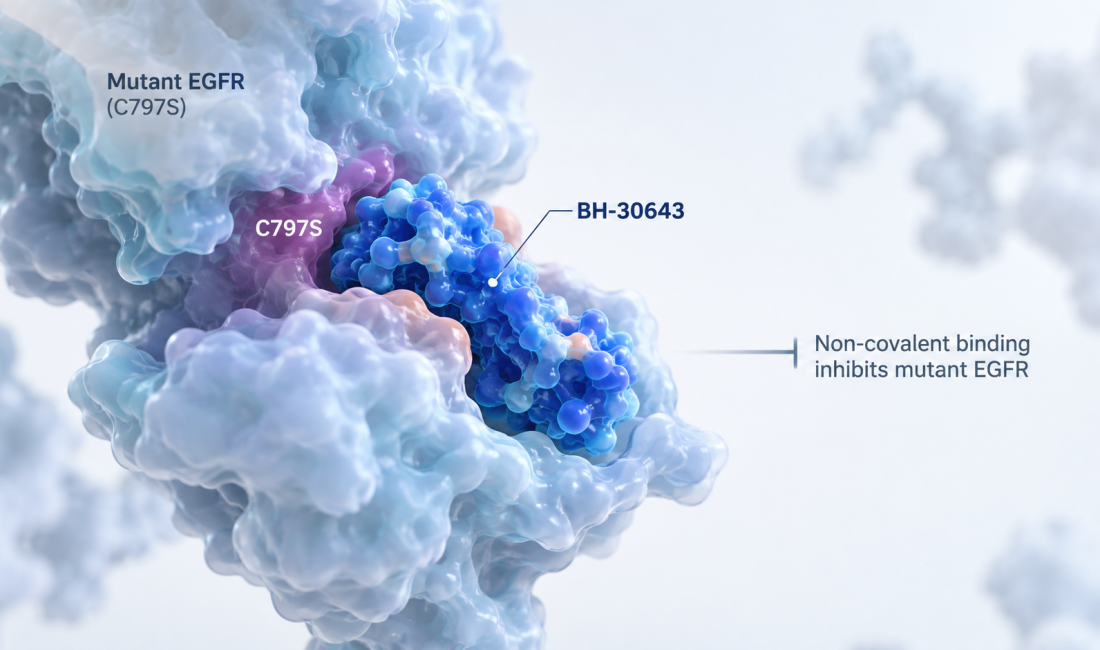
BH-30643 is an oral, non-covalent macrocyclic EGFR inhibitor with brain activity and selectivity for mutant EGFR. The compound was developed to inhibit a broad range of EGFR alterations while limiting inhibition of wild-type EGFR.
C797S is a key on-target resistance mutation that can emerge after treatment with third-generation EGFR TKIs, including osimertinib. The mutation replaces the cysteine residue at position 797 that these drugs use for covalent binding to EGFR, preventing effective target engagement. BH-30643 uses a non-covalent binding mechanism, allowing it to inhibit mutant EGFR without relying on the C797 residue for covalent attachment. This mechanism provides a direct rationale for targeting C797S-driven resistance.
The SOLARA population was heavily pretreated. Patients had received a median of two prior lines of therapy, 98% had previously received osimertinib, and 53% had received chemotherapy and/or an antibody-drug conjugate. More than half had a history of brain metastases, while 35% had concurrent T790M.
Favorable tolerability at expansion doses
Safety data from 174 patients treated with 40 mg, 50 mg or 60 mg twice daily showed treatment-related dose reductions in 9% and treatment-related discontinuations in 3%.
EGFR wild-type-associated treatment-related adverse events were predominantly Grade 1. Bilirubin elevation was the most common treatment-related adverse event and was generally asymptomatic and predominantly unconjugated, consistent with UGT1A1 inhibition associated with BH-30643.
Geoff Oxnard, M.D., Chief Medical Officer of BlossomHill Therapeutics, said the results provide clinical support for the strategy of targeting on-target EGFR resistance, including C797S. Presenting author Hidehito Horinouchi, M.D., Ph.D., noted that responses in this heavily pretreated population could extend the benefits of targeted treatment for patients whose tumors acquire C797S.
Phase 2 planned for 2027
The FDA recently granted Fast Track designation to BH-30643 for advanced or metastatic EGFR C797S-positive NSCLC. The company is continuing dose-expansion studies across C797S-positive disease, other EGFR-mutant populations, targeted therapy-naive patients and combinations with chemotherapy.
BlossomHill plans to initiate a global Phase 2 study in EGFR C797S-positive NSCLC in the first quarter of 2027. The next stage will determine whether the response signal and tolerability observed in SOLARA translate into more durable and clinically meaningful benefit in a larger, molecularly defined population.
Reference
BlossomHill Therapeutics Presents Updated Data from Ongoing Phase 1/2 SOLARA Trial Demonstrating Encouraging Anti-Tumor Activity of OMNI-EGFR™ Inhibitor BH-30643 in EGFR C797S-Positive NSCLC at IASLC 2026 World Conference on Lung Cancer, Blossom Hills Therapeutics, 15 September 2026
A Study of BH-30643 in Subjects With Locally Advanced or Metastatic NSCLC Harboring EGFR and/or HER2 Mutations (SOLARA), ClinicalTrials.gov ID NCT06706076

About the Writer
Saniya Sanjay Katakdhond (Linkedin) is a Doctor of Pharmacy professional with hands-on experience in patient case review, clinical documentation, medical record analysis, and patient care.
Her hospital experience has strengthened her understanding of clinical conditions, treatment approaches, and multidisciplinary healthcare practices.
With ICH-GCP certification and a research-oriented approach, she brings clinical insight and attention to detail to healthcare content development.
As a healthcare writer, Saniya focuses on translating clinical knowledge and patient-care experience into clear, accurate, and evidence-informed medical content.