
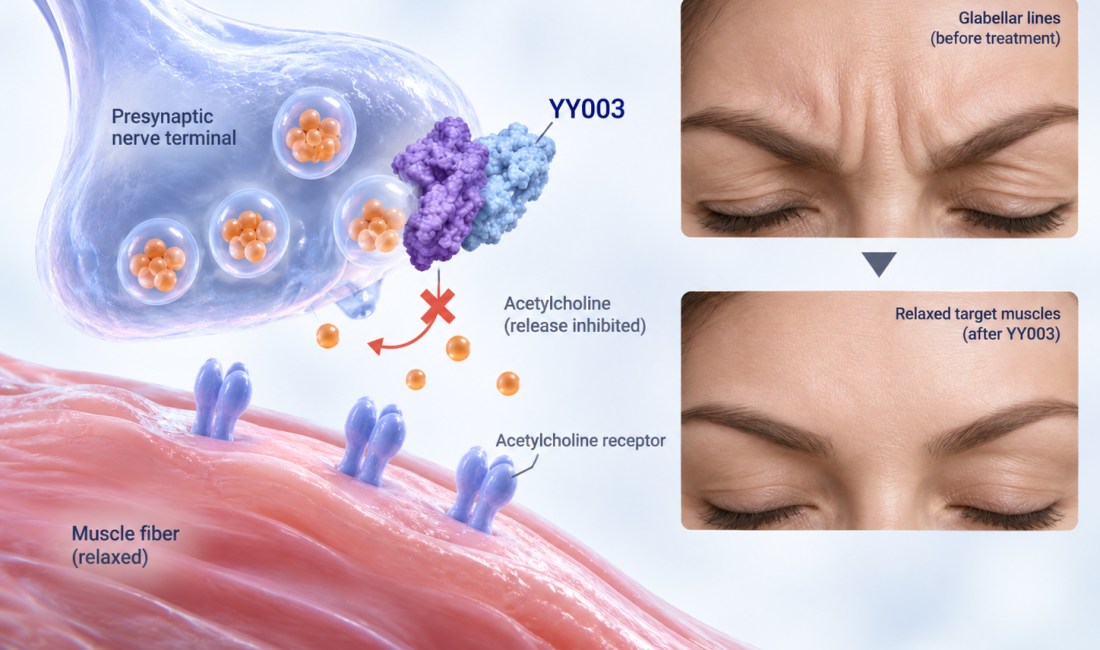
Revelyx Bio’s recombinant botulinum toxin YY003 achieved an 80.8% Week 4 response in a Phase 2 trial for moderate-to-severe glabellar lines.
Written By: Khushi Patel, PharmD
Reviewed By: Pharmacally Editorial Team
Revelyx Bio’s investigational YY003 met its primary and key secondary endpoints in a Phase 2 trial of adults with moderate-to-severe glabellar lines, with the 40 U doses producing an 80.8% composite response at Week 4 versus 0% with vehicle (p<0.001). The ready-to-use liquid recombinant botulinum toxin type A was generally well tolerated, with no treatment-related serious adverse events.
YY003 Combines Recombinant Technology with Ready-to-Use Formulation
YY003 is being developed by Revelyx under an exclusive licensing agreement with Chongqing Claruvis Pharmaceutical, the developer of the recombinant botulinum toxin technology behind the program. Under the agreement, Revelyx holds exclusive rights to develop and commercialize YY003 for aesthetic and therapeutic indications globally, excluding mainland China, Hong Kong, and Macau.
Claruvis is a subsidiary of MingMed Biotechnology and specializes in recombinant botulinum toxin products. Its proprietary platform also underpins Retoxin (YY001), which received approval in China in March 2026 and was described by the company as the world’s first approved recombinant botulinum toxin type A.
YY003 is produced through recombinant expression in E. coli, rather than by purifying neurotoxin from cultures of Clostridium botulinum. The resulting protein is structurally identical to naturally derived neurotoxin. The program also uses a ready-to-use liquid formulation, eliminating the manual reconstitution step required for currently approved botulinum toxin type A products in the United States.
Phase 2 Trial Design
The Phase 2 study (YY003-001-US01; NCT06481475) randomized 153 adults at three clinical sites in Australia under a U.S. Investigational New Drug application.
Part A evaluated safety and tolerability across three dose levels. Part B enrolled 129 participants in a randomized, double-blind, vehicle-controlled evaluation of 30 U and 40 U doses selected by an independent data monitoring committee.
The primary efficacy endpoint at Week 4 used a stringent composite measure. Participants had to achieve a Facial Wrinkle Scale score of none or mild and at least a two-grade improvement from baseline, with the response independently confirmed by both the investigator and participant.
Primary Endpoint Shows Strong Week 4 Efficacy
The 40 U doses produced an 80.8% composite response at Week 4, compared with 66.7% for 30 U and 0% for vehicle. Both active doses were statistically superior to vehicle (p<0.001).
The result is notable because the primary endpoint required agreement between investigator and participant assessments rather than relying solely on an investigator-rated improvement. This provides a more stringent measure of clinically visible and patient-perceived benefit.
Secondary Measures Show Rapid Onset
YY003 also showed evidence of an early treatment effect. By Week 1, 90.4% of participants receiving 40 U had achieved a Facial Wrinkle Scale score of none or mild, compared with 3.8% with vehicle (p<0.001). The Week 1 response was close to the 92.3% recorded at Week 4, suggesting that much of the observed wrinkle reduction occurred early.
At Week 4, 92.3% of participants receiving 40 U had achieved a none-or-mild score according to investigators. In addition, 94.2% reported improvement on the Global Aesthetic Improvement Scale, while 90.4% reported satisfaction with the appearance of their frown lines.
Safety and Immunogenicity Findings Remain Favorable
YY003 was generally safe and well tolerated. Injection-site reactions and headache were the most common treatment-related adverse events. No treatment-related serious adverse events occurred, and no participants discontinued treatment because of adverse events.
Immunogenicity findings were also limited. No neutralizing antibodies were detected in any participant. Only one of 106 participants tested positive for anti-drug antibodies, representing 0.9%, and that participant maintained a clinical response.
Revelyx and Claruvis Prepare for Phase 3 Development
Revelyx CEO Dustin Sjuts said the Phase 2 findings support moving YY003 toward an End-of-Phase-2 meeting with the U.S. Food and Drug Administration. The company plans to use that meeting to discuss the proposed Phase 3 dose and pivotal development program.
The Phase 2 results give Revelyx a clinical basis for advancing YY003 into pivotal development. Claruvis Chief Scientific Officer Wu Yang said the findings are consistent with the company’s broader recombinant platform and highlighted the manufacturing controls associated with recombinant BoNT/A.
For Revelyx, the next major milestone is regulatory alignment on the Phase 3 program. If the FDA supports the proposed development strategy, the company will move YY003 into pivotal testing to determine whether the efficacy, rapid onset, safety and immunogenicity profile observed in Phase 2 can be reproduced in a larger population.
YY003 remains investigational and has not been approved by the FDA or any other regulatory authority.
Reference
Revelyx Bio Reports Positive Topline Phase 2 Results for YY003, a Recombinant, Ready-to-Use Liquid Botulinum Toxin Type A, in Moderate-to-Severe Glabellar Lines, Revelyx, 14 September 2026
A Study to Investigate the Safety and Efficacy of YY003 in Adults With Moderate to Severe Glabellar Lines, ClinicalTrials.gov ID NCT06481475

About the Writer
Khushi Patel is a Pharm.D (Linkedin) professional with a strong foundation in clinical pharmacy, patient-centered care, regulatory affairs, and pharmacovigilance, with published work on Brugada syndrome.
Her interests include regulatory affairs, pharmacovigilance, guideline integration, multimodal therapy, pharmacogenomics, and antibiogram utilization, with a focus on evidence-based clinical decision-making and medication safety.
As a Pharmacally healthcare writer, she translates clinical and scientific evidence into clear, accurate, and clinically relevant healthcare content, while continuously developing her expertise in evolving pharmacy practice.