
Corbus Pharmaceuticals’ CRB-913 achieved 5% weight loss at 60 mg in a Phase 1b obesity trial, with statistically significant results and favorable tolerability.
Written By: Saniya Katakdhond, PharmD
Reviewed By: Pharmacally Editorial Team
Corbus Pharmaceuticals’ oral CB1 inverse agonist CRB-913 produced statistically significant weight loss across all three doses in the CANYON-1 Phase 1b trial, with the 60 mg dose achieving a least-squares mean 5.0% reduction from baseline after 12 weeks. The drug was generally well tolerated, with psychiatric adverse events broadly consistent with GLP-1 therapies and an emerging gastrointestinal profile that appeared more favorable in cross-trial comparisons.
Oral Non-Incretin Approach to Obesity
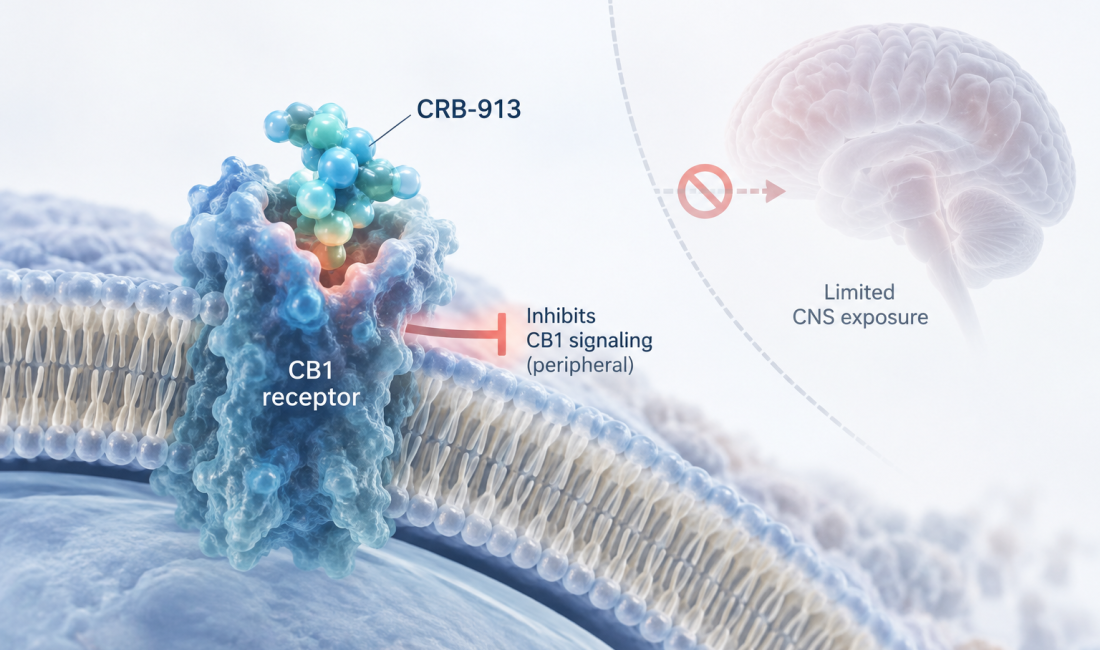
CRB-913 is a peripherally restricted CB1 inverse agonist developed to limit central nervous system exposure while targeting peripheral CB1 signaling. The approach is intended to reduce the psychiatric liabilities associated with earlier CB1 inverse agonists that produced greater brain exposure.
The CANYON-1 findings are therefore important beyond the magnitude of weight loss. The study showed continued weight reduction through 12 weeks, with no evidence of a plateau at any tested dose.
CANYON-1 Shows Dose-Dependent Weight Loss
The double-blind, placebo-controlled Phase 1b trial enrolled 254 adults with obesity who did not have diabetes across 15 US sites. Participants received once-daily oral CRB-913 at 20 mg (n=65), 40 mg (n=61), or 60 mg (n=62), or placebo (n=66). All participants assigned to active treatment began at 20 mg/day and increased their dose every two weeks according to their assigned cohort. Treatment lasted 12 weeks, followed by four weeks of follow-up.
At week 12, least-squares mean weight change was 2.8% with 20 mg, 3.3% with 40 mg, and 5.0% with 60 mg, compared with 0% for placebo. Each dose achieved a p-value below 0.0001 versus placebo.
The 60 mg cohort also showed clinically relevant individual responses. Among participants who completed treatment, 44.4% lost at least 5% of baseline body weight, 6.7% lost more than 7.5%, and the greatest observed reduction reached 13.4%.
Safety Profile Supports Further Development
CRB-913 was generally safe and well tolerated. Treatment discontinuation because of adverse events ranged from 3.1% to 13.1%, compared with 6.9% to 20.7% reported for approved oral GLP-1 therapies in published studies.
Psychiatric adverse events were infrequent, mild to moderate, and transient. No serious or severe psychiatric adverse events or cases of suicidality occurred. Only one moderate, transient case of depressive symptoms was reported among 188 participants receiving CRB-913. Irritability was the most common psychiatric event, and no clear dose-related pattern emerged.
Gastrointestinal events were also generally mild or moderate, with no serious or severe cases. Compared with published oral semaglutide and orforglipron data, CRB-913 showed lower reported rates of vomiting, nausea, and constipation, although these comparisons were not head-to-head and involved different study durations and populations.
Phase 2 Expected in 2027
Corbus plans to present the full CANYON-1 dataset in a late-breaking session at ObesityWeek 2026, scheduled for November 14–17. The company also plans discussions with the FDA on the clinical development program and expects to begin a Phase 2 monotherapy study in the first half of 2027. Combination development with GLP-1 therapy is also under evaluation.
For CRB-913, the next stage will test whether the early weight-loss signal, tolerability profile, and lack of an observed plateau can translate into sustained efficacy in larger and longer studies.
Reference
Corbus Pharmaceuticals Announces Positive Topline Data from CANYON-1 Study of Daily Oral CRB-913 for the Treatment of Obesity, Carbus Pharmaceuticals, 14 September 2026
A 2-part, Phase 1b Clinical Study Designed to Evaluate the Safety, PK, and Efficacy of CRB-913 in Participants With Obesity (CANYON-1), ClinicalTrials.gov ID NCT07310901

About the Writer
Saniya Sanjay Katakdhond (Linkedin) is a Doctor of Pharmacy professional with hands-on experience in patient case review, clinical documentation, medical record analysis, and patient care.
Her hospital experience has strengthened her understanding of clinical conditions, treatment approaches, and multidisciplinary healthcare practices.
With ICH-GCP certification and a research-oriented approach, she brings clinical insight and attention to detail to healthcare content development.
As a healthcare writer, Saniya focuses on translating clinical knowledge and patient-care experience into clear, accurate, and evidence-informed medical content