
Gotistobart extended median overall survival to 18.5 months versus 10.0 months with docetaxel in previously treated squamous NSCLC in updated Phase 3 data.
Written By: Anamika Koshti, PharmD
Reviewed By: Pharmacally Editorial Team
BioNTech and OncoC4 reported updated Phase 3 data showing median overall survival of 18.5 months with investigational gotistobart versus 10.0 months with docetaxel in patients with squamous non-small cell lung cancer (NSCLC) whose disease progressed after prior immunotherapy and platinum-based chemotherapy.
Mature Survival Data Strengthen the Clinical Signal
The updated analysis from the non-pivotal stage 1 of the showed an overall survival hazard ratio of 0.56 with a nominal p-value of 0.0295, indicating a statistically significant survival difference in this analysis.
The findings, presented at the IASLC 2026 World Conference on Lung Cancer (WCLC), were based on a July 17, 2026 data cutoff and a median follow-up of 25.4 months. Among 87 patients with metastatic squamous NSCLC, median overall survival reached 18.5 months with gotistobart compared with 10.0 months with docetaxel.
The mature analysis provides a clearer estimate of survival than the earlier interim readout, when median overall survival with gotistobart had not yet been reached at shorter follow-up.
CTLA-4 Targeting to Restore Antitumor Immunity
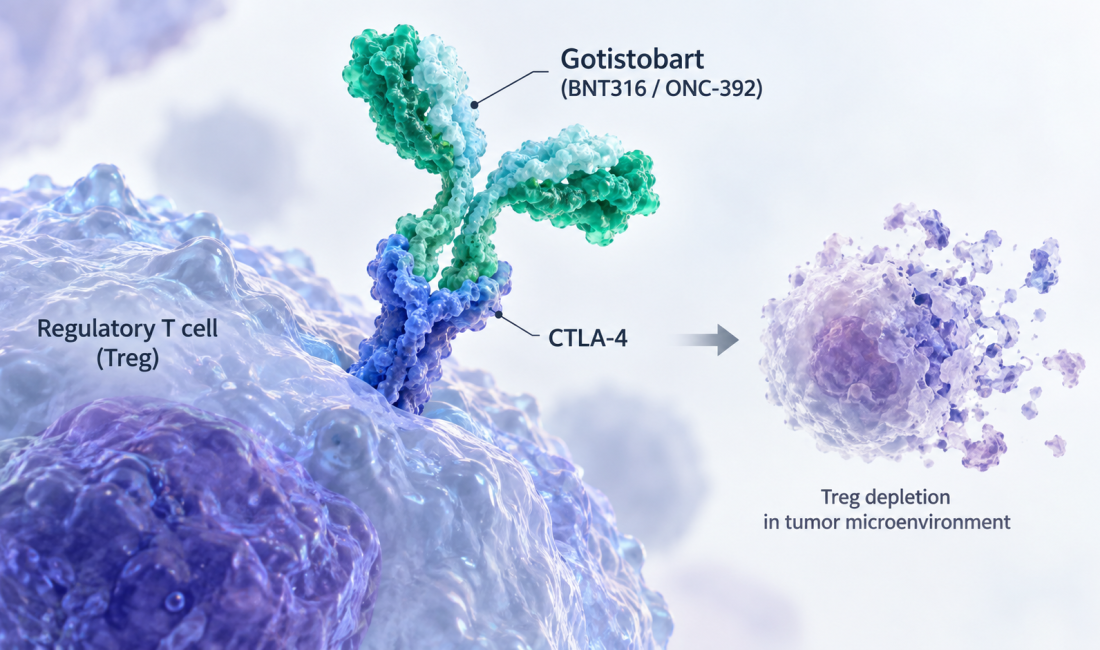
Gotistobart, also known as BNT316 or ONC-392, is an investigational monoclonal antibody targeting CTLA-4, an immune checkpoint expressed on regulatory T cells (Tregs) and other immune cells.
Its pH-sensitive binding mechanism allows CTLA-4 to recycle after the antibody-receptor complex is internalized. This approach is intended to enhance Treg depletion within the tumor microenvironment while preserving CTLA-4 function in peripheral tissues.
By reducing immunosuppressive Tregs within tumors, gotistobart could restore antitumor immune activity in cancers that have become resistant to earlier immune checkpoint therapy.
Safety Remained Comparable with Docetaxel
PRESERVE-003 randomized patients in the second-line or later setting to gotistobart at 6 mg/kg with two 10 mg/kg loading doses or docetaxel at 75 mg/m².
Grade ≥3 treatment-related adverse events occurred in 20 of 45 patients (44.4%) receiving gotistobart and 20 of 42 (48.8%) receiving docetaxel. The companies reported that the safety profile remained consistent with previous data.
The similar rates provide useful context for the survival finding, although the relatively small stage 1 population limits the strength of conclusions from this non-pivotal analysis.
Clinical Significance
The survival result is particularly relevant in a setting where patients with squamous NSCLC have few established options after progression on immunotherapy and chemotherapy. Rama Balaraman, M.D., principal investigator at Ocala Oncology Center, described the chemotherapy-free approach as encouraging while emphasizing that the survival benefit must be confirmed in the pivotal portion of the Phase 3 trial before it could support a change in the treatment standard.
The biological rationale also remains important in later-line disease, where tumors can develop mechanisms that suppress or exhaust antitumor immune responses. BioNTech Chief Medical Officer Prof. Özlem Türeci, M.D., said the updated findings reinforce the rationale for re-engaging antitumor immunity and overcoming acquired resistance through gotistobart’s CTLA-4-targeting mechanism.
Pivotal Development and Regulatory Status
The pivotal stage 2 portion of PRESERVE-003 is ongoing at more than 160 sites globally and specifically evaluates patients with squamous NSCLC. Overall survival is the primary endpoint, with overall response rate, progression-free survival and safety among the secondary endpoints.
Gotistobart has received U.S. FDA Fast Track designation for metastatic NSCLC after progression on prior anti-PD-(L)1 therapy and Orphan Drug designation for squamous NSCLC. China’s National Medical Products Administration granted the candidate Breakthrough Therapy designation in 2025.
The updated stage 1 findings strengthen the rationale for continued development, but they do not establish a new standard of care. Confirmation in the pivotal stage 2 population will determine whether gotistobart can reproduce the survival benefit and potentially provide a chemotherapy-free treatment option for patients with limited therapies after immunotherapy and platinum-based chemotherapy.
Reference
BioNTech and OncoC4 Present Updated Data Showing Gotistobart Nearly Doubled Median Overall Survival versus Standard-of-Care Chemotherapy in Previously Treated Squamous Non-Small Cell Lung Cancer Patients, BioNTech, 14 September 2026
ONC-392 Versus Docetaxel in Metastatic NSCLC That Progressed on PD-1/PD-L1 Inhibitors (PRESERVE-003), ClinicalTrials.gov ID NCT05671510

About the Writer
Anamika Koshti (LinkedIn) is a PharmD professional and healthcare writer with interests in clinical research, pharmacovigilance, and evidence-based medicine. She has authored peer-reviewed publications on Alzheimer’s disease and PCOS, presented research at national conferences, and gained hands-on experience in medical content development and clinical data interpretation. She is committed to translating complex medical research into accurate, accessible content for healthcare professionals and patients.