
Pharvaris’ deucrictibant XR reduced hereditary angioedema attacks by 83% versus placebo in Phase 3 CHAPTER-3, supporting 2027 regulatory submissions
Written By: Anshu Gupta, PharmD
Reviewed By: Pharmacally Editorial Team
Pharvaris reported positive topline results from the pivotal Phase 3 CHAPTER-3 study (NCT06669754) of once-daily oral deucrictibant extended-release (XR) for prophylaxis of hereditary angioedema (HAE), with an 83% reduction in mean monthly attack rate versus placebo (p<0.0001). The study met its primary and all secondary efficacy endpoints, supporting planned regulatory submissions beginning in the first half of 2027.
Phase 3 study covers all three HAE types
CHAPTER-3 is a global, double-blind, placebo-controlled Phase 3 study evaluating deucrictibant XR 40 mg once daily in adolescents and adults with HAE. The trial randomized 85 participants across 21 countries in a 2:1 ratio to deucrictibant XR (n=55) or placebo (n=30) for 24 weeks.
The study is notable because it is the first and only prophylaxis Phase 3 trial to evaluate all three HAE types: Type 1, Type 2, and HAE with normal C1 inhibitor.
Across the full study population, deucrictibant XR reduced the mean monthly HAE attack rate by 83% compared with placebo. Among the 80 participants with Type 1 or Type 2 HAE, the reduction reached 87%. The primary endpoint findings remained consistent across subgroups.
All secondary efficacy endpoints also achieved statistical significance under a sequential multiplicity-control procedure. Protection emerged within the first week of treatment and persisted through the 24-week treatment period, with sustained reductions in attack frequency and a higher proportion of attack-free participants.
Oral blockade of bradykinin signaling
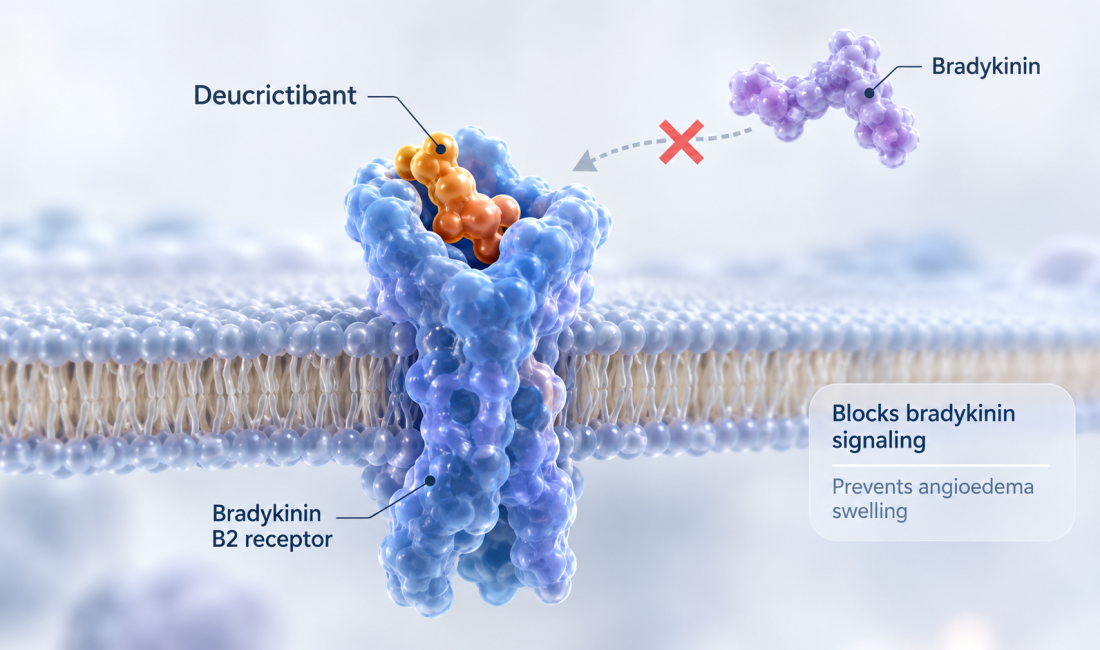
Deucrictibant is an orally bioavailable small-molecule antagonist of the bradykinin B2 receptor, a key mediator of swelling in bradykinin-mediated angioedema. By blocking B2 receptor signaling, the drug is being developed for both prevention and treatment of HAE attacks.
The company is developing two oral formulations. The XR tablet provides sustained exposure for prophylaxis, while an immediate-release (IR) capsule is intended for rapid-onset on-demand treatment.
This dual-formulation approach could allow the same therapeutic molecule to address both long-term prevention and acute HAE management if regulators approve the respective indications.
Safety profile supports continued development
Deucrictibant XR was well tolerated in CHAPTER-3. Most treatment-emergent adverse events were mild or moderate, and no treatment-related serious adverse events were reported. One participant in each treatment group discontinued therapy because of an adverse event.
Marc A. Riedl, principal investigator of CHAPTER-3, said the findings, together with earlier RAPIDe-3 results in the on-demand setting, reinforce the potential of bradykinin B2 receptor blockade across HAE types.
Pharvaris President Peng Lu said the results support the potential for an oral prophylactic option that combines substantial attack reduction with a favorable tolerability profile.
Regulatory path moves toward 2027
The company plans to use CHAPTER-3 data to support marketing applications beginning in the first half of 2027. Pharvaris expects to submit a U.S. New Drug Application for prophylaxis of bradykinin-mediated angioedema attacks during the same period.
The open-label CHAPTER-4 extension study is continuing to assess long-term prophylaxis with deucrictibant XR. Meanwhile, topline Part 1 results from the pivotal Phase 3 CREAATE study in acquired angioedema due to C1 inhibitor deficiency are expected in the first quarter of 2027.
If approved, deucrictibant could establish an oral treatment franchise spanning both on-demand therapy and long-term prophylaxis for bradykinin-mediated angioedema.
Reference
Pharvaris Announces Positive Topline Data from CHAPTER-3 Pivotal Study of Deucrictibant XR for Prophylaxis of HAE Attacks, Pharvaris, 08 September 2026

About the Writer
Anshu Gupta (LinkedIn) is a PharmD professional and healthcare writer with interests in clinical research, pharmacovigilance, regulatory affairs, and medical writing. She has presented research at academic conferences and completed certifications in Good Clinical Practice (GCP), ICH-GCP, and drug safety. Passionate about clinical trials and evidence-based medicine, she is committed to translating scientific evidence into accurate, reliable, and accessible healthcare content.