
DD01 (zabopegdutide) cut liver fat in 76% of patients at 12 weeks in a phase 2 MASH trial, supporting further evaluation of its hepatic effects.
Written By: Khushi Patel, PharmD
Reviewed By: Pharmacally Editorial Team
D&D Pharmatech’s liver-targeted GLP-1/glucagon dual agonist DD01 also known as zabopegdutide produced a rapid and statistically significant reduction in liver fat in adults with metabolic dysfunction-associated steatotic liver disease (MASLD) or metabolic dysfunction-associated steatohepatitis (MASH), with the effect emerging before substantial weight loss.
Rapid liver-fat reduction with DD01
In the ongoing phase 2 DD01-DN-02 trial, 25 of 33 participants (76%) receiving once-weekly subcutaneous DD01 achieved at least a 30% relative reduction in liver fat by week 12, compared with four of 34 (12%) receiving placebo.
The adjusted common odds ratio was 28.8 (95% CI, 7.2–115.2), while the adjusted relative risk was 6.3 (95% CI, 2.5–15.9; p<0.0001).
The findings strengthen the case for DD01 as an incretin-based approach that may produce early hepatic effects alongside its metabolic activity.
Why DD01 could affect the liver directly
MASH is a progressive liver disease associated with obesity, insulin resistance and metabolic dysfunction. Although incretin therapies have improved steatohepatitis and liver fat, questions remain over how much of their hepatic benefit results directly from pharmacology versus substantial weight loss.
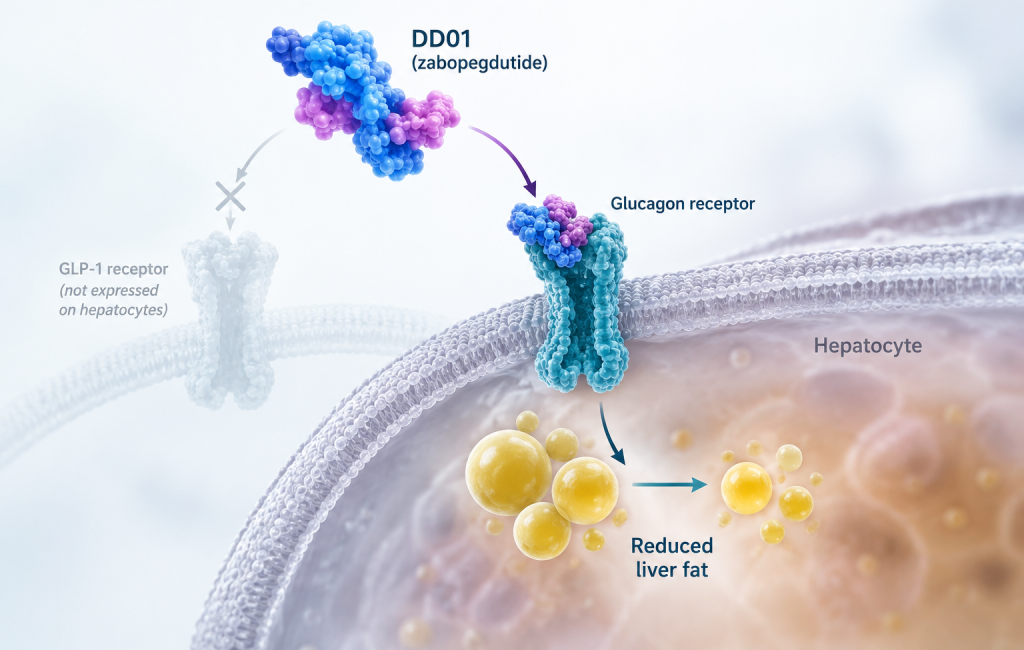
DD01 combines GLP-1 receptor and glucagon receptor agonism at an approximately 11:1 potency ratio. Hepatocytes do not express GLP-1 receptors but have abundant glucagon receptors. Glucagon receptor activation in the liver can increase fatty acid oxidation, suppress de novo lipogenesis and mobilise intrahepatic triglycerides.
This provides a biological rationale for hepatic activity that may occur independently of weight reduction. Earlier phase 1 data also showed a 50% reduction in liver fat after four weeks of treatment.
Phase 2 trial included broad MASLD/MASH population
DD01-DN-02 is a randomised, double-blind, placebo-controlled phase 2 study being conducted across 12 US outpatient sites. The trial enrolled 67 adults aged 18–70 years who were overweight or had obesity and met imaging or biopsy criteria for MASLD or MASH.
Participants received DD01 40 mg or matched placebo once weekly for 48 weeks, with treatment escalated over two weeks. The prespecified primary analysis assessed the proportion achieving at least a 30% relative reduction in liver fat by MRI-proton density fat fraction (MRI-PDFF) at week 12.
The study also incorporated magnetic resonance elastography (MRE), providing an assessment of liver stiffness that MRI-PDFF alone cannot capture.
The cohort included 52 participants (78%) with biopsy-confirmed MASH, while 25 had a fibrosis stage of F2 or F3. The relatively broad fibrosis distribution could provide a more representative view of DD01’s activity across the MASLD-MASH spectrum.
Gastrointestinal adverse events remain the main limitation
Treatment-emergent adverse events occurred in 28 participants (85%) receiving DD01 and 23 (68%) receiving placebo. Nausea was the most common event, reported in 55% of DD01-treated participants, followed by vomiting in 30% and diarrhoea in 27%.
Four participants (12%) discontinued DD01 because of treatment-emergent adverse events, compared with one (3%) receiving placebo. Two serious adverse events occurred in the DD01 group, involving abdominal pain and acute cholecystitis. No deaths were reported.
Longer-term data will determine clinical value
The 12-week results establish an early hepatic signal, but liver-fat reduction alone does not demonstrate improvement in fibrosis or establish MASH resolution. The ongoing 48-week study will therefore be important for determining whether the early reduction in steatosis translates into clinically meaningful changes in liver inflammation and fibrosis.
The results position DD01 for further evaluation against a backdrop in which semaglutide has demonstrated steatohepatitis benefits, while antifibrotic activity remains a central challenge for MASH drug development.
Reference
Mazen Noureddin et al, The glucagon and GLP-1 receptor dual agonist DD01 for metabolic dysfunction-associated steatotic liver disease and steatohepatitis (DD01-DN-02): 12-week results from a randomised, double-blind, multicentre, placebo-controlled, phase 2 trial, The Lancet Gastroenterology & Hepatology, Volume 11, Issue 10, 2026, Pages 887-896, https://doi.org/10.1016/S2468-1253(26)00130-5

About the Writer
Khushi Patel is a Pharm.D (Linkedin) professional with a strong foundation in clinical pharmacy, patient-centered care, regulatory affairs, and pharmacovigilance, with published work on Brugada syndrome.
Her interests include regulatory affairs, pharmacovigilance, guideline integration, multimodal therapy, pharmacogenomics, and antibiogram utilization, with a focus on evidence-based clinical decision-making and medication safety.
As a Pharmacally healthcare writer, she translates clinical and scientific evidence into clear, accurate, and clinically relevant healthcare content, while continuously developing her expertise in evolving pharmacy practice.