
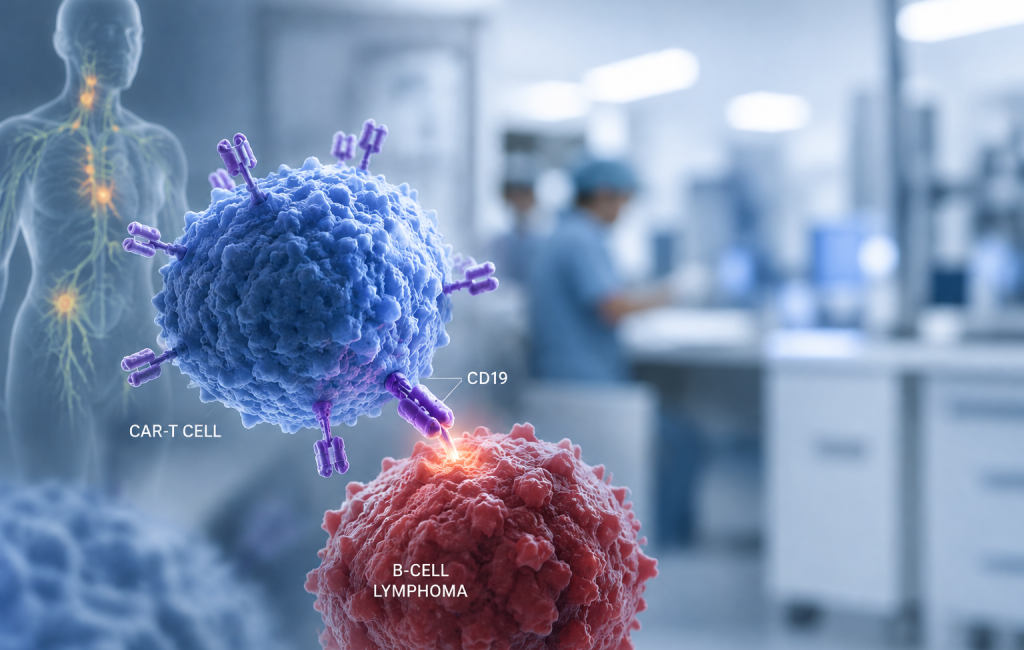
GLPG5101 advances decentralized CAR-T manufacturing in B-cell lymphoma after phase 1 testing selected 110 million CAR-T cells for phase 2.
Written By: Saniya Katakdhond, PharmD
Reviewed By: Pharmacally Editorial Team
Galapagos’ GLPG5101 has completed the phase 1 dose-escalation portion of the ATALANTA-1 study (NCT06561425), demonstrating the feasibility of manufacturing and delivering a fresh CD19 CAR-T therapy through a decentralised model for relapsed or refractory B-cell non-Hodgkin lymphoma.
Published in The Lancet Haematology, the study evaluated three dose levels in patients who had received at least two prior lines of therapy. The safety review committee selected 110 × 10⁶ viable CAR-positive T cells as the recommended phase 2 dose.
The approach addresses a major logistical limitation of autologous CAR-T therapy. Conventional centralised manufacturing requires cells to travel between treatment centres and manufacturing facilities and often involves cryopreservation, contributing to complex logistics and longer vein-to-vein times.
Fresh CAR-T manufactured near treatment centres
GLPG5101 is an autologous CD19-directed CAR-T cell product that genetically modifies a patient’s T cells to express a chimeric antigen receptor targeting CD19.
ATALANTA-1 uses a decentralised manufacturing process, enabling production closer to the treating hospital and administration of a fresh, non-cryopreserved product. The model could simplify cell logistics and reduce manufacturing-related delays compared with centralised production.
ATALANTA-1 phase 1 results
The phase 1 portion enrolled adults with histologically confirmed diffuse large B-cell lymphoma, follicular lymphoma, marginal zone lymphoma or mantle cell lymphoma after two or more prior lines of therapy. Patients required measurable disease under Lugano criteria, an ECOG performance status of 0-2 and adequate organ function.
Between March 15, 2022, and September 10, 2024, investigators screened 27 patients across five hospitals in Belgium and the Netherlands and enrolled 24. All underwent leukapheresis, lymphodepleting chemotherapy and GLPG5101 infusion. One patient received a non-conforming product and was excluded from the safety analysis, leaving 23 safety-evaluable patients.
Five dose-limiting toxicities occurred: grade 3 thrombocytopenia in one patient, prolonged grade 4 neutropenia in three patients, and one death from intra-abdominal haemorrhage.
All 23 safety-evaluable patients experienced at least one grade 3 or higher treatment-emergent adverse event. Neutropenia was most common, occurring in 22 patients (96%), followed by leukopenia (39%), lymphopenia (30%), anaemia (26%) and thrombocytopenia (22%).
Four treatment-related deaths were reported. One occurred during the 14-week treatment period from intra-abdominal haemorrhage. Three occurred after the treatment period and resulted from Escherichia coli sepsis, immune-effector cell-associated haemophagocytic lymphohistiocytosis syndrome and COVID-19.
Phase 2 will test clinical activity
With a median follow-up of 24.0 months, phase 1 characterized the safety profile and demonstrated the feasibility of decentralised production and delivery of fresh CAR-T cells. The selected 110 × 10⁶-cell dose will advance into phase 2, where further data on clinical activity and safety are expected.
The ATALANTA-1 study is registered under NCT06561425 and is closed to recruitment.
If subsequent testing confirms meaningful clinical activity while maintaining the operational advantages of decentralised manufacturing, GLPG5101 could support a more flexible production model for autologous CAR-T therapy and potentially reduce some of the logistical barriers associated with centralised manufacturing.
Reference
Kersten M, Kuipers M, Mutsaers P et al., CD19 CAR T-cell therapy (GLPG5101) for relapsed or refractory B-cell non-Hodgkin lymphoma (ATALANTA-1): phase 1 results from a single-arm, multicentre, phase 1/2 study, The Lancet Haematology, 13, e648-e659

About the Writer
Saniya Sanjay Katakdhond (Linkedin) is a Doctor of Pharmacy professional with hands-on experience in patient case review, clinical documentation, medical record analysis, and patient care.
Her hospital experience has strengthened her understanding of clinical conditions, treatment approaches, and multidisciplinary healthcare practices.
With ICH-GCP certification and a research-oriented approach, she brings clinical insight and attention to detail to healthcare content development.
As a healthcare writer, Saniya focuses on translating clinical knowledge and patient-care experience into clear, accurate, and evidence-informed medical content.