
FDA approves ZANVASTRO (zilganersen), the first disease-modifying treatment for Alexander disease in pediatric and adult patients.
Written By: Siddhi Bhadekar, M. Pharm (QA)
Reviewed By: Pharmacally Editorial Team
Ionis Pharmaceuticals announced on September 3, 2026, that the U.S. Food and Drug Administration (FDA) approved ZANVASTRO™ (zilganersen) for the treatment of Alexander disease (AxD) in pediatric and adult patients. ZANVASTRO is the first and only disease-modifying treatment approved for AxD, an ultra-rare, progressive and often fatal neurological disorder. The FDA also granted Ionis a Rare Pediatric Disease Priority Review Voucher in conjunction with the approval.
FDA-Approved Indication and Dosing Regimen
ZANVASTRO is approved for the treatment of Alexander disease in pediatric and adult patients. The 50 mg dose is administered as an intrathecal injection every three months. Ionis expects ZANVASTRO to become available in the U.S. in the coming weeks. The company is also working with Recordati, which holds exclusive rights to develop and commercialize zilganersen outside the U.S., on regulatory submissions in Europe and Japan expected in 2027.
Clinical Evidence from the Pivotal Study
The approval was supported by positive results from the global, multicenter, randomized, double-blind, controlled Phase 1-3 study of ZANVASTRO (NCT04849741). The study enrolled 54 participants with Alexander disease between 1.5 and 53 years of age across 13 sites in eight countries. Participants were randomized 2:1 to receive ZANVASTRO or control during a 60-week double-blind treatment period. The study evaluated 25 mg and 50 mg dose cohorts, with the 50 mg cohort serving as the pivotal dose cohort and administered every 12 weeks.
In participants aged 5 years and older, ZANVASTRO 50 mg met the primary endpoint by demonstrating statistically significant and clinically meaningful stabilization of gait speed, measured using the 10-Meter Walk Test (10MWT), compared with control at Week 61. The least-square mean difference was 33.3% (p=0.041).
Among children aged 2 to 4 years, ZANVASTRO demonstrated improvement in gross motor function compared with control at Week 61, as assessed using the Gross Motor Function Measure-88 (GMFM-88). Secondary and exploratory assessments based on patient-, caregiver- and clinician-reported outcomes also consistently favored ZANVASTRO.
Eligible participants continued into an open-label treatment period and longer-term extension studies, allowing additional safety and efficacy data to accumulate following the controlled treatment period.
Safety Profile and Aseptic Meningitis Precaution
ZANVASTRO demonstrated a favorable safety and tolerability profile, with most adverse events being mild or moderate in severity. Serious treatment-emergent adverse events occurred less frequently in the ZANVASTRO group than in the control group.
The prescribing information includes a warning for aseptic meningitis. One patient experienced a serious episode during the double-blind treatment period that recurred during the open-label extension. The event required dose interruption and intravenous dexamethasone pretreatment before subsequent ZANVASTRO administration. Despite corticosteroid pretreatment, increases in cerebrospinal fluid white blood cell count and protein continued, although the patient remained asymptomatic and did not discontinue treatment.
The most common adverse reactions, occurring in at least 25% of treated patients and more frequently than in the control group, were vomiting, back pain, cough, headache and post-lumbar puncture syndrome.
Mechanism of Action and Disease Background
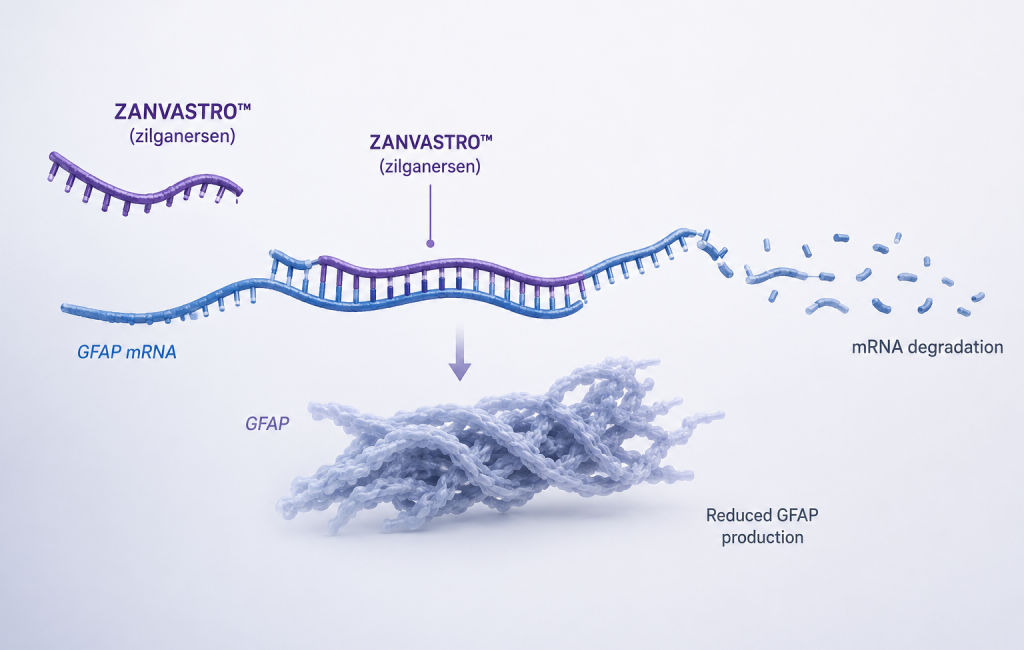
Alexander disease is caused by disease-associated variants in the GFAP gene that lead to overproduction and toxic accumulation of glial fibrillary acidic protein (GFAP) in astrocytes. Over time, dysfunction in these supportive brain cells can damage neurons and myelin, contributing to progressive neurological deterioration.
Zilganersen is an RNA-targeted therapy designed to inhibit production of excess GFAP, addressing the underlying disease mechanism rather than treating individual symptoms separately. ZANVASTRO is administered directly into the spinal canal every three months by a trained healthcare professional.
AxD affects approximately 1 in 1 to 3 million people worldwide. Initial signs can appear from infancy through adulthood, with symptoms varying according to age of onset. As the disease progresses, patients may experience motor and cognitive dysfunction, loss of independence and difficulty controlling muscles involved in purposeful movements, swallowing and airway protection. Alexander disease usually leads to death within 14 to 25 years after symptom onset.
Regulatory Path and Patient Access
ZANVASTRO received Orphan Drug, Fast Track, Breakthrough Therapy and Rare Pediatric Disease designations during its development. The FDA also granted Priority Review for the application and awarded Ionis a Rare Pediatric Disease Priority Review Voucher in conjunction with the approval.
Ionis will support patients prescribed ZANVASTRO through its Ionis Every Step™ program. The program will provide disease and product education for patients and caregivers, access to a dedicated Patient Education Manager, assistance with the insurance approval process, information on affordability programs and other resources throughout the treatment journey.
Ionis expects ZANVASTRO to become available in the U.S. in the coming weeks. In June 2026, the company entered into a license agreement with Recordati granting the company exclusive rights to develop and commercialize zilganersen in countries outside the U.S. Ionis and Recordati are preparing regulatory submissions in Europe and Japan, which are expected in 2027.
Brett P. Monia, Ph.D., chief executive officer of Ionis, described the approval as a new chapter for people living with Alexander disease and their families, who have historically faced a relentlessly progressive disease with treatment focused primarily on symptom management.
Reference

About the Writer
Siddhi Rajendra Bhadekar (Linkedin) is an M.Pharm professional with expertise in medical and scientific writing, literature review, publication writing, and evidence synthesis, supported by four peer-reviewed publications.
She brings working knowledge of ICH-GCP, MedDRA, pharmacovigilance, ADR/AE reporting, clinical data management, and regulatory documentation.
With experience across pharmaceutical R&D, Quality Control, and Quality Assurance, she combines scientific research skills with strong attention to accuracy and detail.
Her background in manuscript development, publication planning, and scientific communication enables her to translate complex healthcare information into clear, reliable content.