
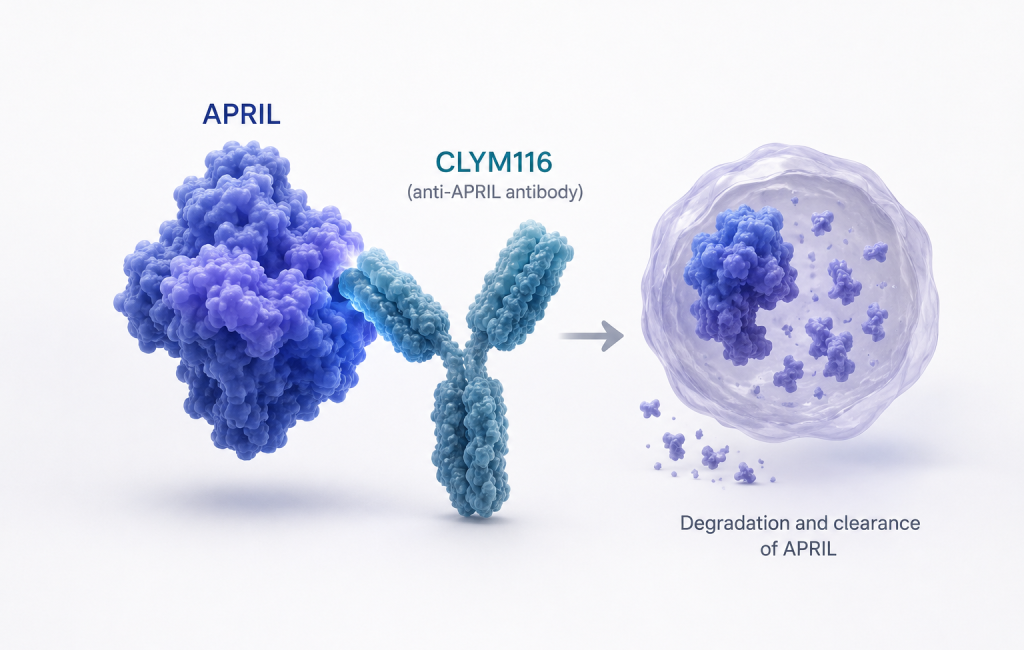
Climb Bio’s CLYM116 showed over 90% APRIL suppression and 60-75% IgA and Gd-IgA1 reduction through 12 weeks in a Phase 1 study.
Written By: Meghana Jinka, PharmD
Reviewed By: Pharmacally Editorial Team
Climb Bio reported initial Phase 1 data for CLYM116, an investigational anti-APRIL monoclonal antibody, showing deep and sustained pharmacodynamic activity after a single subcutaneous dose in healthy volunteers. The company said CLYM116 demonstrated a favorable safety profile while maintaining suppression of APRIL, IgA, and galactose-deficient IgA1 (Gd-IgA1) for up to 12 weeks.
Targeting APRIL to Reduce IgA Production
APRIL is a key regulator of B-cell activity and immunoglobulin production and has emerged as a clinically validated target in IgAN, a chronic kidney disease driven in part by abnormal IgA-containing immune complexes.
CLYM116 uses Climb Bio’s “sweeper” antibody approach, which is intended to promote degradation and clearance of APRIL rather than simply bind and neutralize the cytokine. The company is evaluating whether deeper and more durable APRIL suppression can reduce disease-driving IgA and Gd-IgA1 while allowing less frequent dosing.
Single 320 mg Dose Sustains Biomarker Suppression
The randomized, double-blind, placebo-controlled Phase 1 study (NCT07248865) enrolled 46 healthy subjects across single-ascending-dose and multiple-ascending-dose cohorts. Investigators evaluated safety, tolerability, pharmacokinetics, and pharmacodynamics following subcutaneous administration.
A single 320 mg dose produced more than 90% suppression of free APRIL. IgA, Gd-IgA1, and IgM levels fell by approximately 60-75%, with suppression maintained through 12 weeks.
Pharmacokinetic and pharmacodynamic modeling projected a CLYM116 half-life of approximately 29 days. Climb Bio said this is about three times longer than the reported half-life of sibeprenlimab, another anti-APRIL therapy in development, supporting the potential for every-12-week (Q12W) administration.
Safety findings were also favorable in the early-stage study. No serious adverse events, dose-limiting toxicities, or hypogammaglobulinemia were reported.
Phase 2 Testing Moves into IgA Nephropathy
The company is now evaluating CLYM116 in the ongoing Phase 2 NAVIGATE-2 trial in IgAN. The randomized, open-label study is testing an 800 mg loading dose followed by either 400 mg every eight weeks or every 12 weeks, with the Q12W regimen intended for advancement into Phase 3.
A 200 mg/mL high-concentration formulation allows 400 mg to be delivered through a single subcutaneous injection. A pre-filled syringe has been developed for a future registrational study, while an autoinjector remains in development.
Climb Bio expects initial NAVIGATE-2 data in the first half of 2027 and plans to initiate a Phase 3 registrational study later in 2027. Additional Phase 1 data, along with initial results from a separate Phase 1 study (NCT07375758) conducted by Beijing Mabworks Biotech in healthy volunteers, are expected at a medical meeting in the fourth quarter of 2026.
The company’s strategy now centers on determining whether CLYM116 can translate its durable biomarker suppression into clinically meaningful effects in IgAN while establishing a convenient quarterly dosing regimen.
Reference

About the Writer
Meghana Jinka (LinkedIn) is a Pharm.D graduate with a strong interest in clinical pharmacy, clinical research, pharmacovigilance, and medical writing. She has developed expertise in evaluating scientific literature, interpreting clinical data, and communicating complex medical information in a clear and accessible manner. Through clinical training, patient counseling, and healthcare awareness activities, she has gained practical experience in evidence-based medicine and patient-centered care. Passionate about healthcare communication, Meghana is committed to developing accurate, engaging, and evidence-based healthcare documents that support healthcare professionals and the wider community.