
Ifebemtinib plus garsorasib improved response rates and progression-free survival versus garsorasib alone in previously treated KRAS G12C-mutant colorectal cancer.
Written By: Anamika Koshti, PharmD
Reviewed By: Pharmacally Editorial Team
InxMed’s oral focal adhesion kinase (FAK) inhibitor ifebemtinib (IN10018) combined with the KRAS G12C inhibitor garsorasib (D-1553) produced higher response rates and longer median progression-free survival (PFS) than garsorasib alone in previously treated metastatic colorectal cancer (CRC). Phase Ib/II findings, published in The Lancet Oncology, support further clinical evaluation of this all-oral, chemotherapy-free combination.
Combination Targets an Adaptive Resistance Pathway
KRAS G12C mutations occur in roughly 3–4% of patients with metastatic CRC and remain difficult to treat after standard chemotherapy. Although KRAS G12C inhibitors have expanded treatment options, monotherapy shows limited clinical activity in CRC, largely because tumors trigger compensatory survival signaling pathways.
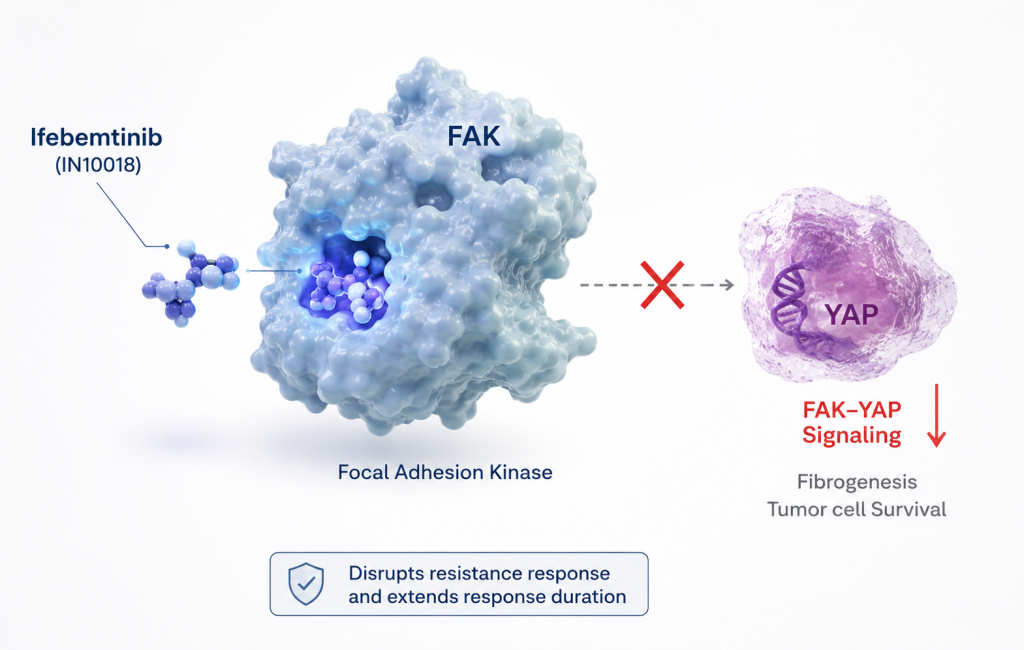
InxMed’s preclinical translational work demonstrated that KRAS G12C inhibition can induce hyperactivation of the FAK–YAP signaling axis and promote fibrogenesis within the tumor microenvironment. Ifebemtinib, a highly selective oral FAK inhibitor, disrupts this resistance response, sensitizing tumor cells to KRAS G12C blockade and extending response duration. The reported Phase Ib/II trial (NCT06166836 / NCT05379946) represents the first clinical evaluation worldwide of a FAK inhibitor combined with a KRAS G12C inhibitor in KRAS G12C-mutant solid tumors.
Phase Ib/II Results Highlight Superior Response and Survival Trends
The trial’s CRC cohort evaluated 51 previously treated patients across two study parts:
- Part 1 (Single-Arm Phase II, n=15): Patients received ifebemtinib 100 mg once daily plus garsorasib 600 mg twice daily. Among 14 response-evaluable patients, the confirmed objective response rate (ORR) was 50.0% (46.7% in the overall population). Median PFS reached 6.9 months, and median overall survival (OS) was 14.3 months.
- Part 2 (Randomized Phase II, n=36): Patients were randomly assigned 1:1 to receive oral combination therapy or oral garsorasib monotherapy.
- ORR: 38.9% with the combination vs. 16.7% with monotherapy (an absolute difference of 22.2 percentage points).
- Disease Control Rate (DCR): 100.0% vs. 77.8%.
- PFS: Median PFS was 7.7 months with the combination versus 4.0 months with monotherapy (HR, 0.48; 95% CI, 0.22–1.04).
- OS: Median OS was not reached in the combination group versus 7.5 months with monotherapy (HR, 0.34; 95% CI, 0.11–1.12).
At the data cutoff (June 30, 2025), median follow-up was 23.8 months in Part 1, and 10.3 and 10.9 months in the Part 2 combination and monotherapy groups, respectively.
Manageable Safety Profile
Across all 33 patients receiving combination therapy, 32 (97%) experienced treatment-related adverse events (TRAEs), the majority of which were Grade 1 or 2. Grade 3 TRAEs occurred in 30% of patients. Notably, no Grade 4 TRAEs, treatment-related deaths, or TRAEs leading to permanent discontinuation were reported. The most common adverse events included diarrhea, proteinuria, nausea, vomiting, and hypertriglyceridemia.
Phase III Development and Broader RAS Strategy
Existing FDA-approved regimens for KRAS G12C-mutant CRC rely on IV-administered anti-EGFR antibodies, which carry distinct dermatologic and infusion-related toxicities. As an all-oral, dual-targeted regimen, ifebemtinib plus garsorasib offers a convenient alternative for patients.
InxMed has submitted an IND application in China for a Phase III trial comparing ifebemtinib plus garsorasib with investigator’s choice of standard therapy in previously treated KRAS G12C-mutant metastatic CRC. Ifebemtinib has received Breakthrough Therapy Designation from China’s NMPA and Fast Track Designation from the U.S. FDA and is also being explored alongside KRAS G12D and multi-RAS inhibitors.
Reference

About the Writer
Anamika Koshti (LinkedIn) is a PharmD professional and healthcare writer with interests in clinical research, pharmacovigilance, and evidence-based medicine. She has authored peer-reviewed publications on Alzheimer’s disease and PCOS, presented research at national conferences, and gained hands-on experience in medical content development and clinical data interpretation. She is committed to translating complex medical research into accurate, accessible content for healthcare professionals and patients.