
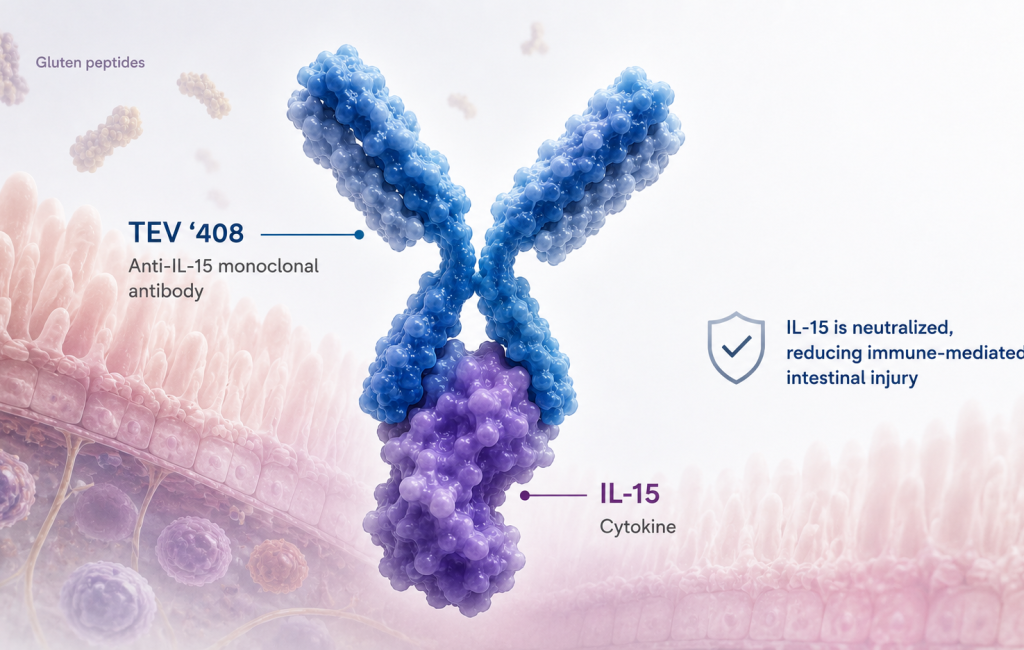
Teva’s TEV ‘408 met its Phase 2a primary endpoint, preventing gluten-induced intestinal damage in adults with celiac disease versus placebo.
Written By: Shaik Yasmeen, PharmD
Reviewed By: Pharmacally Editorial Team
Teva Pharmaceuticals reported positive topline Phase 2a results for TEV ‘408, an investigational monoclonal antibody targeting interleukin-15 (IL-15), in adults with celiac disease. The randomized, placebo-controlled study met its primary endpoint, demonstrating statistically significant and clinically meaningful prevention of gluten-induced intestinal damage at week 8.
The finding addresses an important unmet need because celiac disease has no approved pharmacologic therapies. A strict gluten-free diet remains the standard of care, yet inadvertent gluten exposure can still trigger symptoms, intestinal inflammation, and tissue damage.
Study Tested Protection During Gluten Exposure
The ongoing Phase 2a study (NCT06807463) enrolled 50 adults with celiac disease who were following a gluten-free diet and had minimal intestinal damage at baseline, defined by a villous height-to-crypt depth (Vh:Cd) ratio of at least 2.0.
Participants received a single subcutaneous dose of TEV ‘408 or placebo. Two weeks later, they began a six-week daily gluten challenge, allowing investigators to assess whether TEV ‘408 could protect the intestine against gluten-induced injury.
At week 8, the least-squares mean change in the Vh:Cd ratio was -0.43 with TEV ‘408 compared with -0.88 with placebo. The treatment difference was 0.45 (95% CI, 0.06-0.84; p<0.05), meeting the study’s primary endpoint.
TEV ‘408 also showed a favorable effect on intestinal inflammation. The least-squares mean change from baseline in intraepithelial lymphocyte (IEL) density was 0.37 with TEV ‘408 versus an increase of 27.60 with placebo. The treatment difference was -27.23 (95% CI, -39.67 to -14.79).
Patients receiving TEV ‘408 also reported lower gastrointestinal symptom scores than those receiving placebo, based on the Celiac Disease Symptom Diary (CDSD). The company did not disclose numerical CDSD results or a p-value in its topline update.
The treatment was well tolerated, with no emerging safety signals reported to date.
Targeting IL-15 in Celiac Disease
TEV ‘408 is a Teva-discovered human monoclonal antibody that inhibits IL-15, a cytokine involved in immune-mediated intestinal injury. Blocking IL-15 signaling could reduce the inflammatory response that contributes to intestinal damage following gluten exposure.
Celiac disease affects approximately 1% of the global population and more than three million people in the U.S. Despite careful dietary adherence, patients can experience symptoms and ongoing intestinal inflammation or damage from inadvertent gluten exposure.
Broader Development Program
The Phase 2a celiac disease findings add clinical evidence to Teva’s broader development strategy for TEV ‘408, which is also being evaluated in vitiligo, where IL-15 signaling contributes to immune-mediated destruction of melanocytes.
Following encouraging Phase 1b (NCT06625177) results in vitiligo and positive Phase 2a findings in celiac disease, Teva is advancing TEV ‘408 into a Phase 2b trial in vitiligo. The U.S. FDA granted Fast Track designation to TEV ‘408 for celiac disease in May 2025.
Teva also entered a strategic funding agreement with Royalty Pharma in January 2026 under which it is eligible to receive up to $500 million to accelerate development of TEV ‘408. If the therapy is approved and launched, Teva will pay Royalty Pharma a milestone and royalties on worldwide net sales.
Path Forward
Additional analyses from the Phase 2a celiac disease study are underway. Teva plans to present further findings at a future scientific meeting, which should provide greater detail on the clinical and histologic effects of TEV ‘408.
The current topline data establish a signal of intestinal protection during controlled gluten exposure, but larger and longer studies will be needed to determine whether the effect translates into sustained clinical benefit for people living with celiac disease.
Reference

About the Writer
Shaik Yasmeen (LinkedIn) is a Pharm.D graduate with interests in clinical pharmacy, pharmacovigilance, and medical writing. She has gained experience through hospital clinical postings, patient case reviews, case presentations, and literature evaluation. Passionate about evidence-based healthcare, she is committed to creating accurate and engaging medical content while continuously expanding her professional knowledge.