
Enhertu plus pertuzumab wins EU approval for first-line HER2-positive metastatic breast cancer after DESTINY-Breast09 showed a 44% lower risk of progression or death.
Written By: Umesh Hanumante,
M.Pharm (Reg. Affairs)
Reviewed By: Pharmacally Editorial Team
AstraZeneca and Daiichi Sankyo’s Enhertu (trastuzumab deruxtecan) combined with pertuzumab has received European Commission approval for adults with unresectable or metastatic HER2-positive breast cancer in the first-line setting, supported by the Phase III DESTINY-Breast09 trial (NCT04784715).
The approval expands Enhertu’s use earlier in metastatic HER2-positive breast cancer after DESTINY-Breast09 showed that the combination reduced the risk of disease progression or death by 44% versus taxane, trastuzumab and pertuzumab (THP). Median progression-free survival (PFS) reached 40.7 months with Enhertu plus pertuzumab compared with 26.9 months with THP.
DESTINY-Breast09 establishes a longer first-line treatment window
DESTINY-Breast09 enrolled 1,157 patients with HER2-positive metastatic breast cancer who had not previously received chemotherapy or HER2-targeted therapy for metastatic disease. Patients who had received neoadjuvant or adjuvant HER2-targeted therapy were eligible if more than six months had elapsed before advanced or metastatic disease was diagnosed.
The global, randomised, open-label Phase III study assigned patients 1:1:1 to Enhertu monotherapy plus pertuzumab placebo, Enhertu plus pertuzumab, or standard THP. Randomisation was stratified by prior treatment, hormone receptor status and PIK3CA mutation status.
For the combination, blinded independent central review showed a hazard ratio for disease progression or death of 0.56 (95% CI, 0.44-0.71; p<0.00001), translating to a 44% reduction in risk. Median PFS was 40.7 months versus 26.9 months with THP.
The safety profile of Enhertu plus pertuzumab remained consistent with the established safety profiles of the individual therapies, with no new safety concerns identified.
The Enhertu monotherapy comparison remains blinded and will continue to the final PFS analysis.
HER2-directed ADC moves earlier in treatment
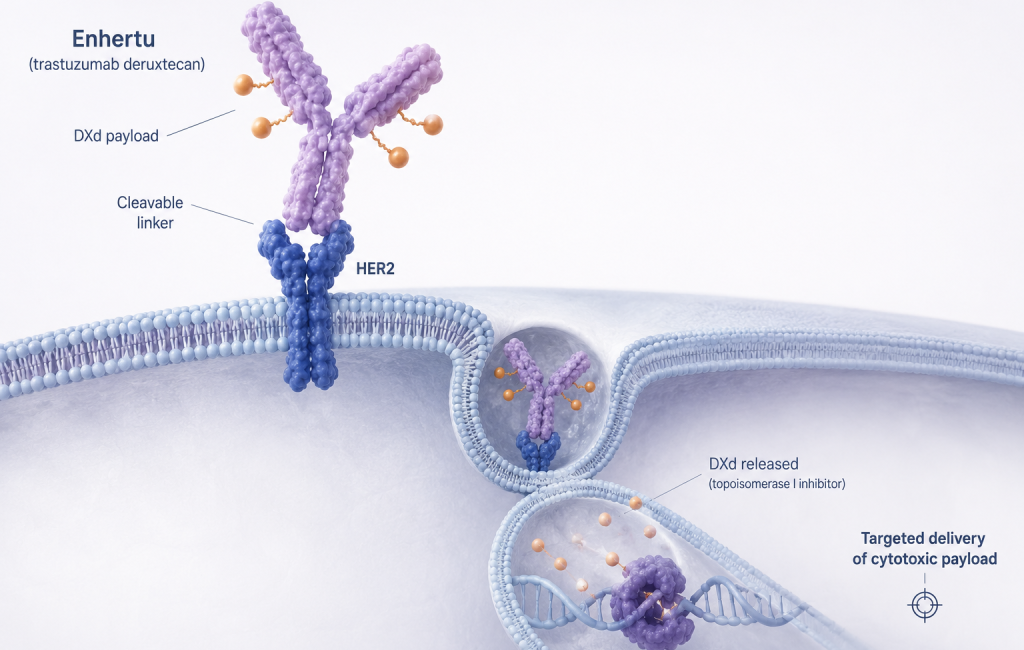
Enhertu is an antibody-drug conjugate (ADC) that targets HER2. Daiichi Sankyo’s DXd ADC technology links a HER2-directed monoclonal antibody to multiple molecules of DXd, an exatecan-derived topoisomerase I inhibitor, through cleavable tetrapeptide linkers.
After binding to HER2, the ADC is internalised by tumour cells and releases its cytotoxic payload, enabling targeted delivery of a topoisomerase I inhibitor.
HER2-positive breast cancer accounts for roughly 15% to 20% of metastatic breast cancer cases and is associated with aggressive disease. THP has remained a first-line standard for more than a decade, but many patients experience progression within two years.
The DESTINY-Breast09 results have already influenced treatment guidance, with the combination included in the ESMO Clinical Practice Guidelines as a Category IA first-line option for metastatic HER2-positive breast cancer regardless of hormone receptor status.
EU approval adds another commercial milestone
The European Commission’s decision follows a positive opinion from the EMA’s Committee for Medicinal Products for Human Use. Cristina Saura of Vall d’Hebron University Hospital and VHIO said the longer PFS observed with the combination could establish a new first-line standard for HER2-positive metastatic disease.
For AstraZeneca and Daiichi Sankyo, the decision also carries a direct financial milestone. AstraZeneca will pay Daiichi Sankyo $100 million following the EU approval, while Daiichi Sankyo recognises Enhertu sales in most EU territories.
Enhertu is also under EU review for patients with HER2-positive early breast cancer who have residual invasive disease after neoadjuvant HER2-targeted therapy, based on DESTINY-Breast05 (NCT04622319).
The first-line metastatic approval therefore extends Enhertu’s role across the HER2-positive treatment pathway while the partners continue to pursue additional indications.
Reference

About the Writer
Umesh Hanumante (M.Pharm) (LinkedIn) is a pharmacy professional and healthcare writer with a background in Regulatory Affairs, pharmaceutical innovation, and clinical research. He has around two years of industry experience as an Executive PMT at Troikaa Pharmaceuticals Ltd and qualified GPAT 2024. His areas of interest include regulatory compliance, dossier preparation, clinical trials, emerging therapies, and advancements in the global pharmaceutical and healthcare sector.