
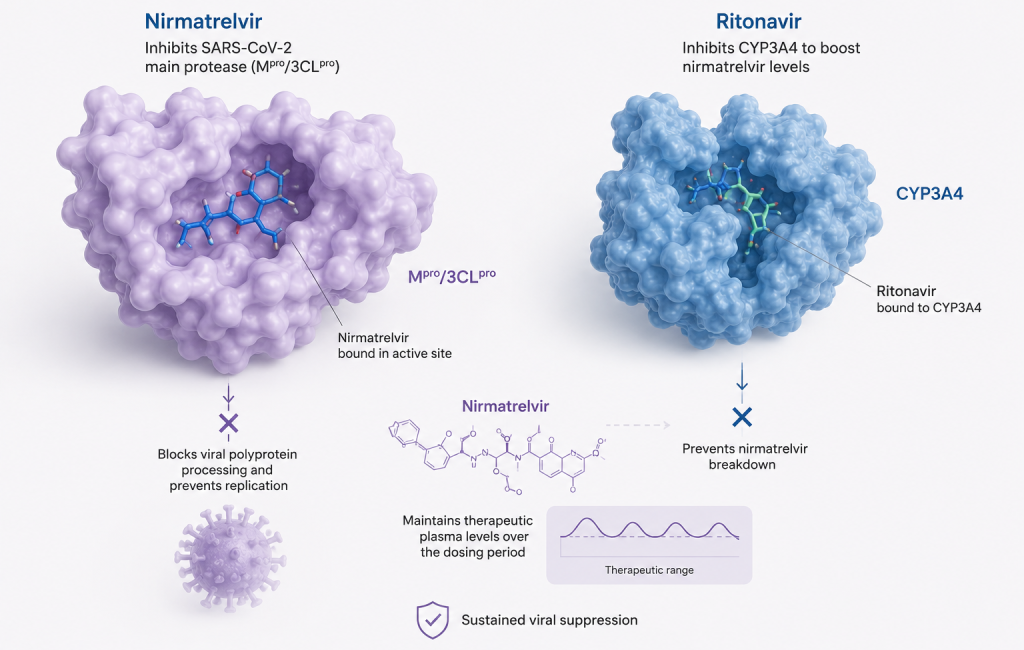
The RECOVER-VITAL phase 2 trial found no benefit from 15 or 25 days of nirmatrelvir–ritonavir for cognitive, autonomic, or exercise symptoms of long COVID.
Written By: Mayuresh Salvi, PharmD
Reviewed By: Pharmacally Editorial Team
A large phase 2 trial published in The Lancet Infectious Diseases found that nirmatrelvir–ritonavir did not improve long COVID symptoms compared with placebo across cognitive dysfunction, autonomic dysfunction, or exercise intolerance. The RECOVER-VITAL study (NCT05595369 ) randomized 964 participants, with 959 included in the modified intention-to-treat population, across 69 US sites.
Participants received either nirmatrelvir 300 mg plus ritonavir 100 mg twice daily for 25 days, the same regimen for 15 days followed by 10 days of placebo, or placebo–ritonavir for 25 days. The primary assessment occurred at day 90, with follow-up continuing through day 180.
Antiviral Strategy Does Not Translate into Symptom Improvement
The trial focused on viral persistence, one of the leading hypotheses for long COVID. Investigators have detected SARS-CoV-2 or viral material in some patients long after acute infection, raising the possibility that ongoing low-level or compartmentalized viral activity could contribute to persistent symptoms.
RECOVER-VITAL therefore concentrated on three clinically important phenotypes: cognitive dysfunction, autonomic dysfunction characterized by orthostatic intolerance, and exercise intolerance with post-exertional malaise. Participants had symptoms persisting for at least 12 weeks and met phenotype-specific symptom and patient-reported outcome thresholds.
At day 90, 58% of patients receiving 25 days of treatment met the predefined cognitive improvement threshold versus 55% with placebo, producing an adjusted difference of 3.2 percentage points (95% CI, −10.4 to 16.8; p=0.65). For the 15-day regimen, the adjusted difference was −2.2 percentage points (95% CI, −15.5 to 11.1; p=0.74).
Autonomic improvement occurred in 62% of the 25-day group, 70% of the 15-day group, and 70% of placebo recipients. The adjusted treatment differences were −6.4 percentage points (p=0.30) and −0.1 percentage points (p=0.99), respectively.
Exercise outcomes were similarly negative. Improvement occurred in 25% of participants receiving 25 days, 34% receiving 15 days, and 33% receiving placebo. Neither active regimen significantly outperformed placebo.
Safety Remained Consistent with Extended Exposure
The extended regimen did not reveal new safety concerns. Treatment-emergent adverse events occurred in 66% of participants receiving 25 days of nirmatrelvir–ritonavir, 64% receiving 15 days, and 58% receiving placebo–ritonavir. Treatment discontinuation because of adverse events occurred in 3%, 6%, and 4%, respectively.
No deaths occurred. Fifty-two serious adverse events were reported in 42 of 963 participants, with similar rates across treatment groups. Investigators considered three serious events treatment-related, including suspected drug-induced liver injury and elevated liver function tests. Diarrhoea and nausea were the most frequently reported adverse events.
Viral Persistence Hypothesis Remains Open
The investigators emphasized that the negative clinical result does not fully resolve whether antiviral treatment could help a biologically defined subgroup of patients with persistent SARS-CoV-2.
RECOVER-VITAL did not require evidence of viral persistence for enrollment, and the study population had long-standing symptoms, with the median interval from the first PASC-related infection to randomization generally around 28–32 months. Blood samples were collected to assess persistent virus and changes in viral antigen, but those analyses remain pending.
The high rate of improvement in placebo recipients also underscores the fluctuating nature of long COVID symptoms and the importance of controlled trials when evaluating potential treatments.
The investigators concluded that up to 25 days of nirmatrelvir–ritonavir did not improve cognitive, autonomic, or exercise-related long COVID symptoms. Future studies may need to identify patients with objective evidence of viral persistence before treatment and explore longer antiviral courses or combinations with other therapies.
Reference

About the Writer
Mayuresh Sunil Salvi (Linkedin) is a PharmD professional and healthcare writer with a strong interest in pharmacovigilance, drug safety, and emerging medical research. He is passionate about exploring new drug discoveries, clinical research, and advances in evidence-based medicine. His interests also include ward rounds, prescription audits, and treatment analysis to support rational pharmacotherapy and improved patient car