
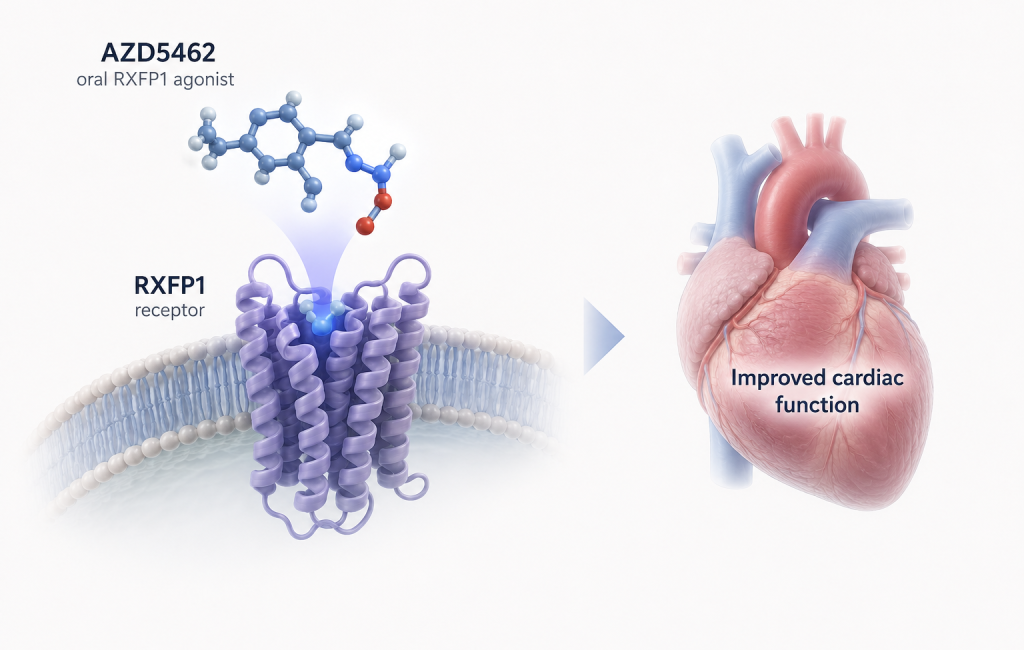
AZD5462 showed early cardiac and vascular effects in the LUMINARA Phase IIb trial, supporting further evaluation in patients with heart failure.
Written by: Kirti Kumbhar M. Pharm (QA)
Reviewed by: Pharmacally Editorial Team
An investigational oral relaxin agonist, AZD5462, showed early effects on cardiac function and vascular resistance in patients with chronic heart failure in the LUMINARA Phase IIb trial (NCT06299826). Results presented during a Hot Line session at ESC Congress 2026 on August 30, 2026, and published simultaneously in Circulation, support further evaluation of AZD5462 in heart failure.
The findings included a signal of improved cardiac function at the lowest dose in patients with LVEF ≤35%, while reductions in systemic vascular resistance were observed across all evaluated doses in patients with LVEF 41–55%. Larger trials will be needed to determine whether these effects translate into meaningful long-term clinical outcomes.
The Need for New Heart Failure Treatments
Despite guideline-directed medical therapies, many patients with heart failure continue to experience substantial disease burden, highlighting the need for additional treatments that can be used alongside existing standard-of-care therapies.
Relaxin, a pregnancy-related peptide hormone, has been investigated for its potentially beneficial effects in heart failure through the relaxin family peptide receptor 1 (RXFP1). Earlier attempts to stimulate this receptor were unsuccessful in part because of side effects potentially associated with supraphysiological exposure.
AZD5462 is an oral RXFP1 agonist. Earlier preclinical and clinical findings provided the basis for its evaluation in patients with heart failure.
LUMINARA Phase IIb Trial Design
LUMINARA was a double-blind, dose-ranging Phase IIb trial conducted at 69 sites across 10 countries. Patients had chronic heart failure and were receiving stable, maximally tolerated standard-of-care therapies.
The study included 235 patients with LVEF ≤35% and 140 patients with LVEF 41–55%. Patients were randomly assigned in a 1:1:1:1 ratio to placebo or AZD5462 20 mg, 80 mg, or 360 mg once daily.
Echocardiography was performed at baseline and after 24 weeks. In patients with LVEF ≤35%, the primary endpoint was change in end-systolic volume index, a measure of adverse cardiac remodelling. In patients with LVEF 41–55%, the primary endpoint was change in systemic vascular resistance index.
Cardiac Function Signal at the Lowest Dose
Among patients with LVEF ≤35%, the greatest effects on cardiac function were observed with the lowest AZD5462 dose.
AZD5462 20 mg decreased end-systolic volume index by 5.4 mL/m² from baseline at 24 weeks, with a reported p=0.054 versus placebo. Secondary measures, including LVEF, also showed the greatest effects at the lowest dose.
Because the primary endpoint result did not reach the conventional statistical significance threshold of p<0.05, these findings should be considered an early signal requiring confirmation in larger trials.
Vasodilation Observed Across Doses
In patients with LVEF 41–55%, AZD5462 demonstrated evidence of vasodilation, as measured by systemic vascular resistance index.
At Week 24, systemic vascular resistance index was reduced by 19% with 20 mg, 21% with 80 mg, and 15% with 360 mg. All three dose groups had p≤0.021.
Safety Findings
The incidence of adverse events was low, with no evidence of an excess among patients receiving AZD5462 compared with placebo.
Mild blood-pressure lowering was observed, but significant hypotension did not differ between AZD5462 and placebo. There was also no evidence of significant volume overload, an issue previously observed with higher doses of relaxin-like drugs.
Overall, no new safety concerns were identified.
Path Forward
The LUMINARA findings demonstrated target engagement in both patient cohorts, with signs of improved cardiac function at the lowest AZD5462 dose when added to standard-of-care therapy.
However, the Phase IIb study was designed to evaluate safety, cardiac and vascular measures, and dose selection for future development. Larger randomized trials focused on clinical outcomes will be needed to establish whether AZD5462 can improve meaningful long-term outcomes in patients with heart failure.
Reference
Novel drug shows promise in an early phase trial in heart failure

About the Writer
Kirti Kumbhar (LinkedIn) is an M.Pharm graduate with experience in Quality Assurance at Lupin Limited and a strong interest in clinical research, regulatory affairs, and Trial Master File (TMF) management. She has developed knowledge of regulatory documentation, quality systems, compliance, and healthcare research through her professional experience. Passionate about clinical development and continuous learning, Kirti is committed to supporting high-quality healthcare documentation, regulatory excellence, and research-driven healthcare advancements.