
Aficamten significantly improved exercise capacity and health status versus placebo in symptomatic nonobstructive hypertrophic cardiomyopathy in the phase 3 ACACIA-HCM trial.
Written By: Meghana Jinka, PharmD
Reviewed By: Pharmacally Editorial Team
Cytokinetics reported positive results from the phase 3 ACACIA-HCM trial of aficamten in symptomatic nonobstructive hypertrophic cardiomyopathy (HCM), with the findings presented in a Hot Line session at the 2026 European Society of Cardiology Congress and simultaneously published August 28 in The New England Journal of Medicine. Aficamten significantly improved both exercise capacity and patient-reported health status versus placebo at 36 weeks, addressing a major treatment gap in nonobstructive HCM, for which no proven medical therapy exists.
Phase 3 Trial Shows Benefit on Both Primary Endpoints
ACACIA-HCM (NCT06081894) randomized 517 adults with symptomatic nonobstructive HCM to aficamten or placebo across 160 sites in 19 countries. Patients received aficamten starting at 5 mg, with dose increases of 5 mg at weeks 2, 4, and 6 up to a maximum of 20 mg, guided by left ventricular ejection fraction (LVEF). Treatment continued for up to 72 weeks, followed by a four-week safety follow-up.
At week 36, KCCQ-CSS increased by 11.4 points with aficamten versus 8.4 points with placebo, producing a least-squares mean difference of 3.0 points (95% CI, 0.5 to 5.5; P=0.02). Peak oxygen uptake increased by 0.64 ml/kg/min with aficamten compared with a 0.03 ml/kg/min decline with placebo, for a between-group difference of 0.67 ml/kg/min (95% CI, 0.22 to 1.11; P=0.003).
The treatment effect extended to several secondary measures. At least one NYHA functional class improvement occurred in 41.9% of aficamten-treated patients versus 27.8% receiving placebo, a 14.1-percentage-point difference (P<0.001). NT-proBNP, a biomarker associated with adverse outcomes in HCM, was also substantially reduced, with a geometric least-squares mean ratio of 0.43 versus placebo at week 36 (P<0.001).
Targeting Sarcomeric Hypercontractility
Nonobstructive HCM lacks clinically significant left ventricular outflow tract obstruction but can still produce substantial symptoms through increased intracardiac pressure, microvascular ischemia, impaired cardiac reserve, and abnormal myocardial energetics.
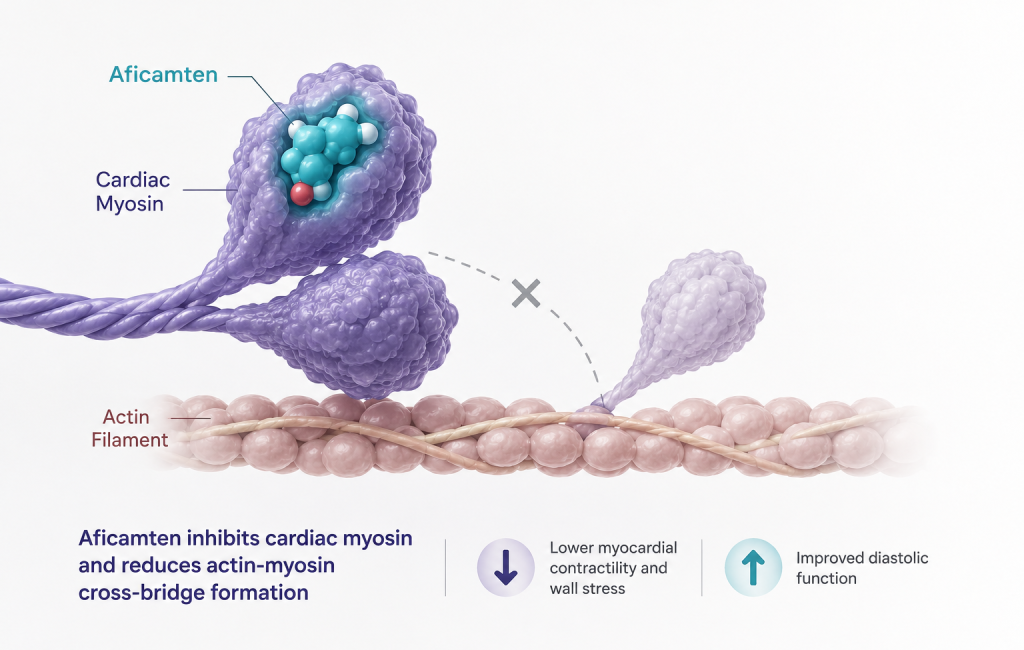
Aficamten inhibits cardiac myosin and reduces actin-myosin cross-bridge formation within the cardiac sarcomere. This lowers excessive myocardial contractility and wall stress while improving diastolic function. Its relatively short plasma half-life also supports dose adjustment and reversibility.
LVEF Reduction Remains the Key Safety Consideration
The safety profile reflected the pharmacology of cardiac myosin inhibition. Serious adverse events occurred in 20.2% of patients receiving aficamten versus 14.7% with placebo. Heart failure was reported as a serious adverse event in 4.3% and 0.4%, respectively.
LVEF was 4.4 percentage points lower with aficamten than placebo at week 36. Reversible LVEF reductions below 50% occurred in 10.5% of aficamten-treated patients versus 0.8% with placebo. Seven patients, or 2.7%, had treatment interrupted after LVEF fell below 40%, with two permanently discontinuing treatment. LVEF returned to baseline after washout.
Clinical Significance and Next Steps
The investigators noted that improvements in both maximal and submaximal exercise performance could translate into greater capacity for daily activities, while patient-reported health status and NYHA class improvements remained greater than placebo through 72 weeks.
The results are particularly relevant because nonobstructive HCM has lacked established medical or invasive treatment options beyond heart transplantation. However, ACACIA-HCM was not powered to determine whether aficamten reduces major clinical outcomes such as heart-failure hospitalization or death, and durability beyond the trial remains an important question. The ongoing FOREST-HCM extension study (NCT04848506) is expected to provide longer-term data.
Cytokinetics plans to submit a supplemental New Drug Application to the U.S. Food and Drug Administration in the fourth quarter of 2026 for aficamten in adults with symptomatic nonobstructive HCM.
Reference
Aficamten for Symptomatic Nonobstructive Hypertrophic Cardiomyopathy

About the Writer
Meghana Jinka (LinkedIn) is a Pharm.D graduate with a strong interest in clinical pharmacy, clinical research, pharmacovigilance, and medical writing. She has developed expertise in evaluating scientific literature, interpreting clinical data, and communicating complex medical information in a clear and accessible manner. Through clinical training, patient counseling, and healthcare awareness activities, she has gained practical experience in evidence-based medicine and patient-centered care. Passionate about healthcare communication, Meghana is committed to developing accurate, engaging, and evidence-based healthcare documents that support healthcare professionals and the wider community.