
AbbVie has submitted an EMA application for subcutaneous SKYRIZI induction in Crohn’s disease, supported by positive Phase 3 AFFIRM results.
Written By: Rishabh Sonawane, BPharm
Reviewed By: Pharmacally Editorial Team
AbbVie has submitted a regulatory application to the European Medicines Agency (EMA) seeking approval of SKYRIZI® (risankizumab) for subcutaneous (SC) induction treatment in adults with moderately to severely active Crohn’s disease. The application is supported by positive results from the Phase 3 AFFIRM study (NCT06063967), which evaluated SC risankizumab induction in adults with and without prior advanced-therapy failure.
EMA Regulatory Submission Would Expand SKYRIZI Induction Options
If approved, the application would provide eligible adults with an additional SKYRIZI induction option, allowing treatment to begin with either SC injection or intravenous (IV) infusion. Risankizumab is already approved in the European Union for adults with moderately to severely active Crohn’s disease who have had an inadequate response to, lost response to, or were intolerant to conventional therapy or a biologic therapy. SKYRIZI became the first specific IL-23 inhibitor approved for Crohn’s disease in the EU in 2022.
The proposed SC induction regimen would complement the existing IV induction option, followed by SC maintenance dosing every eight weeks.
Phase 3 AFFIRM Study Demonstrated Efficacy of SC Induction
AFFIRM is a global, randomized, double-blind, placebo-controlled Phase 3 study evaluating SC risankizumab as induction treatment in adults with moderately to severely active Crohn’s disease. The trial randomized 289 patients 2:1 to SC risankizumab or placebo. Overall, 65% had previously failed advanced therapies, including 50% who had failed two or more advanced therapies.
The co-primary endpoints at Week 12 were CDAI clinical remission, defined as a CDAI score below 150, and endoscopic response. SC risankizumab was superior to placebo on both endpoints, with 55% of patients achieving CDAI clinical remission versus 30% with placebo (P<0.0001), and 44% achieving endoscopic response versus 14% with placebo (P<0.0001).
Among patients who achieved a clinical response after 12 weeks of SC induction and continued to maintenance treatment, 67% achieved CDAI clinical remission at Week 24 and 57% achieved endoscopic response.
Safety Findings Consistent with Established Profile
During the 12-week placebo-controlled period, the safety profile of SC risankizumab was consistent with its established profile in Crohn’s disease, with no new safety risks observed. Serious adverse events occurred in 0.5% of patients receiving risankizumab compared with 3.1% receiving placebo.
IL-23 Mechanism and Regulatory Outlook
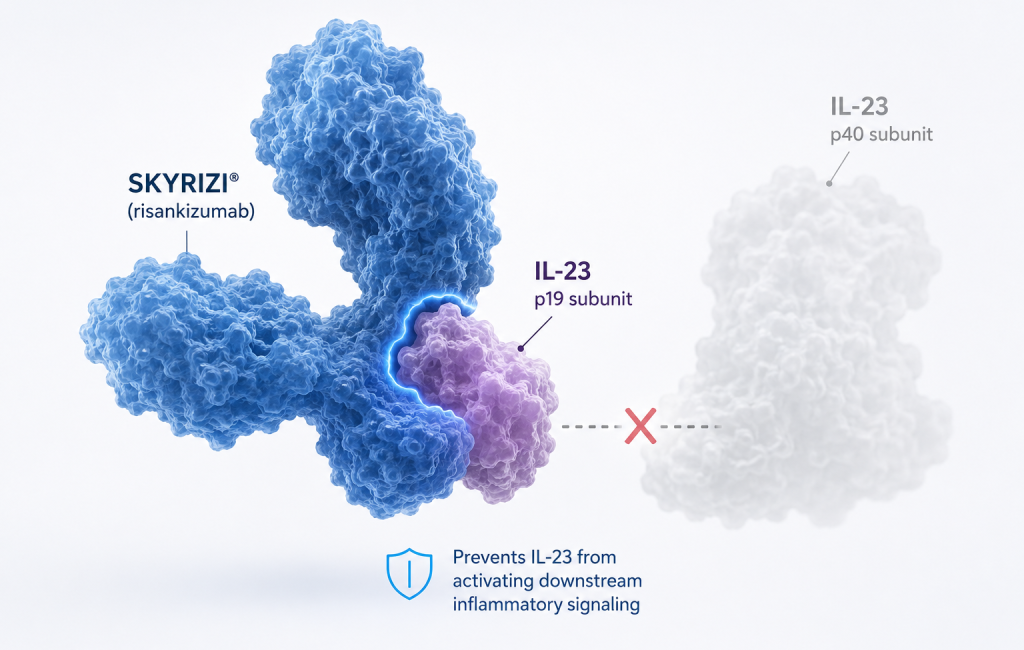
SKYRIZI is an IL-23 inhibitor that selectively binds the cytokine’s p19 subunit. If approved, SC induction would provide patients and healthcare professionals with greater flexibility in initiating SKYRIZI treatment while retaining SC maintenance dosing every eight weeks.
AbbVie’s announcement does not provide an expected regulatory decision date. The proposed expansion of Crohn’s disease induction options therefore remains subject to EMA review and applicable European authorization procedures.
Reference

About the Writer
Rishabha Sonawane, B.Pharm (LinkedIn) is healthcare writer with a strong interest in medical writing, regulatory affairs, clinical research, and AI-driven drug discovery. He has completed specialized training from the NIH and ICMR in clinical pharmacology, clinical research, and scientific writing. Passionate about evidence-based healthcare communication, he focuses on translating complex scientific research into clear, accurate, and engaging medical content.