
Chemo4METPANC phase 2 data show a 64% objective response rate and 91% disease control rate with motixafortide-based therapy in metastatic pancreatic cancer.
Written By: Anshu Gupta, PharmD
Reviewed By: Pharmacally Editorial Team
The Chemo4METPANC study evaluating motixafortide, cemiplimab, gemcitabine, and nab-paclitaxel produced a 64% objective response rate in previously untreated metastatic pancreatic ductal adenocarcinoma (PDAC), with confirmed partial responses in 55% of patients. The preliminary phase 2 findings also identified tumor-microenvironment changes associated with treatment response and resistance. The detailed results are published in Nature Communications.
Targeting the Immune-Excluded Pancreatic Tumor Microenvironment
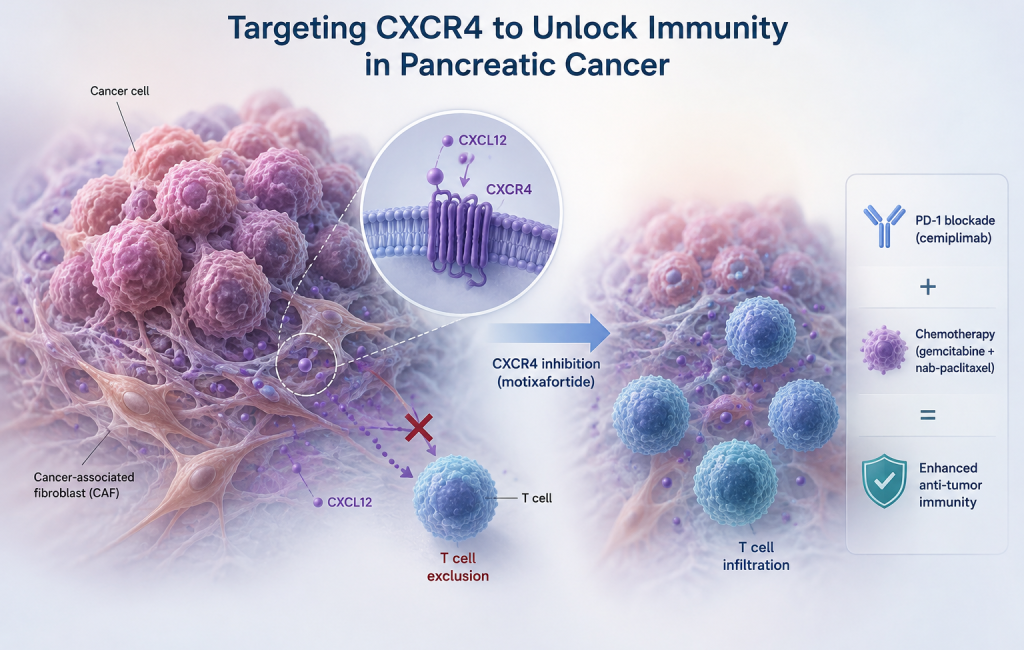
The four-drug regimen, known as MCGN, combines the CXCR4 antagonist motixafortide with the PD-1 inhibitor cemiplimab and gemcitabine/nab-paclitaxel chemotherapy.
The approach targets a major barrier to immunotherapy in PDAC. Cancer-associated fibroblasts release CXCL12, which activates CXCR4 signaling and contributes to T-cell exclusion within the dense, immunosuppressive tumor microenvironment. Blocking CXCR4 with motixafortide may improve immune-cell access to tumor tissue, while cemiplimab restores PD-1-mediated T-cell activity. Gemcitabine also has immunomodulatory effects, including suppression of regulatory T-cell activity.
Chemo4METPANC Phase 2 Study Shows Responses
The first stage of the open-label, multicenter, investigator-initiated phase 2 Chemo4METPANC study (NCT04543071) enrolled 11 treatment-naïve patients with metastatic PDAC. All patients had microsatellite-stable disease and received at least one dose of each study drug. Objective response rate was the primary endpoint, while progression-free survival, overall survival, disease control, and safety were secondary endpoints.
Seven of 11 patients achieved a partial response, corresponding to a 64% objective response rate, including six confirmed partial responses (55%). Three patients had stable disease and one had primary progressive disease, resulting in a 91% disease control rate, or 10 of 11 patients with a complete or partial response or stable disease. Median time to response was 3.5 months, while median duration of response was 8.2 months.
Median progression-free survival was 9.7 months (95% CI, 5.88 to not reached), and median overall survival was 10.1 months (95% CI, 9.34 to not reached). An independent blinded RECIST review identified partial responses in five patients (45%), while the disease control rate remained 91%.
Single-Cell Analysis Identifies Response and Resistance Signals
Serial tumor biopsies provided additional evidence that MCGN altered the tumor microenvironment. Single-nucleus RNA sequencing showed reduced tumor heterogeneity and depletion of epithelial-to-mesenchymal transition-associated states in responders. CXCL12-expressing cancer-associated fibroblasts were also enriched in patients who responded.
The analysis also pointed to potential resistance mechanisms. Nonresponding tumors showed greater myeloid-cell enrichment, while disease progression was associated with inhibitory checkpoint programs across myeloid and T-cell compartments. These findings suggest that persistent immunosuppressive myeloid states could limit the activity of CXCR4 and PD-1 blockade.
Safety Profile and Exceptional Response
The most common adverse events were skin hyperpigmentation in all 11 patients, alopecia in 10, and motixafortide-associated injection-site reactions in nine. The most common grade 3 treatment-related events were anemia in five patients and rash in three. No grade 4 or grade 5 treatment-related adverse events occurred.
One patient achieved a pathological complete response after pancreatoduodenectomy and resection of a residual hepatic lesion. The patient remained disease-free for 18 months without adjuvant therapy.
Randomized Phase 2 Trial Underway
The encouraging first-stage findings led investigators to discontinue the original Simon two-stage design and amend the protocol to a randomized phase 2 study comparing MCGN with gemcitabine/nab-paclitaxel alone. The amended study planned to enroll 108 patients with treatment-naïve metastatic PDAC.
The randomized comparison will be important for determining whether the addition of CXCR4 inhibition and PD-1 blockade provides a clinically meaningful benefit beyond the chemotherapy backbone and whether the biomarker findings can help explain response heterogeneity in metastatic PDAC.
Reference
Raufi AG, D’Souza EK, May MS, et al. Motixafortide, cemiplimab, gemcitabine and nab-paclitaxel in metastatic pancreatic cancer: a single-arm phase 2 study with single-cell correlatives. Nature Communications. 2026. doi:10.1038/s41467-026-76559-4.

About the Writer
Anshu Gupta (LinkedIn) is a PharmD professional and healthcare writer with interests in clinical research, pharmacovigilance, regulatory affairs, and medical writing. She has presented research at academic conferences and completed certifications in Good Clinical Practice (GCP), ICH-GCP, and drug safety. Passionate about clinical trials and evidence-based medicine, she is committed to translating scientific evidence into accurate, reliable, and accessible healthcare content.