
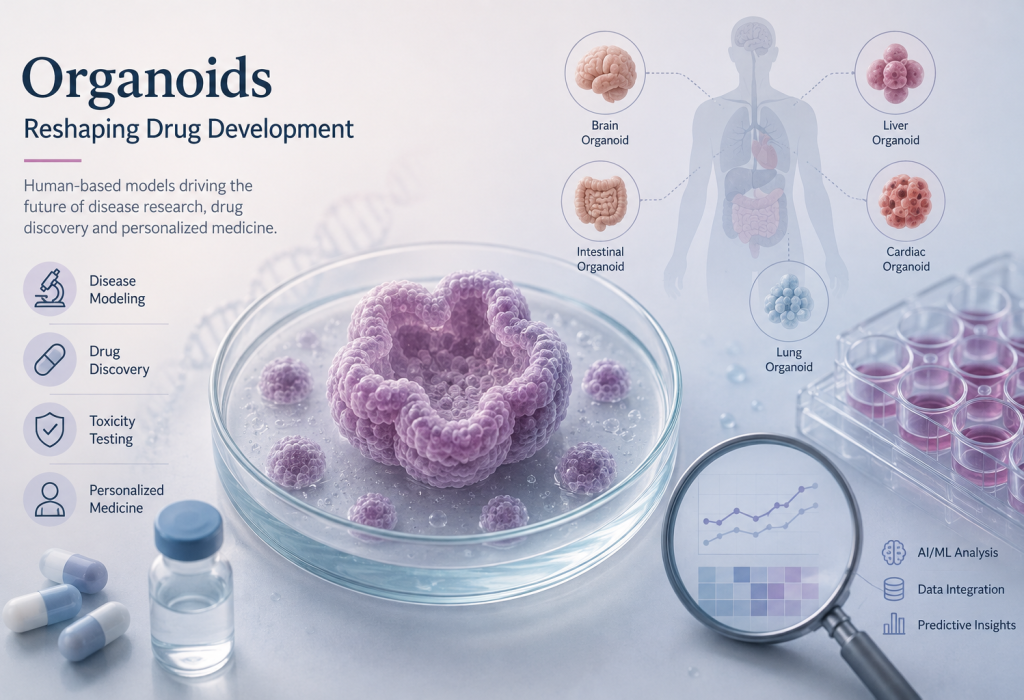
Organoids are reshaping drug development as researchers move toward human-based models for disease research, drug discovery, and personalized medicine.
Written By: Creola Gonsalves, MS Biotech
Reviewed By: Pharmacally Editorial Team
A recent analysis published in JAMA examines how organoids and other human-based research models are changing biomedical research and drug development. The article, published online August 21, 2026, describes the growing use of three-dimensional laboratory-grown models to study human biology, disease and drug responses.
Organoids are three-dimensional, laboratory-grown structures that reproduce important features of human organs or tumors. They can be generated from tumor cells, adult or fetal stem cells, or induced pluripotent stem cells (iPSCs). Researchers increasingly use these models for disease modeling, drug discovery, toxicity testing and personalized medicine.
Organoids Could Help Close the Translational Gap
A notable example comes from cancer drug development. Researchers launched a phase 3 trial (NCT06496178) of petosemtamab, a bispecific antibody being investigated in head and neck and colorectal cancers, after selecting the candidate using patient-derived tumor organoids. Scientists screened more than 500 potential therapies in organoids derived from patients’ malignant cells. Petosemtamab was advanced because it inhibited tumor organoids without inhibiting noncancerous organoids. The FDA has granted the investigational drug two Breakthrough Therapy designations.
The example reflects growing interest in human-based models. Researchers believe organoids may address the translational gap between preclinical research and clinical success by providing information that is more directly relevant to human biology.
How Are Organoids Created?
The modern organoid field began in 2009, when Hans Clevers, MD, PhD, and colleagues in the Netherlands developed a small intestinal organoid, or “minigut,” from a stem cell isolated from an adult mouse intestine.
Human organoids can be generated from adult or fetal stem cells. For organs without suitable active stem cells, researchers can use iPSCs produced by genetically reprogramming skin or blood cells. Nutrients, growth factors and other signals then guide the cells toward the desired tissue type. Organoids can develop over weeks to months and reproduce many cell types and aspects of the spatial organization of their corresponding organs.
Researchers are also developing more complex models, including vascularized heart and liver organoids. These advances address a key limitation: without blood vessels, organoids can grow only to a limited size before cells at their core die. Organoid-on-chip systems are also being developed by connecting multiple mini-organs to better approximate interactions between organs and drug responses.
Disease Research and Personalized Medicine
Organoids have been used to study reproductive diseases, fetal development, congenital abnormalities and infectious diseases. During the Zika outbreak, brain organoids helped researchers understand the relationship between first-trimester infection and microcephaly. Human heart organoids have been used to study COVID-19 vaccine-associated myocarditis, while skin organoids have been used to investigate mpox and response to tecovirimat.
Patient-derived organoids are also being explored for personalized medicine. In cystic fibrosis, researchers in the Netherlands used organoid assays to assess drug responses in patients with rare genetic variants. Patients whose organoids responded to treatment were subsequently able to receive those medications, according to the researchers.
Cancer remains a major application. Tumor organoids retain genetic changes from the original tumors and can be used to study treatment response and resistance. A recent compendium included more than 600 patient-derived organoids and other tumor models covering 25 cancer types. Another study involving 200 patients with operable non-small cell lung cancer is examining whether AI and machine learning can predict relapse and treatment strategies using organoid, imaging and genetic data.
AI, “Clinical Trials in a Dish” and Drug Development
AI and machine learning are increasingly being paired with organoid research. Computational tools can help develop reproducible organoid-generation protocols and analyze the large datasets produced by these models.
These developments have contributed to the concept of “clinical trials in a dish,” in which organoids representing genetically diverse populations could be used to screen therapies and identify likely responders and nonresponders before conventional clinical studies.
Regulatory Interest in New Approach Methodologies
The FDA’s interest in human-based research models is also reflected in its recent regulatory actions. In 2022, the FDA Modernization Act 2.0 clarified that the agency can consider safety and efficacy data generated using new approach methodologies (NAMs) instead of animal testing for new drug and biologics applications.
In March 2026, the FDA issued draft guidance titled “General Considerations for the Use of New Approach Methodologies in Drug Development.” The guidance provides a validation framework and general recommendations for using NAMs in drug development, including approaches that can improve the predictivity of nonclinical studies for clinical safety.
The FDA’s broader efforts also include its 2025 roadmap for reducing animal testing in preclinical safety studies and initiatives supporting human-relevant models such as organoids and organ-on-chip systems. The NIH is similarly supporting human-based research through its Office of Research Innovation, Validation, and Application and its Standardized Organoid Modeling Center.
Limitations Remain
Organoids are not complete human organs or organisms. Their relative simplicity is both a strength and a limitation. They can reproduce important aspects of human tissue but cannot capture every feature of complex human physiology.
A major concern is toxicity testing. Organoids may identify tissue-specific effects but may fail to detect systemic adverse effects that become apparent only in whole-animal studies. Researchers therefore do not expect organoids and other NAMs to completely replace animal models in the immediate future.
The Road Ahead
Organoids are becoming increasingly important in disease modeling, drug discovery, personalized medicine and regulatory science. Their broader adoption will depend on standardized protocols, scalable production, computational tools and validation of their ability to predict human outcomes.
Rather than representing an immediate replacement for animal research, organoids are emerging as an additional human-relevant tool that could improve decision-making earlier in drug development.
Reference

About the Writer
Creola Gonsalves (Linkedin) is an M.S. Biotechnology postgraduate with a strong interest in clinical research, evidence interpretation, and healthcare writing, with a focus on translating life-science knowledge into meaningful real-world insights.
She is trained in Good Clinical Practice (GCP), clinical research principles, and critical interpretation of randomized clinical trials, with certifications from NIH and Stanford University.
Her research background in biotechnological applications and microbial research strengthens her ability to understand scientific evidence and develop clear, accurate, and research-driven healthcare content.