
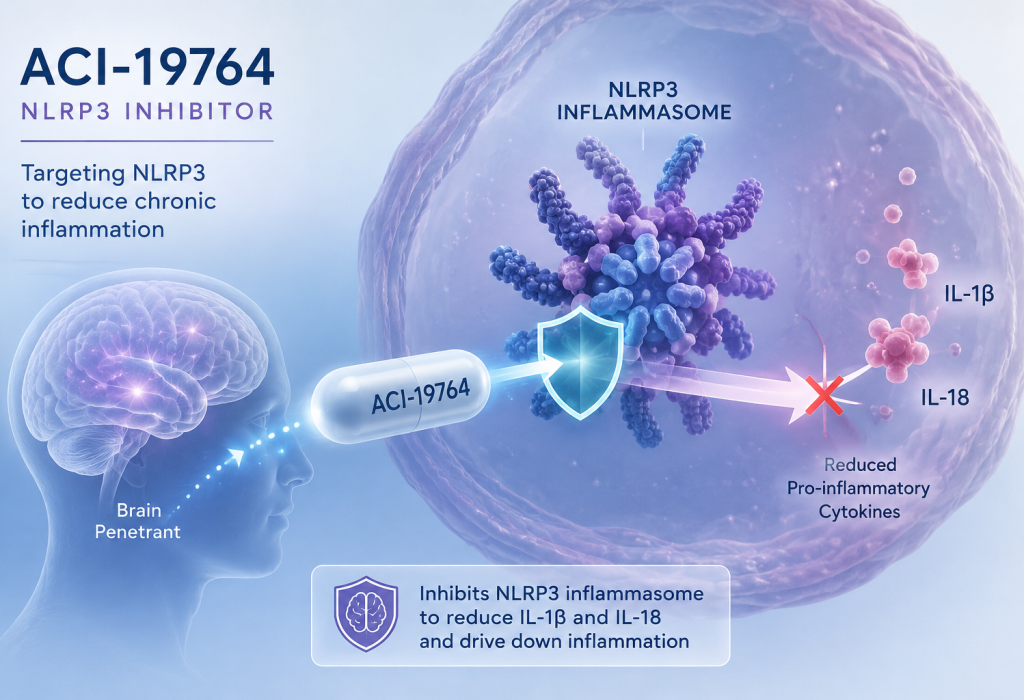
AC Immune reports preliminary Phase 1 data for ACI-19764, an oral NLRP3 inhibitor showing favorable safety, CSF penetration and IL-1β inhibition.
Written By: Kalyani Boharapi,
M.Pharm (Reg. Affair)
Reviewed By: Pharmacally Editorial Team
AC Immune reported positive preliminary Phase 1 data (NCT07463196) for ACI-19764, an oral, brain-penetrant small-molecule inhibitor of the NLRP3 inflammasome. The first-in-human study showed that the candidate was safe and well tolerated, demonstrated cerebrospinal fluid (CSF) exposure, and produced pharmacodynamic evidence of dose-dependent IL-1β inhibition. Based on the emerging pharmacokinetic profile, the company expects a therapeutic dose of 10 mg once daily or lower.
Phase 1 Study Shows Safety and CNS Exposure
The Phase 1 first-in-human study is evaluating the safety, tolerability, pharmacokinetics (PK), and pharmacodynamics of ACI-19764 in healthy volunteers in Europe. Preliminary results from single ascending dose (SAD) and multiple ascending dose (MAD) cohorts showed that the candidate was safe and well tolerated, including at doses up to 20 mg per day in the SAD cohorts.
No serious adverse events or treatment withdrawals have been reported to date. ACI-19764 also showed a serum half-life of more than 30 hours, supporting its potential for once-daily administration.
CSF exposure provided clinical evidence that ACI-19764 reaches the central nervous system. Daily doses of 10 mg or less achieved PK concentrations above the IC90, while blinded analysis of whole-blood assay data showed dose-dependent inhibition of IL-1β release.
NLRP3 Inhibition Targets Neuroinflammation
ACI-19764 selectively inhibits the NLRP3 inflammasome, an intracellular multiprotein complex involved in inflammatory signaling and the production of downstream mediators including IL-1β.
NLRP3-driven inflammation has been implicated in a range of neurological, metabolic, and inflammatory disorders. AC Immune has identified potential applications for its NLRP3 inhibitors in neurodegenerative diseases including Alzheimer’s disease, Parkinson’s disease, amyotrophic lateral sclerosis, and frontotemporal dementia.
The current clinical program, however, has not yet moved into patients with these neurodegenerative diseases. The initial Phase 1 study is establishing safety, PK, CNS exposure, and pharmacodynamic activity before disease-specific testing.
Preclinical studies provide additional support for the CNS strategy. ACI-19764 reduced activation of Iba1-positive microglia and GFAP-positive astrocytes in models of experimental autoimmune encephalitis and chronic lipopolysaccharide-mediated CNS inflammation.
Phase 1b Cohort Tests Anti-Inflammatory Activity
The study has now advanced into a Phase 1b cardiovascular-risk cohort. Participants have elevated serum high-sensitivity C-reactive protein (hsCRP) and either type 2 diabetes or obesity.
The cohort will assess whether NLRP3 inhibition produces measurable systemic anti-inflammatory activity, with hsCRP serving as an early biomarker. Recruitment is ongoing, and initial results are expected before the end of 2026.
Martin Zügel, interim CEO of AC Immune, said the preliminary findings provide a basis for testing whether ACI-19764 can produce clinical evidence of hsCRP inhibition in the coming months.
Preclinical Potency Supports Further Development
ACI-19764 has shown potent inhibition of IL-1β production in human macrophages and human whole blood. AC Immune reports an IC50 of 2 nM in human macrophages and 20.5 nM in human whole blood, rather than a single potency value applicable across both assay systems.
The candidate also showed statistically significant reductions in neuroinflammation in preclinical models, including reduced activation of microglia and astrocytes. These findings, together with clinical CSF exposure, provide the rationale for continued development in CNS and peripheral inflammatory settings.
Full Phase 1/1b Results Expected in 2027
The next key milestone is the Phase 1b hsCRP readout, which should provide an early indication of whether the pharmacologic activity observed in healthy-volunteer testing translates into measurable anti-inflammatory effects in a higher-risk population.
AC Immune expects initial Phase 1b results before year end and full results from the Phase 1/1b program in the first half of 2027. The data will help determine the appropriate dose and inform the design of subsequent studies in neurodegenerative and other NLRP3-associated diseases.
Reference
AC Immune Announces Positive Preliminary Phase 1 Data for NLRP3 Inhibitor ACI-19764 | AC Immune SA

About the Writer
Kalyani Boharapi (LinkedIn) is a pharmacy professional and healthcare writer currently pursuing an M.Pharm in Regulatory Affairs at Dr. D. Y. Patil College of Pharmacy, with interests in pharmaceutical regulations, drug development, and healthcare innovation. She has academic exposure to dossier preparation, scientific writing, and regulatory documentation. Kalyani has also completed certification courses in Generative AI, AI in Pharma, and Bioinformatics, and actively participates in pharmaceutical conferences to stay updated with emerging trends and advancements in the healthcare and pharmaceutical industry.