
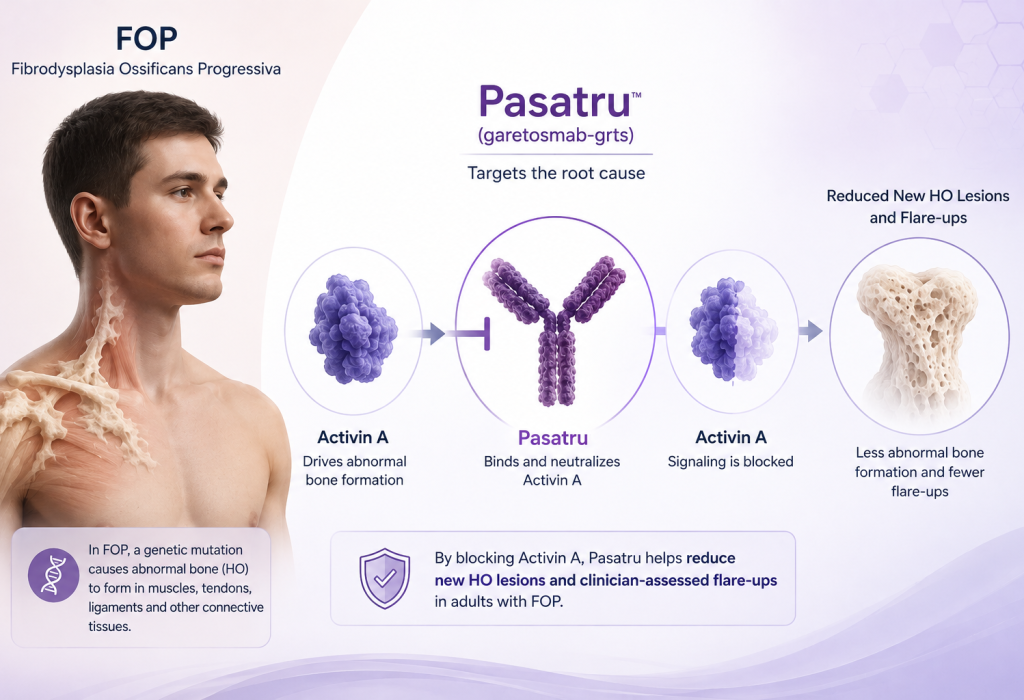
FDA approves Regeneron’s Pasatru for adults with FOP to reduce new heterotopic ossification lesions and clinician-assessed flare-ups based on Phase 3 OPTIMA data.
Written By: Kirti Kumbhar,
M.Pharm (Reg. Affairs)
Reviewed By: Pharmacally Editorial Team
The U.S. Food and Drug Administration has approved Regeneron Pharmaceuticals’ Pasatru (garetosmab-grts) to reduce the formation of new heterotopic ossification (HO) lesions and clinician-assessed flare-ups in adults with fibrodysplasia ossificans progressiva (FOP). The approval is supported by Phase 3 OPTIMA data showing 90% and 94% reductions in new HO lesions at 56 weeks with the 10 mg/kg and 3 mg/kg doses, respectively, versus placebo.
Pasatru is the second FDA-approved disease-directed therapy for FOP, following palovarotene (Sohonos), which received FDA approval in 2023. Its approval adds a treatment specifically indicated to reduce both new HO lesions and clinician-assessed flare-ups in adults with FOP.
Targeting Activin A in FOP
FOP is an ultra-rare genetic disorder caused by pathogenic variants in the ACVR1 gene, which encodes the type I Activin A receptor. The disease drives progressive formation of bone outside the normal skeleton, particularly within muscles, tendons, ligaments and other connective tissues.
This process, known as heterotopic ossification, can progressively restrict joint movement and impair essential functions. Bone formation affecting the jaw, spine, hips and rib cage can interfere with eating, speaking, walking and breathing. Approximately 900 people worldwide are diagnosed with FOP, and many patients become wheelchair-dependent by age 30.
Pasatru is a fully human monoclonal antibody derived using Regeneron’s VelocImmune platform. It binds and neutralizes Activin A, a signaling protein that Regeneron scientists identified as a key driver of pathological bone formation in FOP.
OPTIMA showed substantial reductions in new HO lesions
The multinational, multicenter Phase 3 OPTIMA trial (NCT05394116) enrolled 63 adults aged 18 years or older with an FOP-causing ACVR1 variant and evidence of active disease or HO progression. Participants received intravenous Pasatru at 10 mg/kg, 3 mg/kg, or placebo every four weeks for 56 weeks.
At week 56, whole-body CT scans showed two new HO lesions in the 10 mg/kg group compared with 19 with placebo, representing a 90% reduction. The 3 mg/kg group had one new lesion versus 19 with placebo, corresponding to a 94% reduction. Both Pasatru doses met the trial’s primary endpoint.
Clinician-assessed flare-ups, a key secondary endpoint, also declined. The 10 mg/kg group recorded nine flare-ups, an 88% reduction versus 66 with placebo. The 3 mg/kg group recorded 53 flare-ups, representing a 15% reduction. Importantly, these findings were based on clinician-assessed flare-ups. Changes in patient-reported flare-ups through week 56 were not significantly different between Pasatru and placebo.
Safety profile includes infection-related risks
Among the 63 participants, serious treatment-emergent adverse events occurred in two patients receiving 10 mg/kg, one receiving 3 mg/kg and two receiving placebo.
The prescribing information highlights skin and subcutaneous tissue infections, including events such as abscesses and cellulitis, among the clinically important safety considerations. Common adverse reactions occurring in at least 10% of adults treated with Pasatru included abscess, acne, increased hair growth, loss of eyebrows, oral ulcers, nosebleeds, folliculitis, nail infections and rash.
The safety profile will remain an important consideration as treatment expands into routine clinical use, particularly given the chronic nature of FOP and the need for repeated monthly administration.
Monthly intravenous treatment and next development steps
The recommended starting dose is weight-based Pasatru 10 mg/kg, administered intravenously over 60 minutes once every four weeks. If the starting dose is not tolerated, treatment may be reduced to 3 mg/kg on the same monthly schedule. Administration may occur in different care settings, including home infusion when appropriate.
OPTIMA participants could continue their assigned treatment in a double-blind extension for at least 84 weeks or enter an observation-only period after the initial 56-week treatment phase.
The European Medicines Agency is reviewing a regulatory submission for Pasatru, while additional submissions are planned, including in Japan. The FDA previously granted the therapy Fast Track and Orphan Drug designations.
A Phase 3 study, OPTIMA 2 (NCT07559513), evaluating Pasatru in adolescents and children with FOP is expected to begin later in 2026, extending development into younger patient populations.
Reference

About the Writer
Kirti Kumbhar (LinkedIn) is an M.Pharm graduate with experience in Quality Assurance at Lupin Limited and a strong interest in clinical research, regulatory affairs, and Trial Master File (TMF) management. She has developed knowledge of regulatory documentation, quality systems, compliance, and healthcare research through her professional experience. Passionate about clinical development and continuous learning, Kirti is committed to supporting high-quality healthcare documentation, regulatory excellence, and research-driven healthcare advancements.