
Abcuro secures $66M in Series D funding to launch a potentially registrational trial of ulviprubart for inclusion body myositis (IBM) in Q4 2026.
Written By: Rishabh Sonawane, BPharm
Reviewed By: Pharmacally Editorial Team
Abcuro, Inc. has closed a $66 million Series D financing to fund a new, potentially registrational study of ulviprubart, its first-in-class monoclonal antibody candidate for inclusion body myositis (IBM). The financing was led by New Leaf Venture Partners, with participation from new investor Rock Springs Capital alongside existing investors including funds managed by abrdn Inc., Bain Capital Life Sciences, Samsara BioCapital, Redmile Group, Mass General Brigham Ventures, RA Capital Management, Pontifax, Sanofi Ventures, Foresite Capital, NEA, and Eurofarma Ventures.
Proceeds will primarily support a trial focused on patients with less severe IBM and other development activities necessary to pursue a Biologics License Application (BLA) with the U.S. Food and Drug Administration (FDA). Abcuro expects to initiate the study in the fourth quarter of 2026.
Clinical Evidence Supporting Patient Selection
The decision to target a less severe IBM population is informed by results from the Phase 2/3 (NCT05721573) MUSCLE study, presented at the 6th Global Conference on Myositis in March 2026. While the overall MUSCLE primary analysis did not reach statistical significance, prespecified subgroup analyses identified a cohort with IBM Functional Rating Scale (IBMFRS) scores greater than 29 who experienced roughly a 50% slowing of disease progression compared with placebo. Safety and tolerability were favourable across treatment arms. Namita Goyal, MD, Chief of the Neuromuscular Division at the University of California, Irvine, characterised the less severe subgroup analysis as encouraging and aligned with ulviprubart’s mechanism of action.
Scientific Mechanism and Rationale
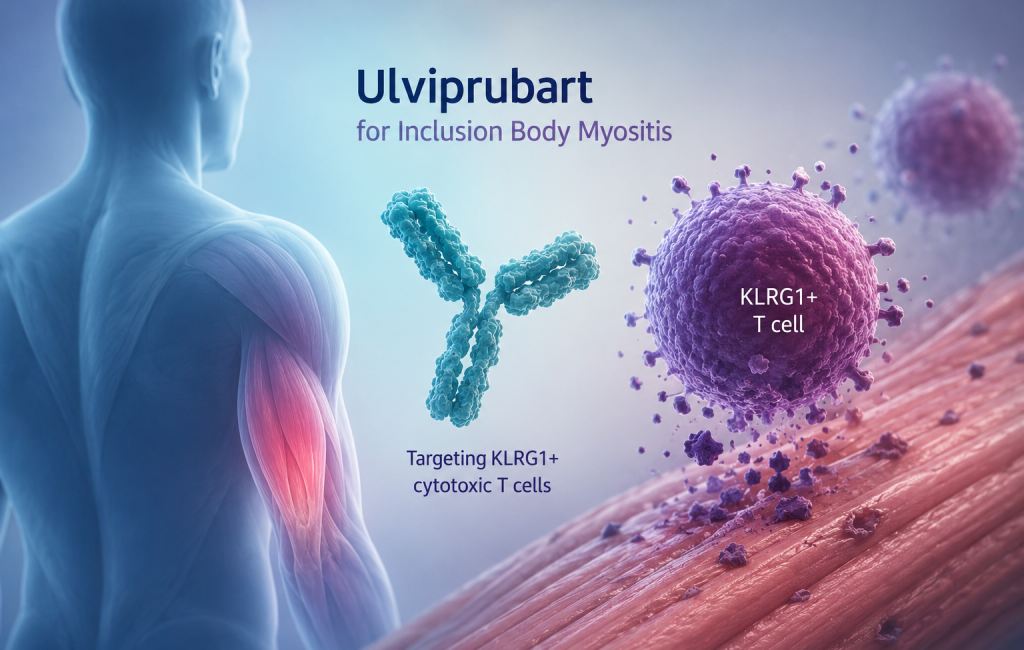
Ulviprubart selectively targets killer cell lectin-like receptor G1 (KLRG1)-expressing T cells, aiming to deplete highly differentiated cytotoxic KLRG1-positive populations while sparing broader immune cell compartments. This selective depletion is intended to mitigate muscle fibre–directed immune-mediated injury thought to drive IBM progression, potentially delivering clinical benefit with a reduced risk of generalised immunosuppression.
Commercial Implications and Patient Population
IBM is a progressive autoimmune myopathy marked by declining grip, dexterity, and mobility, and currently lacks approved pharmacologic therapies. Abcuro estimates about 40,000 diagnosed IBM patients in the United States and roughly 35,000 across major European markets and Japan, with patients having less severe disease comprising nearly half of the diagnosed population. If ulviprubart proves effective in the targeted subgroup and gains approval, the therapy could address a substantial unmet need within a clearly defined patient segment.
Financial and Strategic Development Milestones
The $66 million Series D provides capital to execute the registrational strategy for ulviprubart and to support Abcuro’s broader rare autoimmune disease pipeline priorities, including an ongoing Phase I/II study in T-cell large granular lymphocytic leukemia (T-LGLL). New Leaf Venture Partners cited the company’s focused scientific approach to cytotoxic T cells and clinical insights from MUSCLE in explaining continued support. The funding will cover trial startup costs, site activation, biomarker and safety monitoring, and related regulatory activities required for a BLA-enabling dataset.
Regulatory Pathway
Abcuro anticipates initiating the potentially registrational trial in Q4 2026, with topline results expected in the second half of 2028. Subject to positive results from that study, the company plans to file a BLA with the FDA. No specific BLA submission date or detailed FDA review milestones have been announced; timelines will depend on trial outcomes and subsequent regulatory interactions.
Reference

About the Writer
Rishabha Sonawane, B.Pharm (LinkedIn) is healthcare writer with a strong interest in medical writing, regulatory affairs, clinical research, and AI-driven drug discovery. He has completed specialized training from the NIH and ICMR in clinical pharmacology, clinical research, and scientific writing. Passionate about evidence-based healthcare communication, he focuses on translating complex scientific research into clear, accurate, and engaging medical content.