
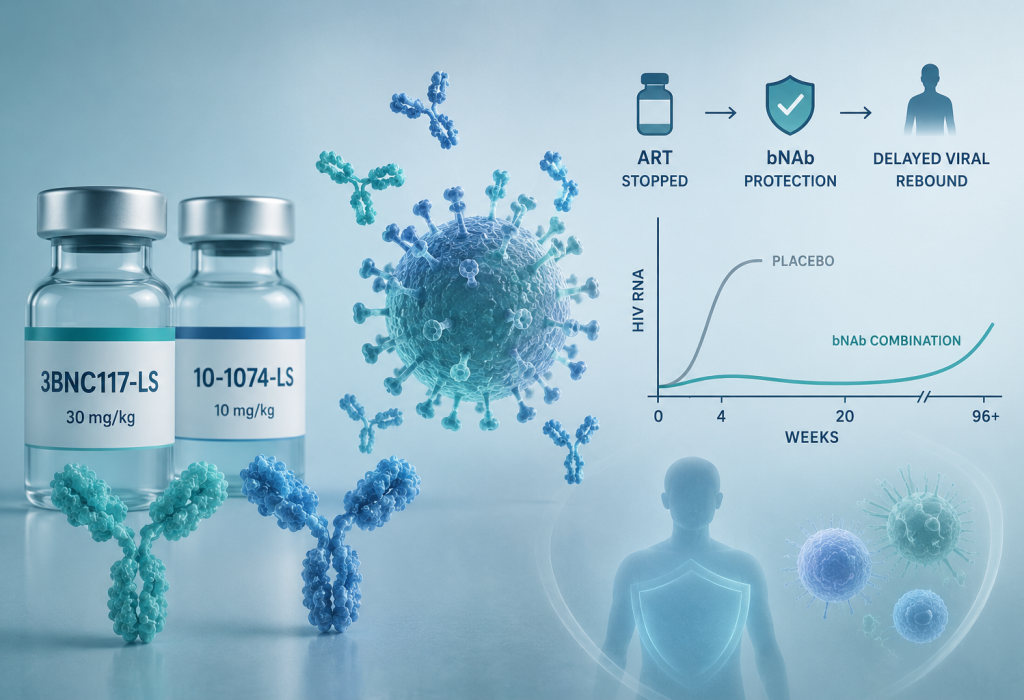
The Phase 2 RIO trial found that 3BNC117-LS and 10-1074-LS reduced HIV viral rebound risk by 91% after ART interruption, with some participants maintaining control beyond 96 weeks.
Written By: Shaik Yasmeen, PharmD
Reviewed By: Pharmacally Editorial Team
The Phase 2, double-blind, randomised, placebo-controlled RIO trial (NCT04319367), published in The Lancet HIV, evaluated whether Fc-engineered broadly neutralising antibodies (bNAbs) could maintain HIV suppression after antiretroviral therapy (ART) was stopped. Conducted by the RIO Study Team across 12 HIV treatment centres in the UK and Denmark, the study enrolled 68 adults aged 18–60 years who had started ART during primary or early-stage HIV infection and were virally suppressed.
Participants received intravenous 10-1074-LS at 10 mg/kg plus 3BNC117-LS at 30 mg/kg, or saline placebo, before entering an analytical treatment interruption (ATI). A second antibody dose was offered to participants who remained virally suppressed without ART at 20 weeks.
Baseline sensitivity was assessed before antibody treatment
Pre-existing viral resistance is an important limitation of bNAb therapy. RIO therefore screened participants for predicted sensitivity to 10-1074 using genotypic methods. Among those screened, 28 of 34 participants in the bNAb arm and 30 of 34 in the placebo arm met the predefined resistance criterion.
However, the investigators noted that current methods cannot reliably predict clinical sensitivity. Some participants experienced rebound despite substantial circulating bNAb concentrations, raising the possibility of undetected or newly emerging bNAb resistance.
91% reduction in viral rebound risk
By week 20, viral rebound occurred in eight participants receiving the bNAb combination compared with 30 receiving placebo. Seventy-five percent of the bNAb group remained free of rebound versus 11% of placebo recipients, corresponding to a hazard ratio of 0.09 (95% CI, 0.04–0.21; p<0.0001).
The effect extended beyond the primary endpoint. Seven participants receiving LS-bNAbs remained free of viral rebound beyond 96 weeks, compared with two placebo recipients. Five continued without ART between 98 and 195 weeks.
The pharmacokinetic analysis estimated half-lives of 72.5 days for 10-1074-LS and 64.7 days for 3BNC117-LS. Notably, participants maintaining control beyond 96 weeks were expected to have antibody concentrations below the previously assumed 10 μg/mL therapeutic threshold.
A possible “vaccinal effect” may explain prolonged control
The prolonged suppression after antibody concentrations declined suggests that direct neutralisation may not fully explain the response. The investigators propose that bNAbs may enhance pre-existing immunity and induce or sustain HIV-specific CD4 and CD8 T-cell responses, supporting a possible “vaccinal effect.” Other contributors could include innate immunity, autologous antibodies and characteristics of the HIV reservoir. The precise mechanism remains unresolved.
Safety and Tolerability
The safety profile was favourable, with 19 treatment- or procedure-related adverse events in the bNAb arm versus 41 with placebo. Nine serious adverse events occurred overall, none of which were considered treatment-related. Fatigue, lethargy and somnolence were the most frequently reported treatment- or procedure-related adverse events.
No New ART Resistance Mutations Detected
All participants eventually achieved viral resuppression after restarting ART, with 94% reaching undetectable plasma HIV RNA within 12 weeks. No new antiretroviral drug resistance-associated mutations emerged in the bNAb arm. However, this does not mean bNAb resistance was absent. Despite baseline sensitivity screening, the investigators found evidence of emerging bNAb resistance in some participants, highlighting the limitations of current sensitivity-testing methods and the need for resistance surveillance.
The RIO findings provide clinical evidence that long-acting bNAb combinations can substantially extend ART-free viral control. Further studies will need to determine how consistently this effect can be reproduced, clarify the immune mechanisms underlying prolonged control and establish optimal dosing and resistance-monitoring strategies for broader HIV remission approaches.
Reference

About the Writer
Shaik Yasmeen (LinkedIn) is a Pharm.D graduate with interests in clinical pharmacy, pharmacovigilance, and medical writing. She has gained experience through hospital clinical postings, patient case reviews, case presentations, and literature evaluation. Passionate about evidence-based healthcare, she is committed to creating accurate and engaging medical content while continuously expanding her professional knowledge.