
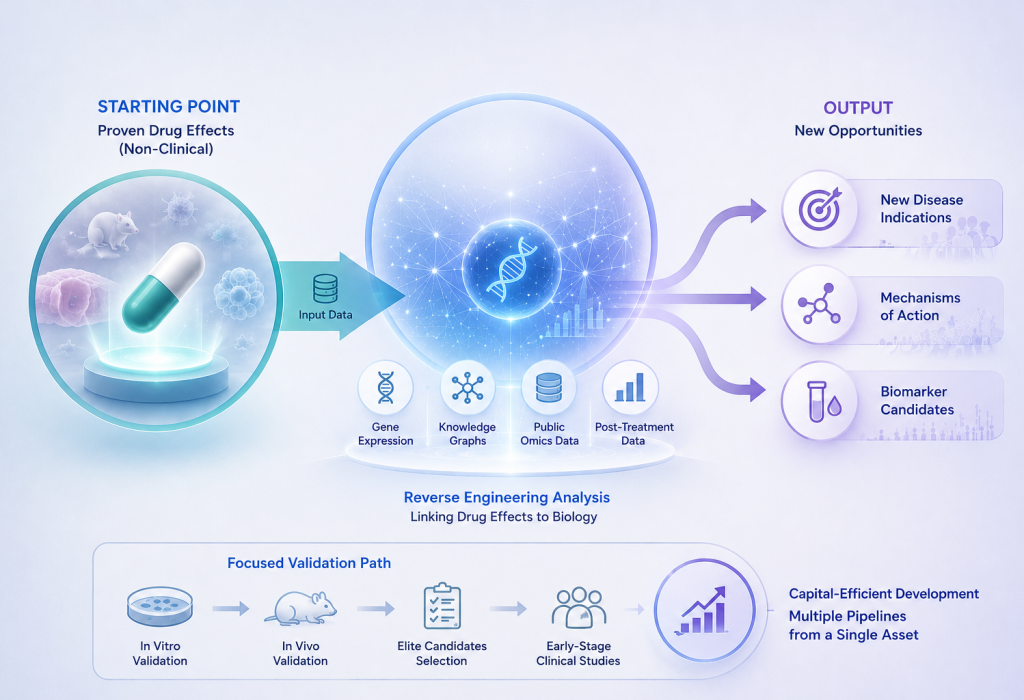
THPharm is using Insilico Medicine’s PandaOmics to link proven drug effects with disease mechanisms, biomarkers and new metabolic disease indications.
Written By: Kirti Kumbhar, M. Pharm (QA)
Reviewed By: Pharmacally Editorial Team
THPharm is applying Insilico Medicine’s PandaOmics platform to build a bio-AI-driven “reverse engineering” strategy for expanding indications of metabolic disease drug candidates. The approach starts with pharmacological effects already demonstrated in non-clinical studies and works backward to identify diseases, molecular mechanisms, and biomarkers that could support new development programs.
From Pharmacological Effects to New Indications
Traditional drug development generally begins by selecting a disease and then identifying compounds that can modify relevant biological pathways. THPharm is taking the opposite approach. It is using established drug effects and phenotypes as the starting point, then applying computational analysis to determine where those effects may have the greatest therapeutic relevance.
The strategy could reduce some of the early uncertainty involved in indication discovery by using existing biological and pharmacological evidence rather than starting each program with a new disease hypothesis.
For THP-001, the companies are integrating drug-target information, literature-derived knowledge graphs, public omics datasets, and gene-expression data collected after treatment. PandaOmics then analyzes downstream target signals and related gene networks to identify potential disease associations and biomarker candidates.
PandaOmics Analysis Builds on THP-001 Data
The collaboration has entered an initial data-integration phase for THP-001, which is currently being evaluated in multinational Phase 3 clinical trials. The partners have secured 16 public datasets containing 269 samples to establish a foundation for gene-expression analysis and meta-analysis.
Early work is focused on connecting pharmacological effects observed in non-clinical studies with disease-specific molecular pathways and candidate biomarkers. The objective is to determine whether reproducible molecular signatures can link the drug’s established biological activity to additional disease settings.
The AI-generated hypotheses will not directly translate into clinical development. THPharm plans to validate promising disease and biomarker candidates in disease-specific cellular and animal models before advancing candidates into early clinical studies.
Metabolic Diseases Under Consideration
The initial indication areas include heart failure, fatty liver disease, and obesity, all of which involve substantial unmet medical needs and complex biological pathways.
Rather than pursuing multiple indications simultaneously, THPharm plans to rank opportunities using several criteria, including the strength of the AI-generated evidence, biomarker reproducibility, feasibility of non-clinical validation, and commercial potential.
The company also plans to extend the approach beyond THP-001 to follow-on metabolic disease candidates based on its drug delivery system (DDS) platform. These programs already have non-clinical efficacy and safety or toxicity data, providing additional datasets for the reverse-engineering framework.
Building Multiple Programs from Existing Assets
Alex Zhavoronkov, PhD, founder and CEO of Insilico Medicine, said PandaOmics can extract additional biological insights from existing datasets by connecting observed pharmacological effects with disease biology and potential therapeutic opportunities.
THPharm CEO Tae Hee “Theo” Han said the company intends to use the strategy to connect validated pharmacological effects with disease mechanisms and identify clinically relevant pathways, potentially allowing multiple development programs to emerge from a single asset.
The next step will be experimental validation of AI-derived indications and biomarkers. Candidates that demonstrate reproducible efficacy and mechanistic support will determine which opportunities progress toward clinical development.
Reference

About the Writer
Kirti Kumbhar (LinkedIn) is an M.Pharm graduate with experience in Quality Assurance at Lupin Limited and a strong interest in clinical research, regulatory affairs, and Trial Master File (TMF) management. She has developed knowledge of regulatory documentation, quality systems, compliance, and healthcare research through her professional experience. Passionate about clinical development and continuous learning, Kirti is committed to supporting high-quality healthcare documentation, regulatory excellence, and research-driven healthcare advancements.