
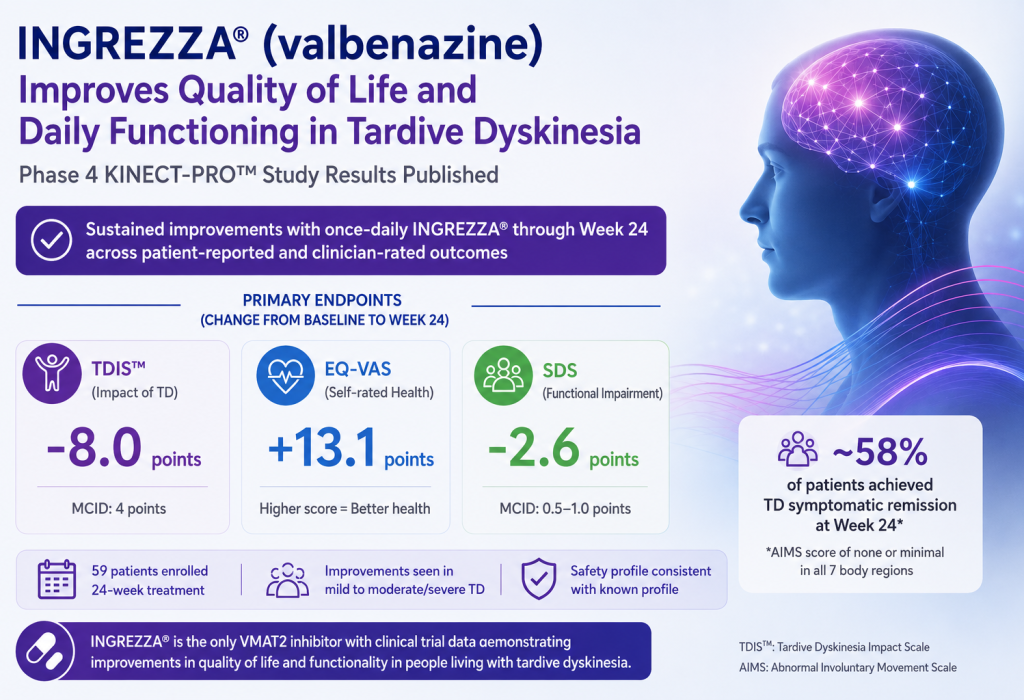
Phase 4 KINECT-PRO findings show INGREZZA (valbenazine) improved quality of life, daily functioning and movement severity in tardive dyskinesia.
Written By: Meghana Jinka, PharmD
Reviewed By: Pharmacally Editorial Team
Neurocrine Biosciences reported publication of the KINECT-PRO Phase 4 study, in which once-daily INGREZZA (valbenazine) produced sustained improvements in quality of life, daily functioning, and movement severity among adults with tardive dyskinesia (TD). The findings, published in CNS Spectrums, showed clinically meaningful changes across multiple validated patient- and clinician-reported measures, with improvements observed regardless of psychiatric diagnosis or baseline TD severity.
KINECT-PRO is notable for incorporating the Tardive Dyskinesa Impact Scale (TDIS), a psychometrically validated patient-reported measure that assesses the physical, social, and emotional burden of TD. The study also used the EuroQoL Visual Analogue Scale (EQ-VAS) and Sheehan Disability Scale (SDS) to capture broader effects on health status and functioning.
Phase 4 Study Included Mild and More Severe TD
The open-label study enrolled 59 adults with at least mild TD and an underlying diagnosis of schizophrenia, schizoaffective disorder, bipolar disorder, or major depressive disorder. Participants received INGREZZA 40 mg once daily for the first four weeks, followed by flexible dosing at 40 mg, 60 mg, or 80 mg once daily according to individual treatment needs. The treatment period lasted 24 weeks, followed by a two-week safety assessment.
At baseline, 24 patients had mild TD movement severity and 35 had moderate or severe disease. Fifty-two participants completed the Week 24 visit, while 45 were included in the efficacy analysis.
Improvements Exceeded Clinically Meaningful Thresholds
By Week 24, the overall efficacy population showed a mean 8.0-point reduction in TDIS, compared with a minimal clinically important difference (MCID) of 4 points. AIMS total scores, which measure abnormal involuntary movements, fell by a mean 6.8 points against an MCID of 2 points. EQ-VAS increased by 13.1 points, indicating improved self-rated health status. SDS scores also declined across social and family domains, reflecting reduced functional impairment.
The effects extended to patients with mild TD. This subgroup showed mean reductions of 6.8 points on TDIS and 5.6 points on AIMS at Week 24, both exceeding the reported clinically meaningful thresholds. Improvements in TDIS and AIMS reached those thresholds as early as Weeks 8 and 4, respectively, and remained evident through Week 24.
Approximately 58% of patients in the relevant Week 24 analysis, 26 of 45, met the study’s definition of TD symptomatic remission, with AIMS scores of none or minimal across all seven assessed body regions.
Valbenazine Targets VMAT2
Valbenazine is a selective vesicular monoamine transporter 2 (VMAT2) inhibitor. It reduces dopamine release by selectively inhibiting VMAT2, although the precise mechanism underlying its clinical effects in TD is not fully established. INGREZZA is FDA-approved for adults with TD and for chorea associated with Huntington’s disease.
The company reported that safety and tolerability in KINECT-PRO remained consistent with the established safety profile, with no new safety concerns identified. Common adverse effects in TD include sleepiness and tiredness. The prescribing information also carries warnings for serious risks including QT prolongation, neuroleptic malignant syndrome, parkinsonism, and allergic reactions.
Findings Expand the Clinical Evidence Base
Neurocrine Chief Medical Officer Sanjay Keswani said the use of validated patient-reported measures helped characterize treatment effects beyond movement severity. Study author Christoph U. Correll emphasized that quality of life and daily functioning are important considerations when assessing TD and treatment response.
The KINECT-PRO findings add patient-reported and functional outcomes to the clinical evidence for valbenazine. However, the study was open-label and enrolled a relatively small population, so the findings do not establish comparative efficacy against another treatment. The release also does not report p-values or a randomized comparator. Longer-term and comparative evidence will therefore remain important for determining how these improvements translate across broader real-world TD populations.
Reference

About the Writer
Meghana Jinka (LinkedIn) is a Pharm.D graduate with a strong interest in clinical pharmacy, clinical research, pharmacovigilance, and medical writing. She has developed expertise in evaluating scientific literature, interpreting clinical data, and communicating complex medical information in a clear and accessible manner. Through clinical training, patient counseling, and healthcare awareness activities, she has gained practical experience in evidence-based medicine and patient-centered care. Passionate about healthcare communication, Meghana is committed to developing accurate, engaging, and evidence-based healthcare documents that support healthcare professionals and the wider community.