
BioMarin discontinues BMN 401 for ENPP1 deficiency after Phase 3 ENERGY 3 trial meets biochemical endpoint but fails to improve clinical rickets severity.
Written By: Kirti Kumbhar, M. Pharm (QA)
Reviewed By: Pharmacally Editorial Team
BioMarin Pharmaceutical has discontinued the clinical development of BMN 401 (formerly INZ-701) across all indications following its evaluation of results from the Phase 3 ENERGY 3 study in children with ENPP1 deficiency. The decision follows the company’s May 2026 announcement that while the trial met its biochemical co-primary endpoint, the improvement in plasma inorganic pyrophosphate (PPi) did not translate into measurable clinical benefit.
Phase 3 ENERGY 3 Trial Results
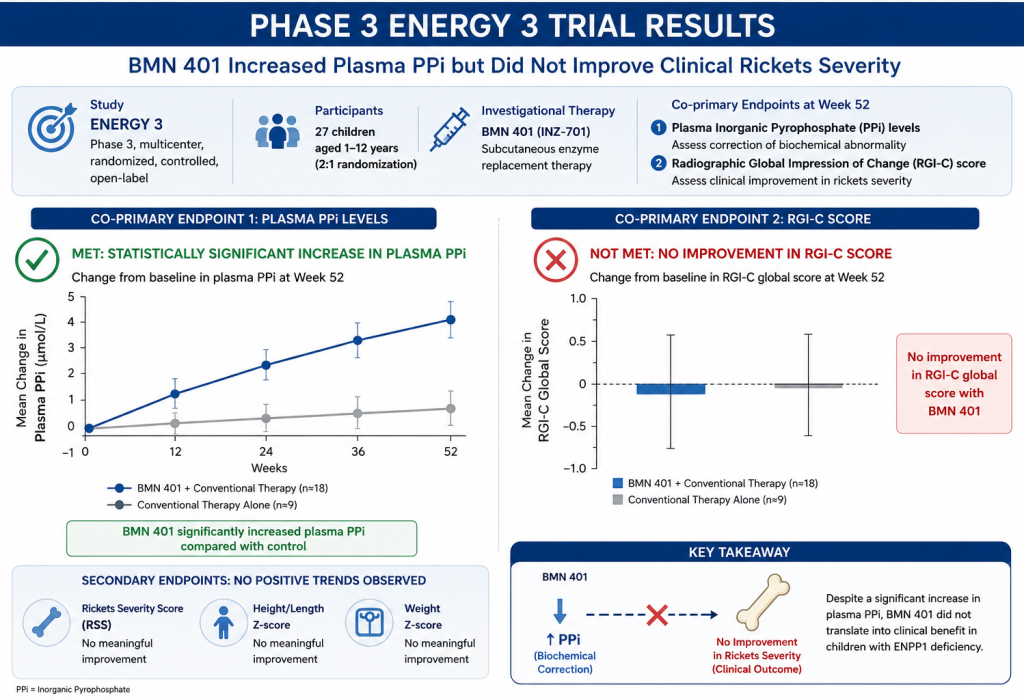
ENERGY 3 was a Phase 3 (NCT06046820), multicenter, randomized, controlled, open-label study evaluating BMN 401 in 27 pediatric participants aged 1 to 12 years using a 2:1 randomization. The study evaluated two co-primary endpoints at Week 52:
- Plasma inorganic pyrophosphate (PPi) levels: Intended to assess the biological effect of BMN 401 and correction of the underlying biochemical abnormality.
- Radiographic Global Impression of Change (RGI-C) score: Intended to assess clinically meaningful improvement in rickets severity.
BMN 401 achieved a statistically significant increase in plasma PPi compared with the conventional therapy control arm but failed to demonstrate improvement in RGI-C global scores. No positive trends were also observed across key secondary endpoints, including the Rickets Severity Score (RSS) and growth Z-scores for height or body length and weight.
Reason for Discontinuation
BioMarin’s decision was driven by the failure to demonstrate clinical benefit on the key skeletal disease endpoint. Safety was not a factor; BMN 401 was generally well tolerated, with no new safety signals reported during the trial.
The key finding from ENERGY 3 was the disconnect between biochemical correction and clinical efficacy. Although BMN 401 significantly increased plasma PPi, this improvement was not accompanied by measurable improvement in rickets severity in the pediatric population studied. BioMarin therefore concluded that the Phase 3 data did not support continued development of the program.
Disease Background and Impact on the Field
ENPP1 deficiency is a rare genetic disorder caused by pathogenic variants in the ENPP1 gene, leading to reduced enzyme function and abnormally low plasma PPi. The condition can present differently across life stages:
- Infants: Generalized arterial calcification of infancy type 1.
- Children: Autosomal-recessive hypophosphatemic rickets type 2.
- Adolescents and adults: Osteomalacia, bone pain and impaired mobility.
- Systemic complications: Joint and arterial calcification, hearing loss and cardiovascular abnormalities.
BMN 401 was designed as a potential first-in-class subcutaneous enzyme replacement therapy intended to address the underlying PPi deficit. Its discontinuation highlights a key challenge in rare disease drug development: demonstrating that correction of a disease-associated biological abnormality translates into meaningful clinical benefit.
BioMarin plans to present detailed ENERGY 3 data at an upcoming medical conference. These findings may provide additional insight into the trial outcome and the relationship between PPi restoration and skeletal disease in children with ENPP1 deficiency.
Reference
BioMarin Reports Second Quarter 2026 Financial and Operating Results | BioMarin

About the Writer
Kirti Kumbhar (LinkedIn) is an M.Pharm graduate with experience in Quality Assurance at Lupin Limited and a strong interest in clinical research, regulatory affairs, and Trial Master File (TMF) management. She has developed knowledge of regulatory documentation, quality systems, compliance, and healthcare research through her professional experience. Passionate about clinical development and continuous learning, Kirti is committed to supporting high-quality healthcare documentation, regulatory excellence, and research-driven healthcare advancements.