
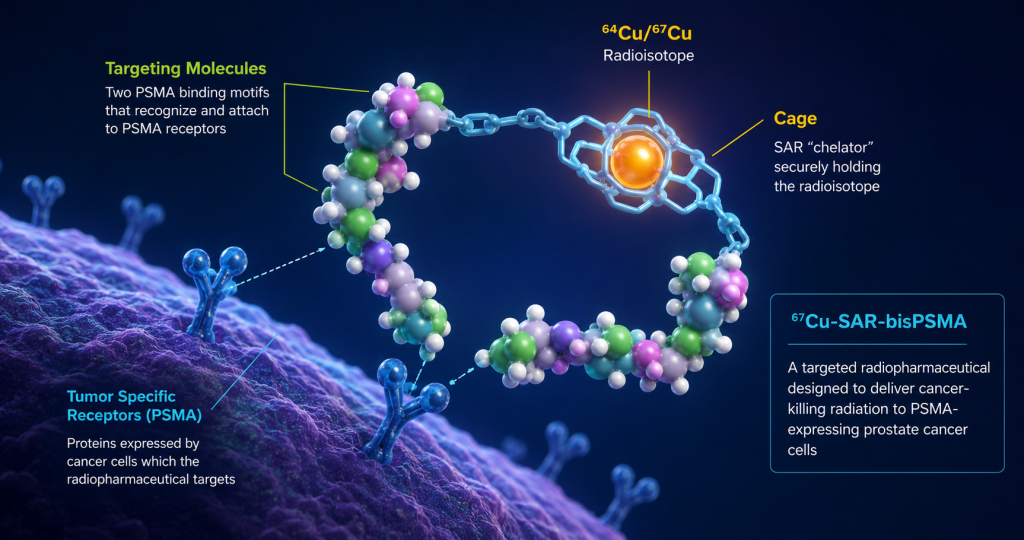
Clarity’s SECuRE trial reports 81% disease control and deep PSA responses with investigational 67Cu-SAR-bisPSMA in heavily pretreated mCRPC.
Written By: Farha Farheen, PharmD
Reviewed By: Pharmacally Editorial Team
Clarity Pharmaceuticals has reported encouraging interim findings from the ongoing Phase I/IIa SECuRE trial (NCT04868604) evaluating 67Cu-SAR-bisPSMA in patients with PSMA-expressing metastatic castration-resistant prostate cancer (mCRPC). The latest analysis focused on 19 heavily pretreated patients who received the 8 GBq dose level, including 16 participants from the Cohort Expansion phase and three from the Dose Escalation phase. The interim data showed substantial antitumor activity, durable disease control, and a favorable safety profile, supporting continued development of the targeted radiopharmaceutical.
Heavily Pretreated Patient Population
The study evaluated a difficult-to-treat patient population. Most participants had advanced disease, with 63% presenting bone metastases and 79% having received five or more prior anticancer therapies before enrollment. Previous treatments included androgen deprivation therapy (ADT), first- and second-generation androgen receptor pathway inhibitors (ARPIs), radiation therapy, taxane-based chemotherapy, and, in some cases, investigational PSMA T-cell engager therapy. Patients received a median of two treatment cycles of 67Cu-SAR-bisPSMA, while three participants in the Cohort Expansion phase also received enzalutamide in combination with treatment.
Trial Demonstrates Deep PSA Responses and Strong Disease Control
The study demonstrated notable antitumor activity across multiple efficacy measures. Among treated participants, 74% achieved at least a 25% reduction in prostate-specific antigen (PSA) levels (PSA25), while 63% achieved a PSA50 response, indicating PSA reductions of at least 50%. In addition, 53% achieved PSA75 and 26% achieved PSA90, reflecting deep biochemical responses. The company noted that these responses continue to mature in participants who remain on treatment.
Radiographic assessments further supported these findings. Among the 16 evaluable patients, 81% achieved disease control, including 50% with stable disease and 31% who achieved complete response or undetectable disease, as assessed by RECIST and/or bone scan.
Safety Profile Remains Favorable
Treatment with the 8 GBq doses continued to demonstrate a favorable tolerability profile. The incidence and severity of treatment-related adverse events were generally lower than those observed across the overall SECuRE trial population. The most common treatment-related adverse events included dry mouth (47%), nausea (42%), fatigue (26%), anemia (21%), and decreased neutrophil count (21%). Most adverse events were mild to moderate (Grade 1/2) and temporary. Only one participant experienced Grade 3 treatment-related hematologic toxicity, while no Grade 4 or higher treatment-related adverse events were reported.
Seven Complete Responses Reported Across Clinical Program
Clarity also announced that seven patients have now achieved complete response or undetectable disease across the broader 67Cu-SAR-bisPSMA clinical program. Two newly reported RECIST-confirmed complete responses were observed in the Cohort Expansion phase of the SECuRE trial, bringing the total to seven. Notably, five of these responses occurred at the 8 GBq dose level, representing nearly one-third of radiographically evaluable patients treated in that cohort.
Executive Perspective
Clarity Executive Chairperson Dr. Alan Taylor said the growing body of clinical evidence continues to support the potential of SAR-bisPSMA across both diagnostic and therapeutic (theranostic) applications. He highlighted that achieving complete responses or undetectable disease in heavily pretreated patients after only a limited number of treatment cycles is particularly encouraging. Dr. Taylor also noted that the combination of deep PSA responses and a favorable safety profile support further evaluation of the therapy in earlier stages of prostate cancer.
Path Forward for the SECuRE Program
The SECuRE trial is an ongoing multicenter, single-arm Phase I/IIa theranostic study in the United States that plans to enroll approximately 54 patients with PSMA-expressing mCRPC. The study uses 64Cu-SAR-bisPSMA for diagnostic imaging and patient selection before treatment with 67Cu-SAR-bisPSMA. Following favorable results from the Dose Escalation phase, the study advanced to the Phase II Cohort Expansion phase, evaluating the 8 GBq dose with up to six treatment cycles per patient. Enrollment remains ongoing, including a subgroup receiving combination therapy with enzalutamide, while the company confirmed that planning for a Phase III registrational trial is underway.
What This Means for Patients
The interim findings suggest that 67Cu-SAR-bisPSMA has the potential to provide meaningful clinical benefit for patients with heavily pretreated metastatic castration-resistant prostate cancer, including deep PSA reductions, durable disease control, and complete responses in some patients. The therapy was generally well tolerated, with predominantly mild to moderate side effects and no Grade 4 or higher treatment-related adverse events. While the treatment remains investigational and these results require confirmation in larger studies, the favorable efficacy and safety profile supports its continued clinical development and ongoing Phase III planning.
Reference

About the Writer
Farha Farheen, PharmD (LinkedIn) is a pharmacy professional with a strong interest in pharmacovigilance and clinical research. She has completed her Doctor of Pharmacy (Pharm.D) along with her internship as a Clinical Pharmacist. She has hands-on experience in adverse drug reaction (ADR) reporting, safety data documentation, and pharmacovigilance workflows, and is proficient in using VigiFlow. She is also a patent holder for an antibacterial formulation enriched with bioactive substances, granted by the German Patent and Trademark Office.