
The 2026 Nobel Prize in Medicine honors Karl Deisseroth, Peter Hegemann and Georg Nagel for discoveries that enabled light-based control of nerve cells.
Written By: Kirti Kumbhar, M.Pharm (QA)
Reviewed By: Pharmacally Editorial Team
The Nobel Assembly at Karolinska Institutet has awarded the 2026 Nobel Prize in Physiology or Medicine jointly to Karl Deisseroth of Stanford University and the Howard Hughes Medical Institute, Peter Hegemann of Humboldt University of Berlin, and Georg Nagel of the University of Würzburg for their discoveries concerning light-gated ion channels and optogenetics.
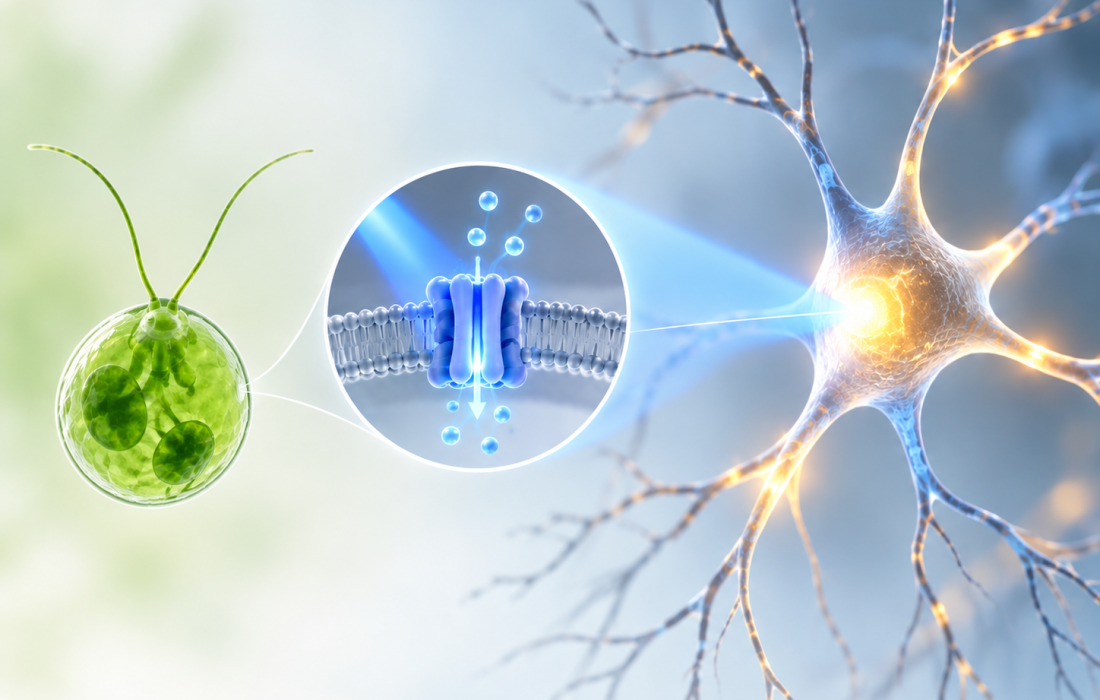
Their work established a new way to investigate how specific nerve cells and neural circuits contribute to functions including memory, emotion and behaviour. Hegemann, Nagel and colleagues established that light-sensitive proteins from the single-celled green alga Chlamydomonas reinhardtii could function as light-gated ion channels. Deisseroth and colleagues subsequently developed these proteins into practical tools for controlling neuronal activity with light.
From a Light-Sensing Alga to a Neural Switch
The discovery began with efforts to understand how Chlamydomonas detects and responds to light. Research led by Hegemann in the early 1990s had established that rhodopsins were involved in algal light sensing. In 2002 and 2003, Hegemann, Nagel and Ernst Bamberg demonstrated that algal rhodopsins could function as directly light-gated ion channels. These proteins were subsequently known as channelrhodopsins.
One of the key proteins, channelrhodopsin-2 (ChR2), became particularly important for neuroscience. When activated by blue light, the channel opens and permits ions to cross the cell membrane, shifting the cell’s electrical state. In neurons expressing ChR2, this can produce depolarization and trigger action potentials.
This discovery provided the molecular component needed to control electrically excitable cells with light. Building on this work, Karl Deisseroth and colleagues introduced microbial opsin genes into neurons. In 2005, they demonstrated light-based control of neuronal activity, helping establish the experimental foundation of modern optogenetics.
In 2007, Deisseroth and collaborators extended the approach to living animals, demonstrating optical control of neuronal activity in the brains of mice and developing fiber-optic methods to stimulate defined neural populations in vivo.
The resulting approach became known as optogenetics, combining genetic targeting of light-sensitive proteins with optical control of cellular activity.
Optogenetics Opens a New Era in Neuroscience
Optogenetics transformed neuroscience because it allowed researchers to manipulate selected populations of neurons with high temporal and cellular precision while observing the resulting effects on neural circuits and behaviour. Earlier approaches could identify associations between particular brain regions and functions, but optogenetics provided a powerful way to test whether specific neural populations were causally involved.
The technology has since become an important research platform for studying neural circuits involved in behaviour, learning, memory and neurological and psychiatric disorders. Modern optogenetic systems can selectively activate or inhibit defined neuronal populations, allowing researchers to investigate how individual circuits contribute to normal and pathological brain function.
The technology is also being investigated for potential clinical applications. Researchers are exploring optogenetic strategies for conditions including vision loss and other neurological disorders, although these applications remain under clinical investigation rather than established routine treatments.
The 2026 Nobel Prize recognizes the progression from understanding how a single-celled organism senses light to developing a technology capable of manipulating neural circuits in living animals. Together, the discoveries by Hegemann, Nagel and Deisseroth established a new experimental framework for understanding how the brain generates behaviour and how specific neural circuits function.
The 2026 Nobel Prize carries an award of 12 million Swedish kronor, to be shared equally among the three laureates.
The Laureates
Karl Deisseroth, born in 1971, is a professor at Stanford University and an investigator with the Howard Hughes Medical Institute. His work helped establish optogenetics as a method for controlling and studying defined neural circuits in living systems.
Peter Hegemann, born in 1954, is Hertie Senior Professor of Neuroscience at Humboldt University of Berlin. His research into algal photoreceptors and rhodopsins provided critical foundations for understanding light-gated ion channels. His key channelrhodopsin work was conducted with collaborators including Georg Nagel and Ernst Bamberg at the University of Regensburg.
Georg Nagel, born in 1953, is Professor of Molecular Plant Physiology at the University of Würzburg. His electrophysiological studies of algal rhodopsins were central to establishing their function as directly light-gated ion channels.
Reference
Nobel Prize, The Nobel Prize in Physiology or Medicine 2026, NobelPrize.org, 5 October 2026.

About the Writer
Kirti Kumbhar (LinkedIn) is an M.Pharm graduate with experience in Quality Assurance at Lupin Limited and a strong interest in clinical research, regulatory affairs, and Trial Master File (TMF) management. She has developed knowledge of regulatory documentation, quality systems, compliance, and healthcare research through her professional experience. Passionate about clinical development and continuous learning, Kirti is committed to supporting high-quality healthcare documentation, regulatory excellence, and research-driven healthcare advancements.