
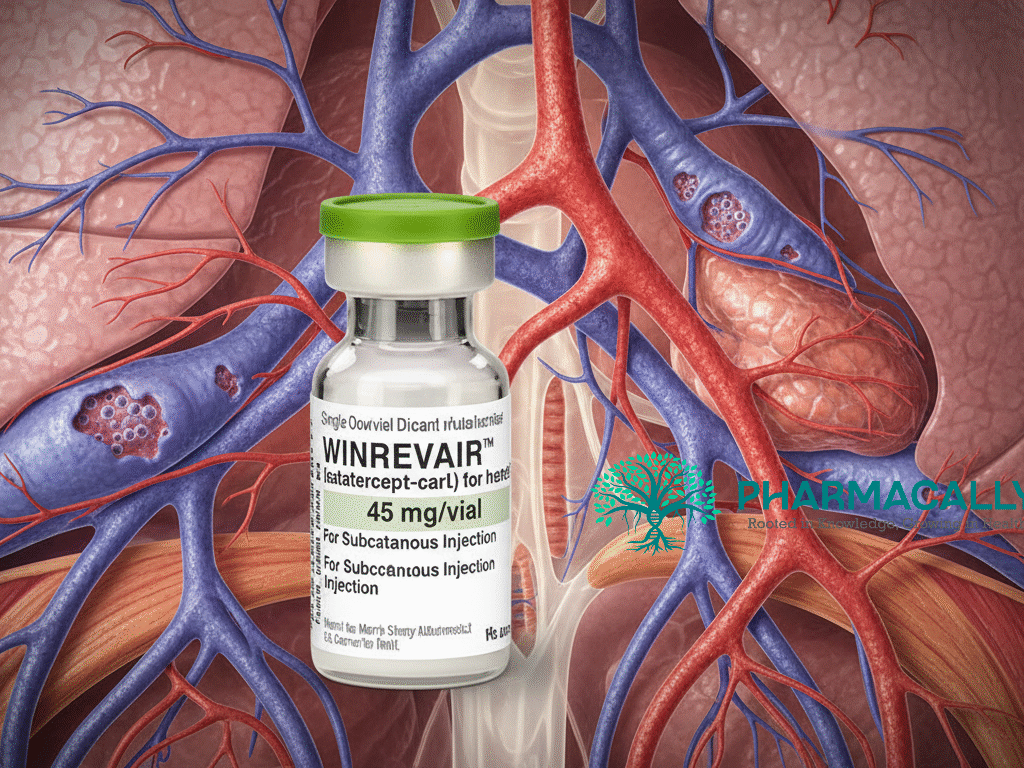
Written By: Pharmacally Medical News Desk
Merck (MSD) has announced promising topline results from its Phase 2 CADENCE study evaluating WINREVAIR™ (sotatercept-csrk) in adults with combined post- and precapillary pulmonary hypertension (CpcPH) due to heart failure with preserved ejection fraction (HFpEF). The study met its primary endpoint by demonstrating a statistically significant and clinically meaningful reduction in pulmonary vascular resistance (PVR) at 24 weeks compared to placebo. This improvement in PVR reflects enhanced hemodynamics related to cardiac and pulmonary vessel function, potentially translating to improved patient outcomes in this difficult-to-treat population.
The CADENCE study enrolled 164 adults diagnosed with CpcPH due to HFpEF who had New York Heart Association (NYHA) functional class II or III. It was a randomized, double-blind, placebo-controlled proof-of-concept study designed to assess WINREVAIR’s efficacy and safety. Patients were randomized to receive either placebo or one of two doses of WINREVAIR (0.3 mg/kg or 0.7 mg/kg). Besides PVR, the study also evaluated secondary endpoints including exercise capacity, echocardiographic and biomarker measures, and clinical events. The safety profile observed was consistent with prior WINREVAIR data, supporting further development.
WINREVAIR demonstrated a significant reduction in the primary endpoint of pulmonary vascular resistance (PVR) at 24 weeks compared to placebo, indicating improved hemodynamics and blood flow through the lungs to the heart. This improvement has the potential to translate into better patient outcomes in this difficult-to-treat population. Secondary endpoints including exercise capacity, echocardiographic and biomarker measures, and clinical events showed positive directional trends.
The safety profile observed in the CADENCE study was generally consistent with WINREVAIR’s known safety data from prior studies. Key safety events included increased hemoglobin, decreased platelet count, serious bleeding, and the potential for fetal harm if given to pregnant women. No new safety signals emerged, supporting the drug’s continued development. In previous studies of WINREVAIR, serious bleeding events occurred at a low rate and were more common in patients on background prostacyclin therapy or antithrombotic agents. Patients are advised to be monitored for signs of bleeding and to avoid administration if serious bleeding occurs.
CpcPH is a severe form of pulmonary hypertension classified under WHO Group 2, caused by left heart disease and characterized by worsening pulmonary vascular remodeling. It is associated with poor prognosis and limited treatment options, notably in HFpEF, a complex cardiovascular syndrome whose prevalence is rising.
WINREVAIR, already FDA-approved for pulmonary arterial hypertension (WHO Group 1), functions as an activin signaling inhibitor that modulates vascular proliferation and has shown the ability to reverse vascular remodeling and improve right ventricular function in preclinical models. The CADENCE results potentially broaden WINREVAIR’s therapeutic scope to a high unmet need population. WINREVAIR demonstrated early benefit in pulmonary arterial hypertension when added within the first year of diagnosis in the Phase 3 HYPERION trial. The Phase 3 ZENITH trial showed significant improvement in exercise capacity and WHO functional class, reinforcing WINREVAIR’s role in enhancing patient outcomes.
WINREVAIR significantly improved pulmonary vascular resistance, a key hemodynamic measure linked to heart and lung vessel function, with potential to enhance outcomes in patients with combined post- and precapillary pulmonary hypertension due to HFpEF, said Dr. Mahesh Patel, vice president, global clinical development, Merck Research Laboratories.
Merck plans to present the full dataset at an upcoming scientific congress and pursue Phase 3 studies based on this proof-of-concept success. The study’s positive outcome may enable regulatory advancement and invite further exploration of WINREVAIR’s benefits in diverse patient subgroups with pulmonary hypertension due to heart failure.
Reference
A Study of Sotatercept for the Treatment of Cpc-PH Due to HFpEF (MK-7962-007/A011-16) (CADENCE), ClinicalTrials.gov ID NCT04945460,
https://clinicaltrials.gov/study/NCT04945460
Merck’s WINREVAIR™ (sotatercept-csrk) Met Primary Endpoint in Phase 2 CADENCE Study in Adults With Combined Post- and Precapillary Pulmonary Hypertension (CpcPH) due to Heart Failure With Preserved Ejection Fraction (HFpEF), 18 November 2025, MERCK, https://www.merck.com/news/mercks-winrevair-sotatercept-csrk-met-primary-endpoint-in-phase-2-cadence-study-in-adults-with-combined-post-and-precapillary-pulmonary-hypertension-cpcph-due-to-heart-failure-w/
Highlights of Prescribing Information, WINREVAIR™ (sotatercept-csrk) for injection, for subcutaneous use, https://www.accessdata.fda.gov/drugsatfda_docs/label/2024/761363s000lbl.pdf
Sotatercept Shows Early Benefit in Pulmonary Arterial Hypertension When Added Within First Year of Diagnosis, 30 September 2025, Pharmacally, https://pharmacally.com/sotatercept-shows-early-benefit-in-pulmonary-arterial-hypertension-when-added-within-first-year-of-diagnosis/
New Indication for WINREVAIR: Reducing Hospitalization and Mortality in PAH, 30 October 2025, Pharmacally, https://pharmacally.com/new-fda-indication-for-winrevair-reducing-hospitalizations-and-mortality-in-pah/