
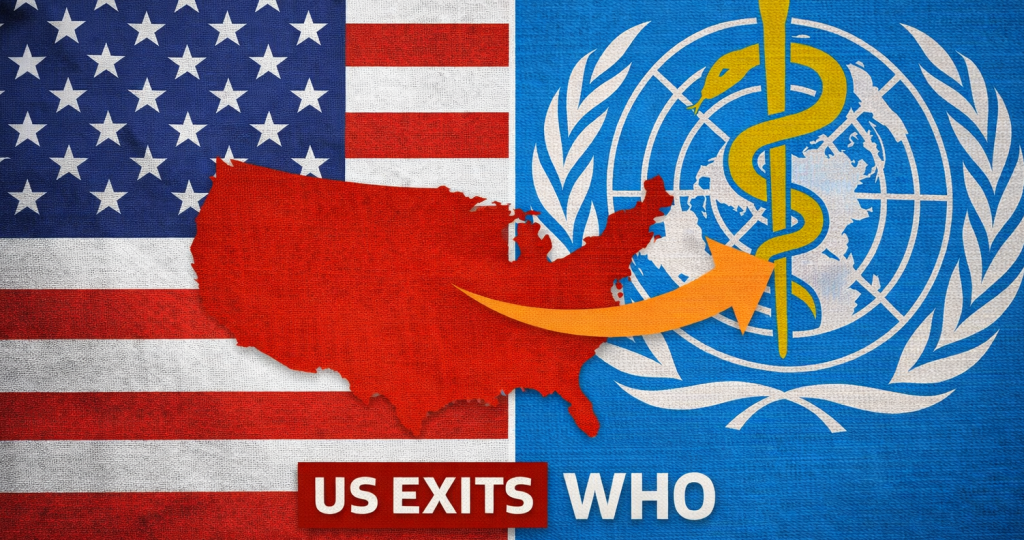
The United States has officially withdrawn from the World Health Organization under a renewed Trump order, citing concerns over the agency’s handling of the COVID-19 pandemic.
Written By: Pharmacally Medical News Desk
The United States has formally withdrawn from the World Health Organization (WHO), completing a long-debated exit that began during President Donald Trump’s first term and was finalized after his return to office. The move marks a major shift in global health diplomacy, with Washington citing concerns over WHO governance and its handling of the COVID-19 pandemic.
A Withdrawal Rooted in the COVID-19 Era
The origins of the US-WHO split trace back to 2020, when Trump first initiated the withdrawal process during the height of the coronavirus crisis. The administration accused the WHO of mismanaging the early outbreak and failing to act independently as the virus spread globally.
That decision was later reversed in January 2021 by President Joe Biden, restoring US participation before the exit could be completed.
Trump’s Second-Term Executive Order Restarted the Exit
After returning to office, Trump revived the withdrawal effort. On January 20, 2025, he signed an executive order directing the US to leave the WHO again, citing the agency’s pandemic response failures, lack of reforms, and what the administration described as disproportionate financial demands placed on the United States.
With the required one-year notice period completed, the withdrawal was formally executed in January 2026, ending almost 80 years of US membership.
Financial Impact of the US Departure
The US exit carries major financial consequences for the WHO. The United States has historically been the organization’s single largest contributor, providing both mandatory membership dues and large voluntary program funding. In recent years, US contributions accounted for roughly 15–18% of WHO revenue, supporting outbreak response, vaccine delivery, HIV and malaria programs, and global health emergency operations. Public health experts warn that the loss of US funding could widen budget gaps and weaken international infectious disease surveillance capacity.
Unpaid Dues and Legal Requirement Before Leaving
The departure also raises unresolved legal and financial obligations. Under the 1948 congressional resolution that enabled US membership in WHO, withdrawal requires not only a one-year advance notice, but also full payment of outstanding assessed contributions. Reuters reported that the US was expected to settle around $260 million in unpaid mandatory dues for the 2024–2025 budget cycle before departure. Unlike voluntary donations, these assessed contributions represent formal membership obligations, and failure to pay has become a key issue surrounding the legality and credibility of the exit.
Immediate Consequences for Global Health Cooperation
The United States has long played a central role in WHO decision-making, scientific coordination, and emergency preparedness planning. Health analysts caution that withdrawal may reduce US access to shared disease monitoring systems and diminish its influence in shaping future pandemic response frameworks.
US officials argue that America will continue to lead global health efforts through domestic agencies such as the CDC and NIH, as well as alternative partnerships outside the WHO structure.
A Major Shift in International Health Governance
The US departure represents one of the most consequential disruptions in modern global health governance. As new infectious threats continue to emerge worldwide, the long-term impact of America’s WHO withdrawal will be closely watched across healthcare systems, regulators, and international public health institutions.
References
The U.S. Has Pulled Out of the WHO. Here’s What That Means for Public Health, 23 January 2026, TIME, https://time.com/7357180/us-withdrawal-who-world-health-organization
Yazdi-Feyzabadi V et al, The United States Withdrawal from the World Health Organization: Implications and Challenges. Int J Health Policy Manag. 2025;14:9086. Epub 2025 Mar 18. PMID: 40767200; PMCID: PMC12089832. https://doi.org/10.34172/ijhpm.9086
Withdrawing the United States from the world health organization, 20 January 2026, The White House, https://www.whitehouse.gov/presidential-actions/2025/01/withdrawing-the-united-states-from-the-worldhealth-organization
The World Health Organization (WHO): Background and U.S. Withdrawal, Congress.gov, https://www.congress.gov/crs-product/IN12496
Fact Sheet: U.S. Withdrawal from the World Health Organization, US Department of Health and Human Services, https://www.hhs.gov/press-room/fact-sheet-us-withdrawal-from-the-world-health-organization.html
The U.S. Government and the World Health Organization, 21 January 2025, KFF, https://www.kff.org/global-health-policy/the-u-s-government-and-the-world-health-organization/
How WHO is funded, WHO, https://www.who.int/about/funding
U.S. Withdrawal from the World Health Organization: Process and Implications, 21 October 2020, EveryCRSReport.com, https://www.everycrsreport.com/reports/R46575.html
Can the US formally withdraw from WHO without paying its debts?, 22 January 2026, devex, https://www.devex.com/news/can-the-us-formally-withdraw-from-who-without-paying-its-debts-111655
US withdraws from the World Health Organization, 23 January 2026, Reuter, https://www.reuters.com/business/healthcare-pharmaceuticals/us-set-quit-world-health-organization-2026-01-22/