
Written By: Pharmacally Medical News Desk
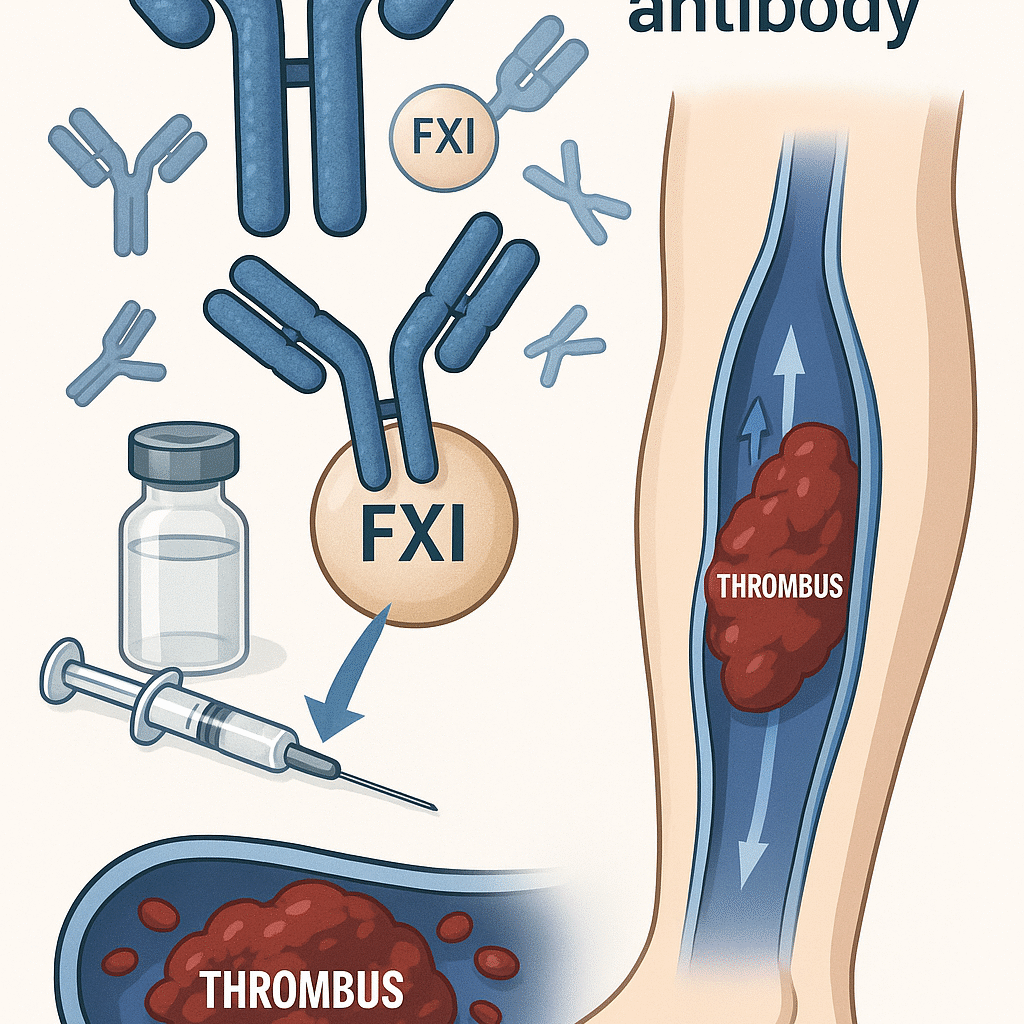
Regeneron Pharmaceuticals recently presented Phase 2 clinical trial data on two novel Factor XI antibodies, REGN7508 and REGN9933, demonstrating their antithrombotic effects in patients undergoing unilateral total knee arthroplasty. These data were simultaneously published in The Lancet and presented at the 2025 American Heart Association Scientific Sessions, highlighting the potential of these antibodies to provide effective venous thromboembolism (VTE) prevention with a favorable bleeding safety profile.
The Phase 2 studies, ROXI-VTE-I and ROXI-VTE-II, were randomized, open-label, active-controlled trials in patients undergoing unilateral total knee arthroplasty. ROXI-VTE-I evaluated REGN9933A2 (A2 domain targeting, 300 mg IV) versus daily enoxaparin and an exploratory arm of twice-daily apixaban, while ROXI-VTE-II assessed REGN7508Cat (catalytic domain targeting, 250 mg IV) versus daily enoxaparin. Patients were enrolled and randomized to study drugs, which were administered 12–24 hours after surgery. Notably, apixaban was not included in the ROXI-VTE-II trial. The primary efficacy endpoint was adjudicated venous thromboembolism through day 12 post-surgery, with drug administration occurring 12–24 hours after surgery.
The primary safety outcome focused on major or clinically relevant non-major bleeding events. Multiple secondary safety and efficacy analyses were conducted, including postoperative anemia and adverse event incidence.
Both REGN7508Cat and REGN9933A2 demonstrated clear and significant efficacy for venous thromboembolism (VTE) prevention following total knee replacement surgery. Historical data indicate that approximately 48% of patients treated with placebo develop VTE in this setting. In the Phase 2 trials, REGN7508Cat markedly reduced VTE rates to 7.1%, showing numerical superiority to the apixaban rate of 12.4%. Similarly, REGN9933A2 reduced VTE rates to 17.2%, which was numerically superior to the enoxaparin rate of 20.6%. These results underscore the strong antithrombotic potential of both Regeneron Factor XI antibodies compared to current standard treatments, with both agents delivering substantial reductions in VTE incidence post-surgery.
REGN7508 binds the catalytic domain of factor XI, while REGN9933 targets the A2 domain, blocking activation by factor XII. Genetic and epidemiological data support the therapeutic rationale, showing factor XI deficiency correlates with reduced thrombosis risk and minimal bleeding. These antibodies selectively inhibit the intrinsic coagulation pathway, aiming to provide anticoagulation with lower bleeding risk than current standards of care, such as DOACs.
Building on these positive Phase 2 outcomes, Regeneron has initiated the ROXI-APEX Phase 3 trial to evaluate REGN7508Cat for VTE prevention after total knee replacement, with apixaban and enoxaparin as comparators. ROXI-ASPEN is comparing REGN9933A2 to aspirin, and ROXI-ATLAS is studying both antibodies versus apixaban in atrial fibrillation. In 2026, further Phase 3 trials are planned for stroke prevention in atrial fibrillation, and additional indications including cancer-associated thrombosis, PICC-associated thrombosis, and peripheral arterial disease.
The Phase 2 trials establish REGN7508 and REGN9933 as promising novel anticoagulants targeting factor XI with strong antithrombotic efficacy and superior safety regarding bleeding risk. Pending Phase 3 trial results and regulatory review, these agents could transform VTE prevention and management in multiple clinical settings.
Jeffrey I. Weitz, Distinguished University Professor at McMaster University and lead author, emphasized that bleeding risks with current anticoagulants often limit patient treatment adherence, increasing vulnerability to serious blood clots. He highlighted that the positive Phase 2 trial results confirm factor XI’s role in postoperative venous thromboembolism and suggest that the two distinct Regeneron antibodies could offer tailored anticoagulant options for patients with varying risk profiles. Additionally, the findings with REGN9933A2 uniquely demonstrate the contribution of factor XIIa-driven activation of factor XI in postoperative VTE, providing important new insight into thrombosis mechanisms.
Reference
Phase 2 Trials Demonstrating Antithrombotic Effect of Two Novel Regeneron Factor XI Antibodies Presented at American Heart Association Scientific Sessions and Published in The Lancet, 08 November 2025, Regeneron, https://investor.regeneron.com/news-releases/news-release-details/phase-2-trials-demonstrating-antithrombotic-effect-two-novel
Weitz, Jeffrey I et al, Efficacy and safety of REGN9933A2 and REGN7508Cat for preventing postoperative venous thromboembolism (ROXI-VTE-I and ROXI-VTE-II): two randomised, open-label, phase 2 trials, The Lancet, November 08, 2025
Regeneron to Advance Two Factor XI Antibodies into a Broad Phase 3 Program Following Positive Phase 2 Proof-of-concept Results, 19 Dec 2024, Regeneron, https://investor.regeneron.com/news-releases/news-release-details/regeneron-advance-two-factor-xi-antibodies-broad-phase-3-program?