
Is mouth taping a safe way to improve sleep? Discover the evidence, clinical studies, and expert warnings behind this viral sleep trend.
Written By: Anand Sathappan, BPharm
Reviewed By: Dr. Suraj Giri, MBBS, MS-ENT
[Otorhinolaryngology]
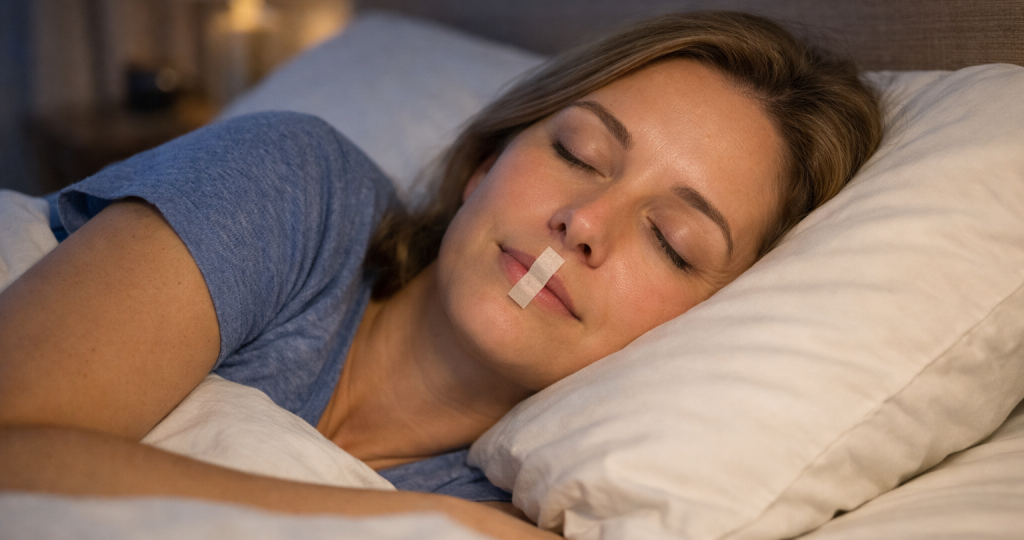
The practice of mouth taping during sleep has gained widespread attention on social media, with proponents claiming it can reduce snoring, improve sleep quality, and promote healthier breathing patterns. The idea behind the trend is simple: placing a small strip of tape across the lips at night encourages nasal breathing instead of mouth breathing.
While nasal breathing has well-established physiological advantages, the scientific evidence supporting mouth taping as a sleep intervention remains limited. A small number of clinical studies and expert opinions suggest potential benefits for certain individuals, but sleep specialists generally caution that the practice may not be safe for everyone.
Why Nasal Breathing Matters During Sleep
Breathing through the nose plays an important physiological role in maintaining airway health. The nasal passages filter airborne particles, humidify inhaled air, and produce nitric oxide, a molecule that helps regulate pulmonary blood flow and oxygen exchange.
In contrast, mouth breathing during sleep is associated with several issues, including dry mouth, snoring, and disrupted sleep patterns. It may also occur in people with underlying conditions such as nasal obstruction, allergies, enlarged tonsils, or obstructive sleep apnea (OSA).
Because of these factors, some sleep researchers have explored whether encouraging nasal breathing during sleep could improve breathing stability
Clinical Evidence on Mouth Taping
In a 2022 pilot study, Huang and colleagues investigated the impact of mouth taping during sleep in 20 patients with mild OSA. The researchers found that mouth taping was associated with:
- A 47% reduction in the snoring index
- A significant reduction in the apnea-hypopnea index (AHI)
- Improved oxygen saturation in some participants
The authors concluded that mouth taping may help reduce snoring and breathing disturbances in selected patients with mild OSA, although they emphasized that larger trials are needed to confirm the findings.
Evidence From Reviews of Existing Studies
A recent literature review examining mouth taping during sleep found that only a small number of studies have evaluated the practice, and most involve small patient populations.
The review reported that some studies showed reductions in snoring or improvements in breathing parameters, but the evidence was heterogeneous and insufficient to support routine clinical use.
What Sleep Experts Say
Several sleep medicine organizations have urged caution regarding the viral trend.
The American Academy of Sleep Medicine (AASM) has warned that mouth taping may pose risks, particularly for people with undiagnosed sleep disorders. According to the organization, blocking the mouth during sleep could potentially worsen breathing problems in individuals with obstructive sleep apnea or nasal obstruction.
Similarly, sleep researchers have emphasized that mouth breathing is often a symptom of an underlying airway issue, such as nasal congestion or structural airway abnormalities, rather than a problem that can be solved simply by taping the mouth.
Evidence From Studies on Mouth Closure in Sleep Apnea
Additional research has explored the effect of mouth closure on airflow during sleep in patients with obstructive sleep apnea. In a 2024 nonrandomized clinical trial, Yang and colleagues evaluated 54 patients with OSA to examine how closing the mouth affected airway airflow dynamics. The study found that mouth closure improved airflow in some individuals, particularly those with specific upper-airway anatomical patterns. However, the response varied widely among participants, suggesting that the effectiveness of mouth closure strategies may depend on individual airway characteristics rather than providing a universal benefit.
Potential Benefits Reported
In limited clinical observations, mouth taping has been associated with some potential benefits in specific individuals, including:
- Reduced snoring
- Encouragement of nasal breathing
- Less dry mouth upon waking
- Improvement in breathing patterns during sleep
However, these benefits appear to occur primarily in people with mild sleep-related breathing issues and normal nasal airflow.
Safety Concerns and Risks
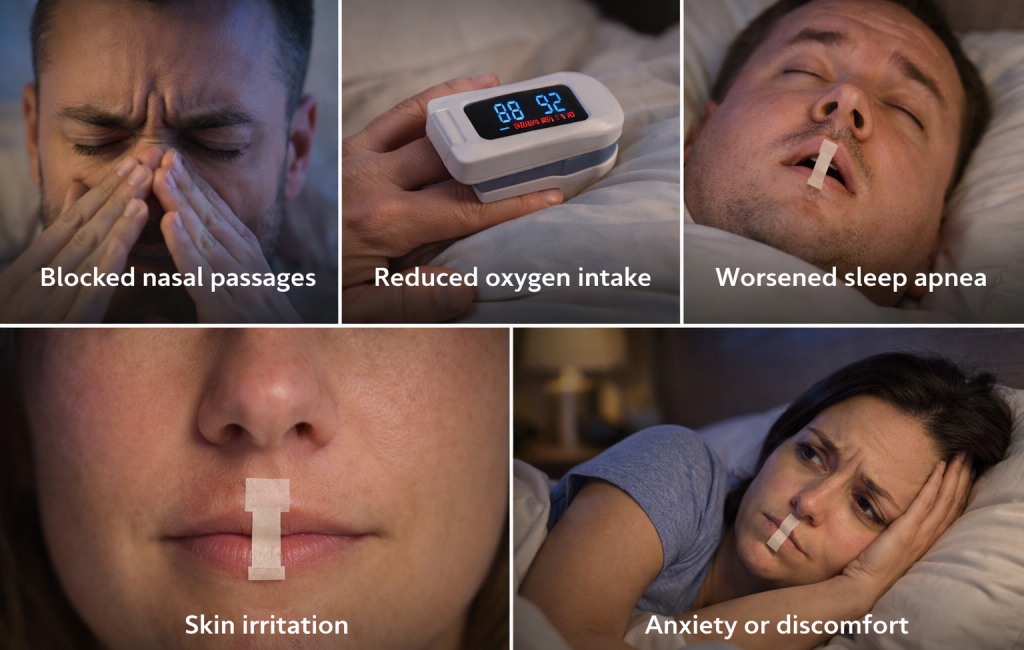
Despite anecdotal reports of improved sleep, experts caution that mouth taping may carry risks.
Potential concerns include:
- Difficulty breathing if nasal passages are blocked
- Reduced oxygen intake during sleep
- Worsening symptoms in individuals with moderate or severe sleep apnea
- Skin irritation from adhesive tape
- Anxiety or discomfort during sleep
Because of these risks, sleep specialists generally recommend medical evaluation for persistent snoring or breathing disturbances, rather than relying on trending sleep hacks.
Who Should Avoid Mouth Taping
According to sleep medicine experts, mouth taping should be avoided by individuals with:
- Moderate or severe obstructive sleep apnea
- Chronic nasal congestion
- Deviated nasal septum
- Respiratory conditions such as asthma
- Severe allergies affecting nasal breathing
In such cases, restricting mouth breathing could potentially compromise airflow during sleep.
Evidence-Based Alternatives to Improve Sleep Breathing
Instead of mouth taping, clinicians often recommend approaches that address the underlying cause of mouth breathing.
- Treating nasal congestion with saline or medications
- Using nasal dilator strips
- Sleeping on the side rather than the back
- Managing weight in patients with sleep apnea risk
- Using CPAP therapy for diagnosed OSA
- Oral appliances prescribed by dental sleep specialists
These interventions are supported by stronger clinical evidence and target airway function directly.
The Bottom Line
Mouth taping during sleep has become a popular wellness trend, but scientific evidence supporting its effectiveness remains limited. A small pilot study suggests it may help reduce snoring and breathing disturbances in certain individuals with mild obstructive sleep apnea, but larger randomized trials are lacking.
Major sleep medicine organizations also caution that the practice may be unsafe for people with nasal obstruction or undiagnosed sleep apnea.
For individuals experiencing persistent snoring or sleep problems, consulting a healthcare professional remains the safest way to identify the underlying cause and choose an appropriate treatment.
Reference
Sarah K. Fangmeyer, et al, Nocturnal mouth-taping and social media: A scoping review of the evidence, American Journal of Otolaryngology, Volume 46, Issue 1, 2025, 104545, https://doi.org/10.1016/j.amjoto.2024.104545
Lee YC et al, The Impact of Mouth-Taping in Mouth-Breathers with Mild Obstructive Sleep Apnea: A Preliminary Study. Healthcare (Basel). 2022 Sep 13;10(9):1755. PMID: 36141367; PMCID: PMC9498537, https://doi.org/10.3390/healthcare10091755
Viral TikTok trends are not the answer for better sleep, American Academy of Sleep Medicine (AASM), https://aasm.org/viral-tiktok-trends-are-not-the-answer-for-better-sleep/
Yang H, Huyett P, Wang T, et al. Mouth Closure and Airflow in Patients with Obstructive Sleep Apnea: A Nonrandomized Clinical Trial. JAMA Otolaryngol Head Neck Surg. 2024;150(11):1012–1019. https://jamanetwork.com/journals/jamaotolaryngology/fullarticle/2824293#250012368
What Can You Use Instead of Mouth Tape for Sleep? The Insomnia and Sleep Institute of Arizona, https://sleeplessinarizona.com/what-can-you-use-instead-of-mouth-tape-for-sleep/


About the Writer
Anand Sathappan is a pharmacy graduate with interests in pharmaceutical sciences, pharmacology, and medical writing. He also holds certification in medical coding and has familiarity with pharmacology and healthcare documentation. He has completed the Medical Writing Skills for Beginners program offered by the International Medical Writers Association (IMWA). His work focuses on exploring developments in pharmaceuticals and presenting scientific information in a clear and structured manner.