
Written By: Shreya Bendsure, BPharm
Reviewed By: Pharmacally Editorial Team
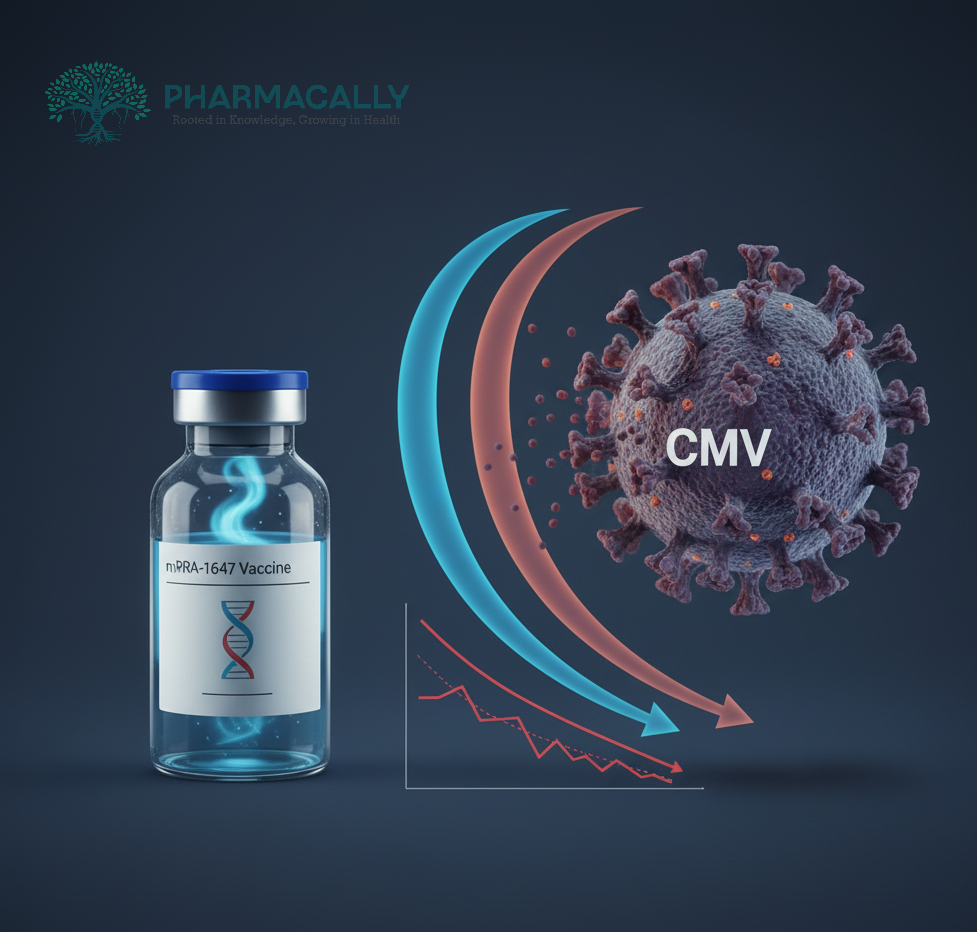
Moderna, a biotech giant recently announced disappointing results from its Phase 3 trial evaluating the efficacy of its investigational cytomegalovirus (CMV) vaccine, mRNA-1647. The vaccine was developed with the hope of preventing primary CMV infections in women of childbearing age, a population at high risk of transmitting the virus to unborn children. Despite years of promising early-stage data, the trial failed to meet its primary efficacy endpoint, showing only 6% to 23% efficacy depending on case definitions. As a result, the company has decided to discontinue its congenital CMV vaccine program. This decision deals a major blow to one of the most advanced CMV vaccine candidates in development.
About Investigational Drugs
mRNA-1647 is a multivalent mRNA vaccine designed to elicit immune responses against six CMV viral proteins, combining two glycoprotein complexes (gB and the pentameric complex) that are essential for viral cell entry and spread. The vaccine uses lipid nanoparticle-encapsulated messenger RNA (mRNA) sequences instructing human cells to produce these viral proteins, thereby training the immune system to recognize and neutralize CMV upon exposure.
Earlier Phase 1 and 2 trials demonstrated robust immune responses. Participants developed neutralizing antibody titers exceeding those observed after natural infection, alongside strong CD4+ and CD8+ T-cell reactivity and durable memory B-cell activation for up to 18 months. These findings suggested potential for long-term immunity and positioned mRNA-1647 as a front-runner among CMV vaccine candidates heading into late-stage evaluation.
Clinical Trial Data
Moderna’s Phase 3 clinical trial, CMVictory (NCT05085366), was a randomized, observer-blinded, placebo-controlled study conducted at 290 sites across 13 countries. The trial enrolled 7484 females between 16 and 40 years of age, with 80% being CMV-seronegative and 20% seropositive at baseline. Participants were randomized 1:1 to receive either three doses of 100 µg mRNA-1647 or placebo at months 0, 2, and 6. Follow-up continued for 30 months to assess both protection and long-term immunogenicity.
The primary efficacy endpoint was prevention of primary CMV infection, defined by seroconversion from CMV IgG negative to positive starting 28 days after the third dose among previously uninfected women. Secondary endpoints included evaluation of neutralizing and binding antibody levels, viral shedding kinetics in seronegative participants who became infected, and assessment of immune responses among seropositive individuals. Safety, reactogenicity, and adverse event monitoring were integral components of the trial design.
Trial Results and Interpretation
Topline data revealed that the mRNA-1647 vaccine did not meet its primary efficacy endpoint. Depending on the diagnostic criteria used to define infection, the vaccine efficacy ranged between 6% and 23% a statistically insignificant level of protection. Although these numbers indicate some immune activity against the virus, the observed protection fell far below regulatory and clinical thresholds to demonstrate benefit.
The trial was particularly ambitious it aimed to prevent primary infection with a latent virus rather than just reducing disease severity. This biological complexity likely contributed to the disappointing outcome, as CMV is adept at evading immune recognition due to its ability to persist in host cells and periodically reactivate.
What Went Wrong
Several factors may explain the lack of effectiveness. One challenge is CMV’s unique biology: it establishes latency, meaning the immune system must sustain long-term control to prevent infection or reactivation. Even though mRNA-1647 induced strong antibody responses, the antibodies might not have been sufficient to block viral entry or transmission in real-world conditions involving frequent exposure particularly from children under five, who are major CMV transmitters. Moreover, trial participants’ varying exposure intensity and regional viral diversity could have influenced outcomes.
Scientific experts note that mRNA’s success in respiratory viruses like SARS-CoV-2 may not directly translate to complex, latency-driven pathogens such as CMV.
Safety Profile
Across all dosing groups, the vaccine demonstrated an acceptable safety and tolerability profile, consistent with earlier trials. Most reported adverse events were mild to moderate, including injection-site pain, headache, fatigue, and transient myalgia. Importantly, the Data Safety Monitoring Board (DSMB) observed no significant safety concerns or adverse trends and recommended the trial continue as planned before final analysis.
Future Direction of the Trial
Following the Phase 3 findings, Moderna has officially discontinued the congenital CMV program. However, the company plans secondary analyses to explore whether subsets of the population such as women with specific immune phenotypes may still demonstrate partial benefit. In addition, mRNA-1647 will continue being studied in Phase 2 settings focusing on CMV reactivation in immunocompromised or transplant patients, where preventing viral reemergence may be more achievable.
Key Opinions
Moderna’s President, Dr. Stephen Hoge, stated, “We are clearly disappointed by the failure to prevent primary infection because it means there is still no vaccine for congenital CMV despite decades of work”. CEO Stéphane Bancel reiterated that while the outcome was not what the company hoped for, it highlights the scientific complexity of CMV and underscores the value of continued exploration using mRNA platforms.
Setback to Patients and Families
The failure to develop a vaccine leaves millions of women and families without a preventive tool against congenital CMV. CMV remains a significant public health challenge, with no approved vaccines currently available, underlining the urgent need for continued research. Families affected by congenital CMV must rely on early detection and management strategies, highlighting the importance of ongoing research efforts.
About CMV
CMV is a member of the herpesvirus family and one of the most common viral infections worldwide. It is typically asymptomatic in healthy individuals, but in pregnant women, CMV infection can transmit to the fetus, leading to congenital cytomegalovirus (cCMV) infection a leading cause of birth-related disabilities such as hearing loss, developmental delay, and vision impairment. The U.S. Centers for Disease Control and Prevention (CDC) estimates that one in every 200 infants is born with cCMV, with about 1 in 5 suffering long-term health problems.
The virus is primarily spread through contact with bodily fluids such as saliva, urine, and breast milk. Once inside the body, CMV establishes lifelong latency and can reactivate under conditions of immune suppression. Currently, there is no approved vaccine for CMV, and preventive strategies rely on behavioral and hygiene measures.
References
Moderna Announces Phase 3 Study of Investigational Cytomegalovirus (CMV) Vaccine Did Not Meet Primary Efficacy Endpoint, 23 October 2025, https://feeds.issuerdirect.com/news-release.html?newsid=5904324204417374&symbol=MRNA
Reflecting on Moderna’s Phase 3 CMV Vaccine Readout, 22 October 2025, https://www.modernatx.com/en-US/media-center/all-media/blogs/phase-3-cmv-vaccine-readout-reflections
Overview of mRNA-1647: Investigational CMV Vaccine, ACIP, https://www.cdc.gov/acip/downloads/slides-2025-04-15-16/03-paris-CMV-508.pdf
Mussi-Pinhata MM, Yamamoto AY, Aragon DC, Duarte G, Fowler KB, Boppana S, Britt WJ. Seroconversion for Cytomegalovirus Infection During Pregnancy and Fetal Infection in a Highly Seropositive Population: “The BraCHS Study”. J Infect Dis. 2018 Sep 8;218(8):1200-1204. Doi: 10.1093/infdis/jiy321. PMID: 29868783; PMCID: PMC6129109.
Akingbola A, Adegbesan A, Adewole O, Adegoke K, Benson AE, Jombo PA, Uchechukwu Eboson S, Oluwasola V, Aiyenuro A. The mRNA-1647 vaccine: A promising step toward the prevention of cytomegalovirus infection (CMV). Hum Vaccin Immunother. 2025 Dec; 21(1):2450045. Doi: 10.1080/21645515.2025.2450045. Epub 2025 Jan 17. PMID: 39825496.