
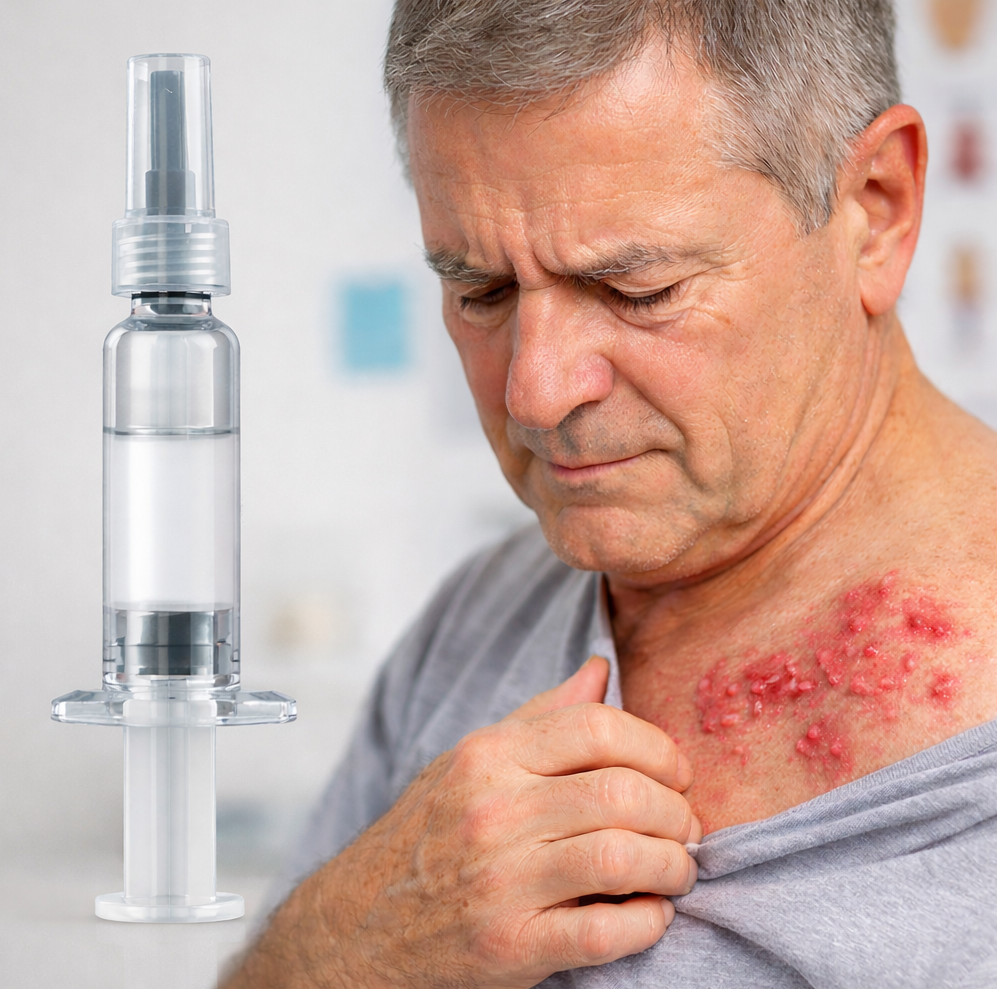
The European Commission has approved a prefilled syringe presentation of GSK’s Shingrix vaccine across the EU, simplifying administration for healthcare professionals without changing dosing or indications.
Written By: Nikita Jha, BPharm
Reviewed By: Pharmacally Editorial Team
GlaxoSmithKline plc (GSK) has announced that the European Commission has granted marketing authorization for a new prefilled syringe presentation of Shingrix across the European Union. The approval applies to GSK’s recombinant zoster vaccine (RZV) and marks an important update to how the vaccine is prepared and administered in clinical practice.
What Has Changed in the New Shingrix Presentation
Until now, Shingrix has been supplied in a two-vial presentation. One vial contains a lyophilised powder antigen, while the second contains a liquid adjuvant. Before administration, healthcare professionals must reconstitute the vaccine by withdrawing the adjuvant and injecting it into the antigen vial.
The newly approved prefilled syringe removes these preparation steps. By eliminating the need for reconstitution, the updated presentation simplifies vaccine administration and reduces handling time for healthcare professionals, while maintaining the same indication and dosing as the existing formulation.
Regulatory Basis for Approval
The European Commission’s decision is based on data confirming technical comparability between the prefilled syringe and the current two-vial presentation. This update does not involve any change to Shingrix’s approved indications, dosage, or clinical use.
GSK’s Perspective
Tony Wood, Chief Scientific Officer at GSK, highlighted the practical value of the new presentation, noting that it was designed to improve ease of administration and support healthcare professionals in protecting adults against shingles. He also emphasized that shingles remains a painful condition that can lead to serious and long-lasting complications, particularly in people living with common chronic diseases such as cardiovascular disease and diabetes.
About Shingles
Shingles, also known as herpes zoster, is caused by the reactivation of the varicella-zoster virus, the same virus responsible for chickenpox. Globally, up to one in three adults will develop shingles during their lifetime. More than 90 percent of adults carry the virus in a dormant state within their nervous system.
Risk increases with age and is further elevated in people with chronic conditions such as cardiovascular disease, chronic kidney disease, chronic obstructive pulmonary disease, asthma, and diabetes. Clinically, shingles often presents as a painful rash with blisters, commonly affecting the chest, abdomen, or face. Following the acute phase, up to 30 percent of patients may develop post-herpetic neuralgia, a persistent nerve pain that can last months and, in some cases, several years.
About Shingrix (Recombinant Zoster Vaccine, RZV)
Shingrix combines the antigen glycoprotein E with the AS01B adjuvant system. This formulation is designed to help address the age-related decline in immune response that makes older adults more vulnerable to shingles. The vaccine is not indicated for the prevention of primary varicella infection, or chickenpox, and should be used in line with official recommendations and local product labeling.
In the European Union, Shingrix has been approved since 2018 for the prevention of herpes zoster and post-herpetic neuralgia in adults aged 50 years and older. Since 2020, it has also been approved for adults aged 18 years and older who are at increased risk of shingles.
References
GSK’s Shingrix (Recombinant Zoster Vaccine) prefilled syringe presentation approved by the European Commission, 07 January 2026, https://www.gsk.com/media/yelno4al/press-release-shingrix-fully-liquid-ec-approval.pdf