
Written By: Sheetal Barbade BPharm
Reviewed By: Pharmacally Editorial Team
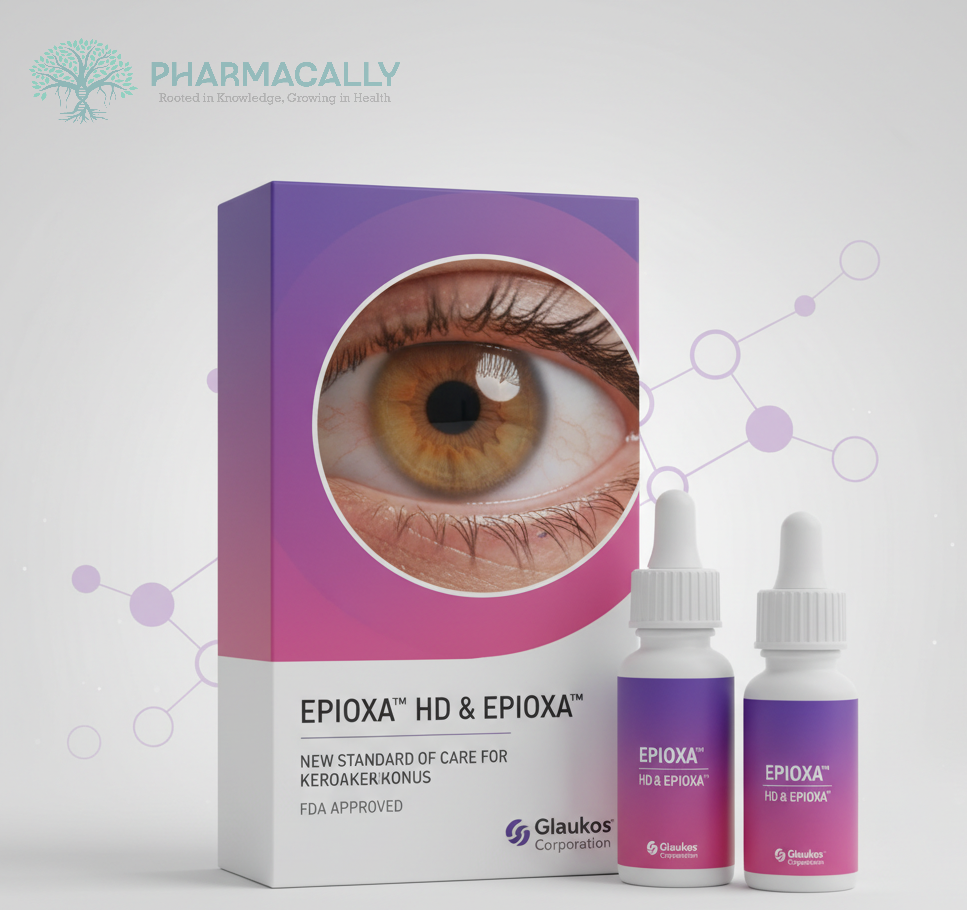
On October 20, 2025, Glaukos Corporation announced FDA approval for Epioxa™ HD 0.239% / Epioxa™ 0.177% (riboflavin 5’-phosphate ophthalmic solution), marking a significant advancement for patients with keratoconus. Epioxa represents the first FDA-approved, incision-free, topical drug therapy for keratoconus, a rare corneal disorder that can result in severe vision loss. Glaukos, a leading innovator in ophthalmic pharmaceuticals and medical devices, is the Marketing Authorization Holder for Epioxa. The therapy leverages proprietary cross-linking technology and will become commercially available in the first quarter of 2026. Glaukos solely leads development, production, and distribution of Epioxa.
About the Drug: Epioxa
Epioxa (Riboflavin 5’ Phosphate) is a groundbreaking, topical drug formulation based on riboflavin (vitamin B2) administered sequentially via two solutions Epioxa HD and Epioxa during the non-invasive, epithelium-on (epi-on) corneal cross-linking procedure. Activated by ultraviolet (UV) light in an oxygen-enriched environment, Epioxa induces cross-linking of corneal collagen fibers, aimed at halting or reducing corneal thinning and bulging, the hallmark features of keratoconus. As the only FDA-approved therapy that preserves the epithelium during cross-linking, Epioxa eliminates pain, shortens recovery, and simplifies the procedure versus traditional methods, which require removal of the corneal surface layer (epithelium).
About the Disease: Keratoconus
Keratoconus is a progressive eye disorder characterized by softening and thinning of the cornea, causing the corneal shape to change from round to cone-like. This weakens vision and, without intervention, can lead to severe visual impairment and corneal transplantation. The disease affects both adults and children current estimates suggest that about 20% of untreated keratoconus patients ultimately require corneal transplant surgery. Until now, available treatments focused on correcting vision with glasses or contacts but did not address the underlying progression.
Clinical Evidence: Trials, Endpoints, and Results
The FDA approval for Epioxa is supported by two pivotal, multicenter, randomized, double-masked Phase 3 clinical trials NCT03442751 and NCT05759559 involving over 400 patients. Both studies compared Epioxa to placebo (sham), with the primary efficacy endpoint being the change in maximum corneal curvature (Kmax) at 12 months. Epioxa demonstrated a Kmax treatment effect of –1.0 diopter; showing clinically meaningful and statistically significant reduction in corneal steepening at one year. No patients discontinued treatment due to adverse events, and over 91% completed the 12-month protocol; the majority of adverse events were mild and transient in nature.
Safety Profile
Epioxa exhibited a favorable safety and tolerability profile in Phase 3 clinical trials. No serious ocular adverse events were reported, and there was no evidence of treatment-induced systemic effects. Importantly, unlike traditional “epi-off” cross-linking, Epioxa preserved the corneal epithelium, reducing procedure-related pain and recovery time. Corneal endothelial cell counts remained stable through 12 months, and no increase in intraocular pressure or vision-threatening complications were reported.
Expert Opinions and Implications for Public Health
Thomas Burns, Chairman and CEO of Glaukos, emphasized that Epioxa represents a new standard of care for keratoconus patients and addresses major barriers in current treatment pain and prolonged healing resulting from epithelium removal.
Experts in ophthalmology, including corneal specialists, anticipate higher patient uptake and expanded access to sight-saving therapy, particularly among younger patients and those who may have previously avoided surgical procedures. The much-needed therapeutic advance lowers risk to patients, reduces health system burdens related to surgical complications, and could help decrease the number ultimately requiring corneal transplantation.
Epioxa’s FDA approval represents a new era for keratoconus management, making treatment safer, more tolerable, and more widely accessible for adults and adolescents with this sight-threatening eye disease.
References
Glaukos Announces FDA Approval of Epioxa™, Glaukos, 20 October 2025, https://investors.glaukos.com/news/news-details/2025/Glaukos-Announces-FDA-Approval-of-Epioxa/default.aspx
Beckman KA. Epithelium-on Corneal Collagen Cross-Linking with Hypotonic Riboflavin Solution in Progressive Keratoconus. Clin Ophthalmol. 2021 Jul 7;15:2921-2932. doi: 10.2147/OPTH.S318317. PMID: 34262252; PMCID: PMC8273905.
Study to Evaluate the Safety and Efficacy of Epi-on Corneal Cross-linking in Eyes With Progressive Keratoconus, ClinicalTrials.gov ID NCT03442751, https://clinicaltrials.gov/study/NCT03442751
Highlights of prescribing information, EPIOXA HD (riboflavin 5’-phosphate ophthalmic solution) 0.239%, for topical ophthalmic use EPIOXA (riboflavin 5’-phosphate ophthalmic solution) 0.177%, for topical ophthalmic use, https://www.accessdata.fda.gov/drugsatfda_docs/label/2025/219910s000lbl.pdf