
Written By: Abhinay Wadekar, BPharm
Reviewed By: Pharmacally Editorial Team
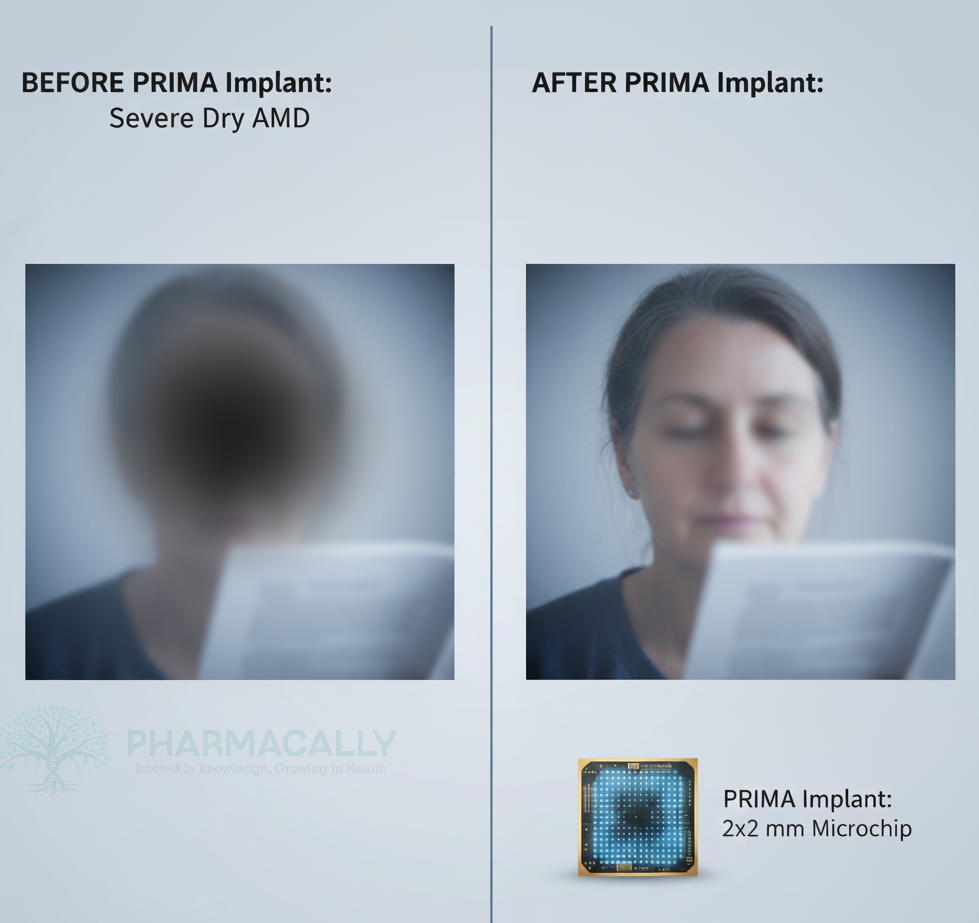
For the first time in medical history, people blinded by advanced dry age-related macular degeneration (AMD) are regaining usable central vision. A breakthrough study published in the New England Journal of Medicine reported that a bionic subretinal implant known as PRIMA has successfully restored reading and object-recognition abilities in patients with geographic atrophy (GA), the most severe stage of dry AMD. This device doesn’t only slow progression in many patients it partially restores functional central vision, allowing tasks such as reading that were previously impossible
Understanding Geographic Atrophy (GA)
Geographic atrophy is a chronic, progressive condition in which the light-sensing cells (photoreceptors) in the retina die due to AMD. As this central part of the eye deteriorates, patients lose the ability to read, recognize faces, or see directly ahead, though they often retain peripheral vision.
While treatments like complement inhibitors (such as pegcetacoplan and avacincaptad pegol) can slow down the degeneration, they can’t bring back lost sight. For millions of elderly individuals living with GA, vision rehabilitation has long been considered impossible until now.
How the PRIMA Implant Works
The PRIMA implant developed at Stanford Medicine is a tiny 2×2 mm microchip that acts as an artificial retina. It is surgically placed under the damaged area of the retina where photoreceptors once worked. The system pairs with a set of augmented reality (AR) glasses that project visual scenes as near-infrared patterns onto the implant.
Each pixel in the implant acts a miniature solar cell it converts the light signal into electrical impulses that stimulate surviving retinal cells. The brain then decodes these signals, recreating visual perception.
Patients essentially see with their own eyes again, using a combination of this artificial central vision and their remaining natural peripheral vision. Over time, the brain learns to merge the two, similar to how people adapt to cochlear implants for hearing.
The implant works through photovoltaic stimulation, using safe, near-infrared pulses that mimic natural light processing in the retina. These pulses trigger the surviving retinal neurons which are often still functional even after photoreceptor loss to send messages to the brain’s visual cortex.
Advanced modeling and simulations have shown that smaller, high-density electrodes (like those in the PRIMA chip) produce stronger and more focused stimulation. Early results show clinically meaningful acuity improvements; modeling and future device refinements could further improve acuity toward levels like 20/100, but this remains a projection.
The Clinical Study Details
Researchers from Europe, Israel, and the U.S. enrolled 38 patients aged 65–85 with advanced GA in this multicenter Phase II trial (ClinicalTrials.gov number NCT04676854). In this trial the vision of patients with GA and a visual acuity of at least 1.2 logMAR were assessed with PRIMA glasses and without PRIMA glasses at 6 and 12 months. The implant was placed below the fovea in one eye, followed by visual rehabilitation using the paired AR glasses for several months.
Primary endpoints included significant improvement in visual acuity (defined as ≥0.2 logMAR) from baseline to 12 months after implantation and confirming safety and device performance.
Key Clinical Results
At 12 months, 80% of participants demonstrated clinically meaningful improvement in visual acuity, with a mean gain of 25.5 ETDRS letters (over five lines). Moreover, 84% could read letters, numbers, or words, restoring functional reading ability. Notably, peripheral vision remained unaffected, enabling patients to simultaneously use prosthetic central vision and natural peripheral sight for orientation and navigation. Participants reported substantial improvement in daily activities such as reading text and identifying signs.
Results are at 12 months; longer-term durability, broader patient selection, and regulatory approvals remain to be established.
Safety and Tolerability
The procedure was generally well tolerated, but several participants experienced surgery-related complications. Reported serious adverse events included retinal detachment, choroidal neovascularization, vitreous hemorrhage, and transient increases in intraocular pressure. Most of these events occurred early after implantation and were successfully managed with standard ophthalmic interventions, without long-term loss of vision or systemic complications. Common non-serious effects included mild postoperative inflammation or localized bleeding that resolved within weeks. No life-threatening or systemic adverse reactions were reported, and peripheral vision in the implanted eye remained stable throughout follow-up. Continued monitoring in extended studies will clarify long-term device safety and durability.
Expert Insights and Human Perspective
Professor Frank G. Holz (University of Bonn), the lead investigator, stated that this innovation “redefines what is possible in restoring sight for patients who had lost all hope.” Researchers like Dr. José-Alain Sahel (Sorbonne Université) remarked that “seeing patients read again has been emotionally profound it’s a moment we have waited decades for.”
From Moorfields Eye Hospital, Dr. Mahi Muqit called the findings “a leap beyond stopping AMD it’s the beginning of reversing blindness.” Max Hodak, CEO of Science Corp., the company behind the PRIMA system, shared that these results confirm “neuroengineering can truly repair lost sensory systems”.
What This Means for Patients
For patients living with GA, this research opens an entirely new chapter in eye care. PRIMA doesn’t replace medical treatments like complement inhibitors it complements them. While drug therapies may slow disease, PRIMA can restore function in areas where vision is already gone.
If approved in Europe and later the U.S and other parts of the world, the implant could become a safe and relatively simple outpatient procedure that provides lasting restoration for millions affected by AMD. The long-term hope is that artificial vision could eventually reach resolutions close to natural sight, transforming independence and quality of life for elderly patients.
For decades, AMD was a one-way path toward blindness. This NEJM trial shows that, with modern bioengineering, that path may now bend back toward light. The PRIMA subretinal photovoltaic implant represents not just a technological milestone but a deeply human one offering hope.
Reference
Holz FG, Palanker D, Sahel JA, Muqit M, et al. Subretinal Photovoltaic Implant to Restore Vision in Geographic Atrophy Due to Age-Related Macular Degeneration. N Engl J Med. 2025; DOI: 10.1056/NEJMoa2501396.
Restoration of Central Vision With the PRIMA System in Patients With Atrophic AMD (PRIMAvera), ClinicalTrials.gov ID NCT04676854, https://clinicaltrials.gov/study/NCT04676854?utm_source=chatgpt.com
Eye prosthesis is the first to restore sight lost to macular degeneration, Stanford Medicine, 20 October 2025, https://med.stanford.edu/news/all-news/2025/10/eye-prosthesis.html