
Written By: Pharmacally Medical News Desk
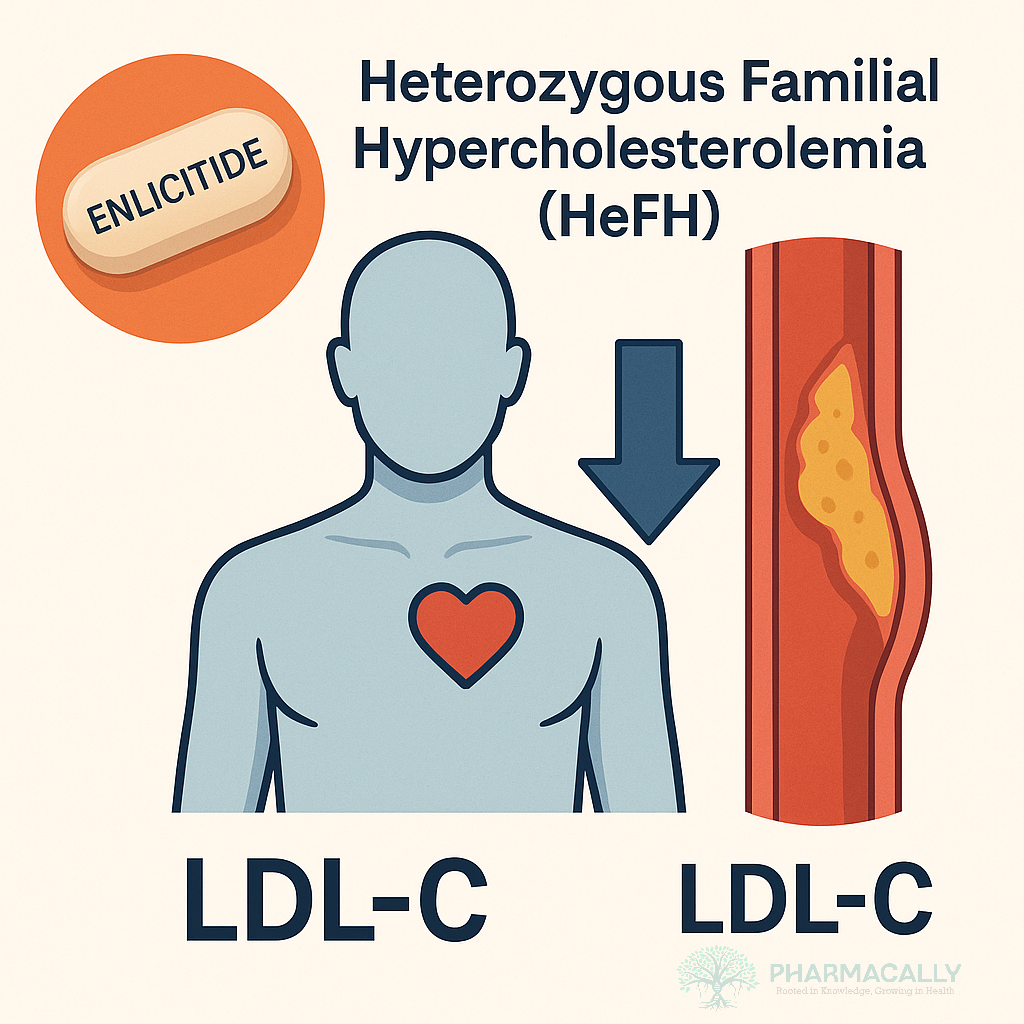
Merck recently announced highly positive results from its pivotal Phase 3 CORALreef clinical trial program evaluating Enlicitide decanoate, an investigational once-daily oral PCSK9 inhibitor. The company reported that treatment with Enlicitide decanoate led to a statistically significant and clinically meaningful reduction in low-density lipoprotein cholesterol (LDL-C) by approximately 59.4% in the primary analysis compared to placebo at 24 weeks in adults with heterozygous familial hypercholesterolemia (HeFH). These results were presented at the American Heart Association Scientific Sessions 2025 and published in JAMA.
Familial hypercholesterolemia (HeFH) is a genetic disorder leading to elevated LDL cholesterol from an early age, requiring aggressive treatment to prevent cardiovascular events. Current PCSK9 inhibitors are given by injection, leaving an unmet need for effective oral agents. Merck’s Enlicitide decanoate is the first oral PCSK9 inhibitor to reach Phase 3 success, offering new hope for patients with HeFH.
Study Design: Phase 3 CORALreef HeFH Trial
The Phase 3 CORALreef HeFH trial (NCT05952869) was a multicenter, randomized, double-blind, placebo-controlled study conducted in adults with heterozygous familial hypercholesterolemia (HeFH). Participants were required to be on stable background lipid-lowering therapy, including at least moderate- or high-intensity statins. The primary endpoint was the percent change from baseline in LDL-C at week 24. Secondary endpoints included changes in LDL-C at week 52, non-HDL cholesterol, apolipoprotein B (ApoB), lipoprotein (a) [LP (a)], and LDL-C goal attainment.
The results showed that Enlicitide decanoate led to a significant 59.4% reduction in LDL-C at 24 weeks compared to placebo (p<0.001). LDL-C reductions were noticeable as early as week 4 and were maintained through one year, with a 61.5% mean reduction versus placebo at week 52. Secondary lipid improvements at week 24 included a 53.0% reduction in non-HDL cholesterol, a 49.1% decrease in ApoB, and a 27.5% reduction in Lp(a), all statistically significant (p<0.001). Additionally, 67.3% of patients treated with Enlicitide achieved ≥50% LDL-C reduction and LDL-C levels below 55 mg/dL, compared to just 1.0% in the placebo group. The trial demonstrated durable and robust lipid-lowering effects, positioning Enlicitide as a promising oral therapy for HeFH.
Endpoint | Result (%) | Statistical Significance & Notes |
LDL-C Reduction at 24 weeks | 59.4% reduction vs placebo | 95% CI: -65.6, -53.2; p<0.001 |
LDL-C Reduction Durability | 61.5% mean reduction at 52 weeks | Sustained from week 4 through 52 weeks |
Non-HDL-C Reduction at 24 weeks | 53.0% reduction | 95% CI: -58.5, -47.4; p<0.001 |
ApoB Reduction at 24 weeks | 49.1% reduction | 95% CI: -54.0, -44.3; p<0.001 |
Lp(a) Reduction at 24 weeks | 27.5% reduction | 95% CI: -34.3, -20.6; p<0.001 |
LDL-C Goal Attainment at 24 weeks | 67.3% of patients achieved ≥50% reduction and <55 mg/dL LDL-C | Versus 1.0% in placebo group |
Safety Data
Enlicitide decanoate demonstrated a favorable safety profile in the Phase 3 CORALreef HeFH trial. The overall frequency of adverse events was similar for Enlicitide and placebo-treated patients, with most events being mild to moderate in severity. Serious adverse events (SAEs) occurred at comparable rates in both groups, with no new safety signals or unexpected safety issues reported. The rate of treatment discontinuations due to adverse events was low and similar between Enlicitide (2.0%) and placebo (3.0%), underscoring good treatment tolerability. Laboratory assessments and vital sign monitoring revealed no clinically meaningful abnormalities attributed to Enlicitide.
About Enlicitide decanoate
Enlicitide decanoate, formerly known by the clinical stage identifier MK-0616, was discovered and developed by Merck/MSD as the first-in-class oral macrocyclic peptide PCSK9 inhibitor to reach successful Phase 3 development for hypercholesterolemia and HeFH populations. As a macrocyclic peptide optimized for oral bioavailability, Enlicitide is formulated as a once-daily tablet, aiming to deliver injectable-like LDL-C lowering efficacy with the convenience of an oral dosage form. A key advantage over other PCSK9-targeting drugs is its effective once-daily oral administration that removes the need for injections while achieving antibody-comparable LDL-C reductions in late-stage studies.
Enlicitide exerts its mechanism of action by specifically binding to the LDL receptor–binding domain of PCSK9 with high affinity, in the sub-nanomolar to low-nanomolar range. By binding to PCSK9, Enlicitide blocks the PCSK9–LDLR interaction, preventing the lysosomal degradation of LDL receptors. This inhibition preserves and increases the recycling and availability of LDL receptors on hepatocyte surfaces, enhancing the clearance of circulating LDL-C from the blood.
Key Opinions
Dr. Dean Y. Li, president of Merck Research Laboratories, highlighted that the CORALreef HeFH study showed significant and sustained reductions in LDL-C, ApoB, non-HDL-C, and Lp(a) over one year in adults with HeFH on stable lipid-lowering therapy. Dr. Christie M. Ballantyne, lead author and Baylor College of Medicine professor, stated enlicitide addresses unmet needs in HeFH, offering efficacy comparable to injectable PCSK9 antibodies as a promising oral option to help patients reach LDL-C goals and reduce cardiovascular risk.
References
Merck’s Enlicitide Decanoate, an Investigational Oral PCSK9 Inhibitor, Significantly Reduced LDL-C in Adults with Heterozygous Familial Hypercholesterolemia (HeFH) in Phase 3 CORALreef HeFH Trial, Merck, 09 November 2025, https://www.merck.com/news/mercks-enlicitide-decanoate-an-investigational-oral-pcsk9-inhibitor-significantly-reduced-ldl-c-in-adults-with-heterozygous-familial-hypercholesterolemia-hefh-in-phase-3-coralreef-hefh-tr/
A Study of Enlicitide Decanoate (MK-0616 Oral PCSK9 Inhibitor) in Adults With Heterozygous Familial Hypercholesterolemia (MK-0616-017) CORALreef HeFH, ClinicalTrials.gov ID NCT05952869, https://clinicaltrials.gov/study/NCT05952869
Ballantyne CM et al, Efficacy and Safety of Oral PCSK9 Inhibitor Enlicitide in Adults With Heterozygous Familial Hypercholesterolemia: A Randomized Clinical Trial. JAMA, 2025 Nov 9:e2520620. Doi: 10.1001/jama.2025.20620. Epub ahead of print. PMID: 41206969; PMCID: PMC12598580.