
Written By: Pharmacally Medical News Desk
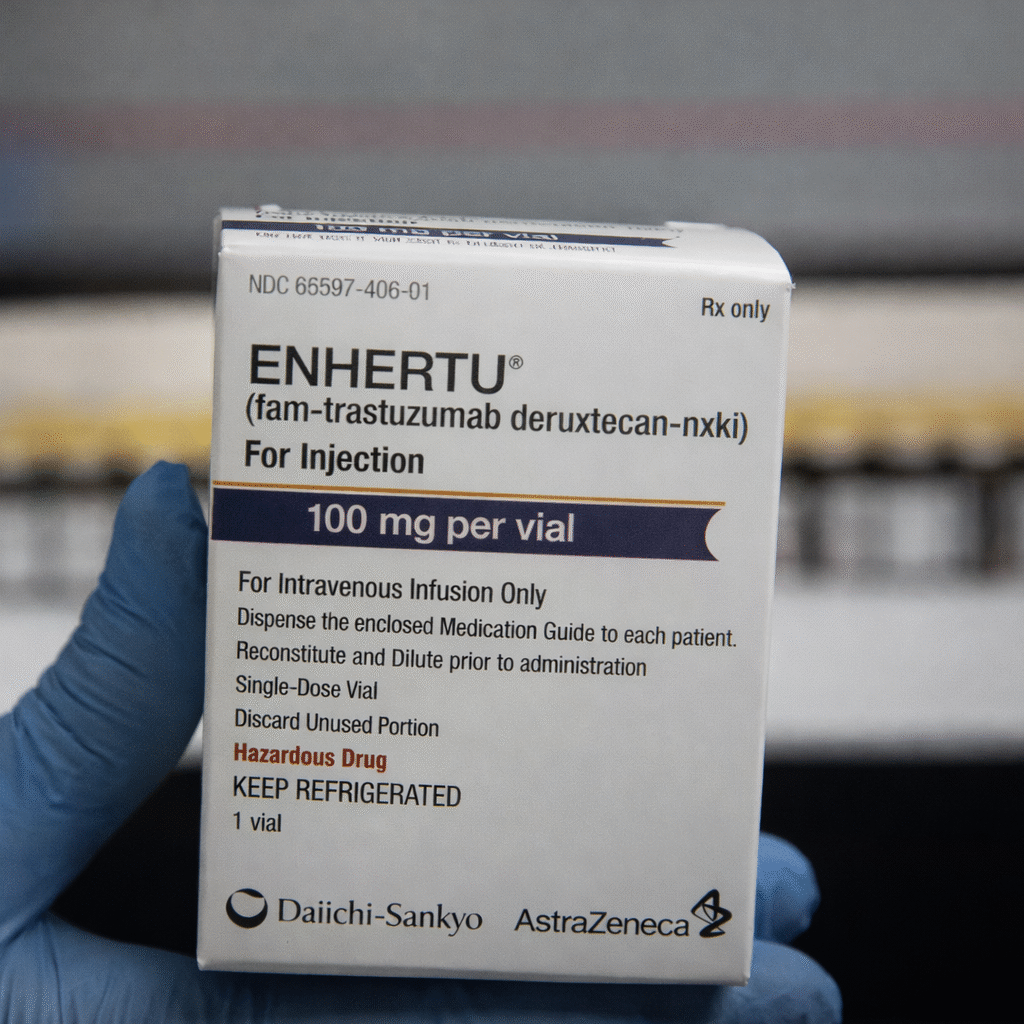
China has approved ENHERTU (trastuzumab deruxtecan, 5.4 mg/kg intravenously every 3 weeks) for adults with unresectable or metastatic hormone receptor positive breast cancer who have HER2-low or HER2-ultralow tumors and whose disease progressed after one or more endocrine therapies. This decision expands treatment possibilities for a large group of patients who previously had limited targeted options. The approval is supported by the DESTINY-Breast06 phase 3 trial, which showed clear benefits over chemotherapy in delaying disease progression and improving response.
Michio Hayashi, China President, Daiichi Sankyo, said that ENHERTU is the first HER2-targeted option in China for patients with HER2-low or ultralow metastatic breast cancer, and that its fifth approval in under three years shows the company’s commitment to expanding access to this therapy for more patients who could benefit.
The approval is based on results from DESTINY-Breast06 trial (NCT04494425), presented at ASCO 2024 and published in the NEJM. In chemotherapy-naïve patients with HR-positive, HER2-low metastatic breast cancer, ENHERTU reduced the risk of progression or death by 38 percent compared with chemotherapy (HR 0.62). Median progression-free survival reached 13.2 months versus 8.1 months with chemotherapy. The confirmed response rate was 56.5 percent for ENHERTU compared with 32.2 percent for chemotherapy.
Among patients with HER2-ultralow disease, median progression-free survival was also 13.2 months versus 8.3 months with chemotherapy, and response rates favoured ENHERTU. Although this subgroup was not powered for statistical significance, the treatment effect remained clinically meaningful.
The safety profile in DESTINY-Breast06 was consistent with earlier studies. The most common grade 3 or 4 adverse events included neutropenia, anaemia, fatigue, leukopenia, thrombocytopenia, nausea, and lymphopenia. Interstitial lung disease (ILD) remains an important identified risk. Grade 5 adverse events occurred in 1.4 percent of patients, including ILD in 1 percent. Treatment discontinuation due to adverse events occurred in 11.2 percent, most often due to ILD. Careful monitoring and early management of respiratory symptoms are essential in clinical practice.
Dave Fredrickson, Executive Vice President of AstraZeneca’s Oncology Hematology Business Unit, said that DESTINY-Breast06 represents an important shift by allowing more HR-positive patients to receive a HER2-targeted option. He added that the approval in China highlights the importance of testing tumors for even very low HER2 expression, since these patients may still benefit from ENHERTU after progression on endocrine therapy.
Xichun Hu, Chair Professor of the Department of Medical Oncology, Fudan University Shanghai Cancer Centre and lead investigator of the DESTINY-Breast06 trial, China explained that patients with HER2-low and ultralow breast cancer previously lacked targeted options because they were grouped as HER2-negative. He noted that DESTINY-Breast06 shows, for the first time, that a precision therapy like ENHERTU can benefit this underserved group, representing a meaningful scientific step and expanding access to antibody-drug conjugate treatment for more patients.
ENHERTU continues to be studied across multiple HER2-targetable cancers as monotherapy and in combination with other agents. The clinical development program includes ongoing confirmatory and exploratory trials across breast, lung, gastric, and other solid tumors. With the DESTINY program advancing, future directions will likely explore earlier-line therapy, refined patient selection, and optimized safety management, particularly for ILD.
References
ENHERTU® Approved in China as First HER2 Directed Medicine for Patients with HER2 Low or HER2 Ultralow Metastatic Breast Cancer Following Disease Progression After One or More Endocrine Therapies, 25 December 2025, https://www.daiichisankyo.com/files/news/pressrelease/pdf/202512/20251225_E.pdf
Study of Trastuzumab Deruxtecan (T-DXd) vs Investigator’s Choice Chemotherapy in HER2-low, Hormone Receptor Positive, Metastatic Breast Cancer (DB-06), ClinicalTrials.gov ID NCT04494425, https://clinicaltrials.gov/study/NCT04494425
Bardia A et al, Trastuzumab Deruxtecan after Endocrine Therapy in Metastatic Breast Cancer. N Engl J Med. 2024 Dec 5;391(22):2110-2122. Doi: 10.1056/NEJMoa2407086. Epub 2024 Sep 15. PMID: 39282896.