
Written By: Pharmacally Medical News Desk
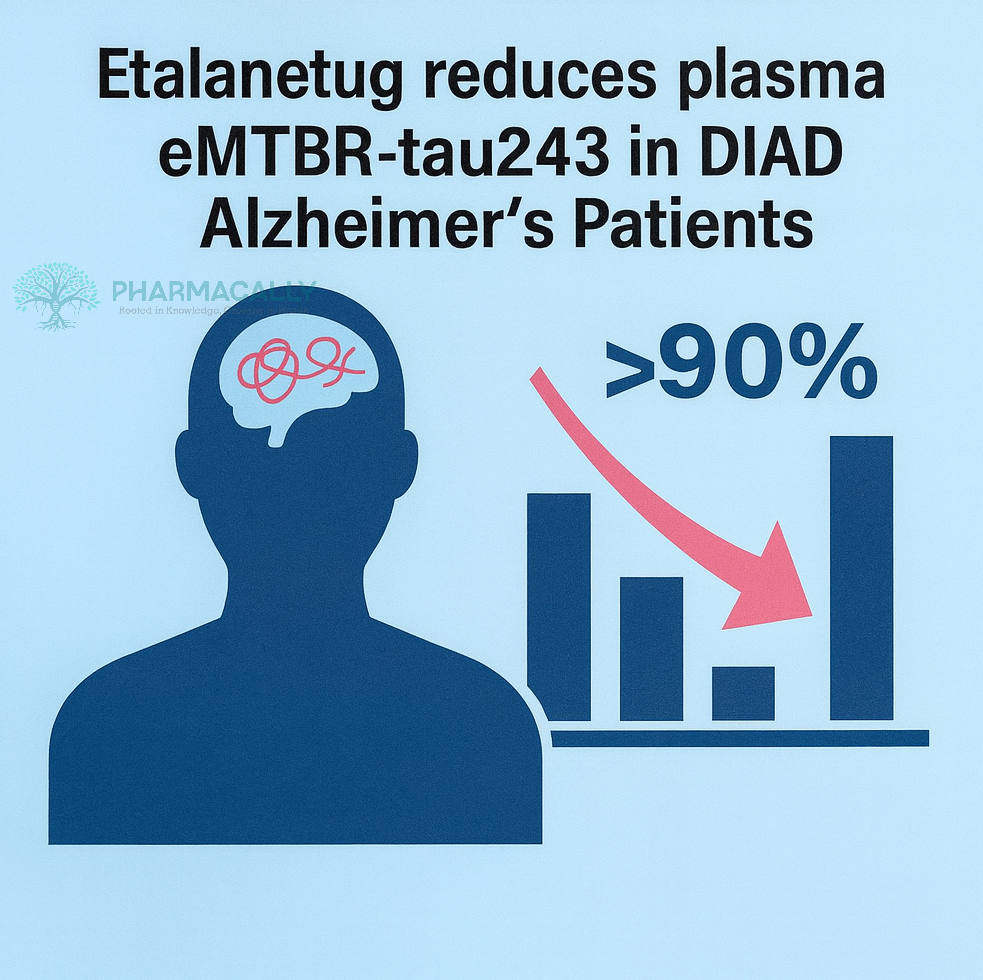
Eisai shared new Phase Ib/II results for Etalanetug (E2814), an investigational anti-tau antibody, at the 18th Clinical Trials on Alzheimer’s disease (CTAD) Conference. The data show strong reductions in the blood-based biomarker eMTBR-tau243 in people with dominantly inherited Alzheimer’s disease (DIAD). These findings support Etalanetug potential to slow the spread of tau pathology, a key driver of Alzheimer’s progression.
Etalanetug targets the microtubule-binding region (MTBR) of tau. By binding to this region, the antibody is designed to block the seeding and propagation of tau aggregates in the brain. The therapy was discovered through research collaboration between Eisai and University College London. In September 2025, the FDA granted Etalanetug Fast Track designation.
Key Phase Ib/II Findings (E2814-103 Study)
The Phase Ib/II E2814-103 trial (NCT04971733) included seven patients with DIAD, a rare, inherited form of Alzheimer’s disease.
Study results showed:
CSF eMTBR-tau243 levels
• 62% reduction at 3 months
• 89% reduction at 9 months
Plasma eMTBR-tau243 levels
• 78% reduction at 3 months
• More than 90% reduction at 9 months
Earlier tau PET scans from three participants demonstrated stable or lower PET signals, suggesting reduced accumulation of tau aggregates.
Understanding eMTBR-tau243
eMTBR-tau243 is a new biomarker that reflects brain tau pathology. It contains tau fragments around amino acid residue 243 and parts of the microtubule-binding region, with natural cleavage at the C-terminal side of residue 256.
Levels of this biomarker correlate strongly with tau PET and neurofibrillary tangle burden, making it useful for monitoring the effect of tau-targeted treatments in both DIAD and sporadic Alzheimer’s disease.
Ongoing Clinical Programs
Etalanetug is being advanced in two major trials in combination with Lecanemab (LEQEMBI), Eisai’s anti-amyloid protofibril antibody:
DIAN-TU Tau NexGen Phase II/III Trial
Led by Washington University School of Medicine
Enrolling individuals with dominantly inherited Alzheimer’s disease
Lecanemab used as standard-of-care backbone therapy
Phase II Study 202
Targeting early sporadic Alzheimer’s disease
Evaluates Etalanetug on top of Lecanemab
These trials build on Etalanetug encouraging safety, pharmacokinetics, and strong biomarker engagement demonstrated in the DIAD population.
About Dominantly Inherited Alzheimer’s Disease (DIAD)
DIAD is a rare genetic form of Alzheimer’s caused by autosomal dominant mutations. It usually leads to symptoms such as memory loss and cognitive decline in individuals in their 30s to 50s and represents less than 1% of all Alzheimer’s cases.
References
Eisai Presents New Data on Anti-Tau Antibody Etalanetug (E2814) at CTAD 2025, Eisai Global, 02 December 2025, https://www.eisai.com/news/2025/news202583.html
A Study to Assess Safety and Target Engagement of E2814 in Participants with Mild to Moderate Cognitive Impairment Due to Dominantly Inherited Alzheimer’s disease, ClinicalTrials.gov ID NCT04971733, https://clinicaltrials.gov/study/NCT04971733