
China’s NMPA has granted conditional approval to ENHERTU followed by THP for neoadjuvant treatment of HER2-positive stage 2 (high-risk) or stage 3 breast cancer, based on DESTINY-Breast11 phase 3 results showing improved pCR rates.
Written By: Karthik Teja Macharla, PharmD
Reviewed By: Pharmacally Editorial Team
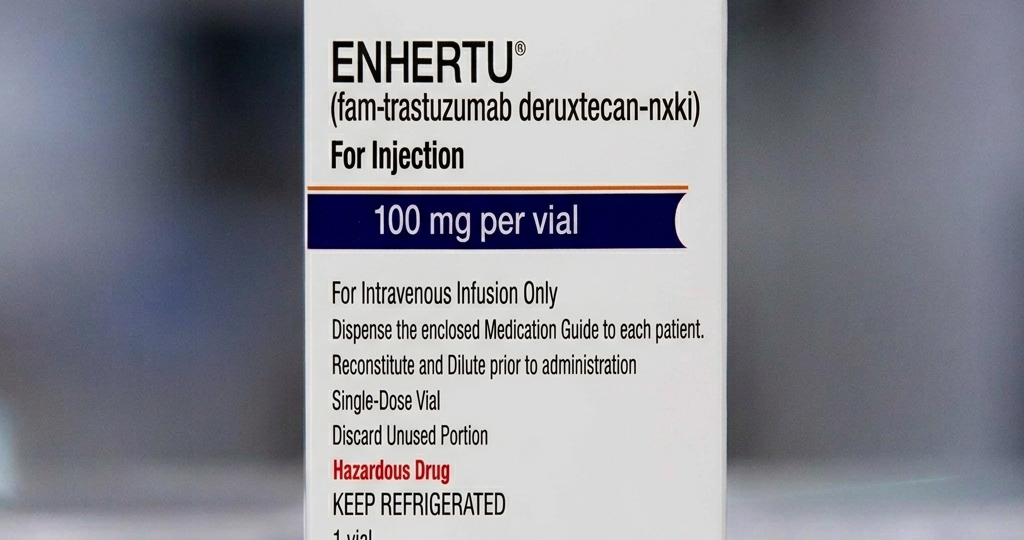
China’s National Medical Products Administration (NMPA) has granted conditional approval to ENHERTU (trastuzumab deruxtecan) followed by paclitaxel, trastuzumab and pertuzumab (THP) for the neoadjuvant treatment of adult patients with HER2-positive stage II (high-risk) or stage III breast cancer. The approval marks the first global authorization of ENHERTU in a curative-intent early breast cancer setting and the first HER2-directed antibody-drug conjugate (ADC) approved in China for this indication.
The decision is based on results from the phase 3 DESTINY-Breast11 trial (NCT05113251), where ENHERTU followed by THP demonstrated a statistically significant improvement in pathologic complete response (pCR) compared with the standard regimen of dose-dense doxorubicin and cyclophosphamide followed by THP (ddAC-THP). In the study, the pCR rate reached 67.29% with ENHERTU followed by THP versus 56.25% with ddAC-THP, representing an improvement of 11.17% (95% CI: 3.95–18.28; p=0.003).
The pCR benefit was generally consistent across prespecified subgroups, including patients with hormone receptor–positive and hormone receptor–negative disease. While the secondary endpoint of event-free survival (EFS) was not mature at the time of analysis, early immature data showed a trend favoring the ENHERTU-based regimen (HR 0.56; 95% CI: 0.26–1.17).
Safety findings from DESTINY-Breast11 were consistent with the known profiles of the individual therapies, with no new safety signals identified. Among patients receiving ENHERTU followed by THP, the most common grade 3 or 4 adverse events included neutropenia (13.8%), diarrhea (5.9%), increased transaminases (5.0%), leukopenia (4.4%), nausea (1.9%), peripheral neuropathy (1.9%) and anemia (1.6%). Grade 5 adverse reactions occurred in 0.3% of patients, including interstitial lung disease.
ENHERTU is a HER2-directed antibody-drug conjugate developed by Daiichi Sankyo and jointly developed and commercialized with AstraZeneca. The therapy combines a HER2 monoclonal antibody with a topoisomerase I inhibitor payload using Daiichi Sankyo’s DXd ADC technology.
The new indication represents the seventh approval for ENHERTU in China within three years. An application for ENHERTU followed by THP in the same neoadjuvant setting is also under regulatory review in the United States based on the DESTINY-Breast11 results.
Conditional approval in China requires confirmation of long-term clinical benefit in ongoing studies evaluating ENHERTU in patients with early or locally advanced HER2-positive breast cancer.
Reference
ENHERTU® Followed by THP Approved in China as the First and Only HER2 Directed ADC for the Neoadjuvant Treatment of HER2 Positive Breast Cancer, 27 March 2026, ENHERTU® Followed by THP Approved in China as the First and Only HER2 Directed ADC for the Neoadjuvant Treatment of HER2 Positive Breast Cancer
Trastuzumab Deruxtecan (T-DXd) Alone or in Sequence With THP, Versus Standard Treatment (ddAC-THP), in HER2-positive Early Breast Cancer, ClinicalTrials.gov ID NCT05113251, Study Details | NCT05113251 | Trastuzumab Deruxtecan (T-DXd) Alone or in Sequence With THP, Versus Standard Treatment (ddAC-THP), in HER2-positive Early Breast Cancer | ClinicalTrials.gov


About the Writer
Karthik Teja Macharla, PharmD is a Pharm.D. graduate with a strong interest in clinical research, pharmacovigilance, and medical writing. In his words, he is passionate about converting complex medical information into clear, evidence-based scientific communication, committed to contributing to patient safety and advancing healthcare through accurate and impactful medical content.