
Written By: Harshal Borhade, BPharm
Reviewed By: Pharmacally Editorial Team
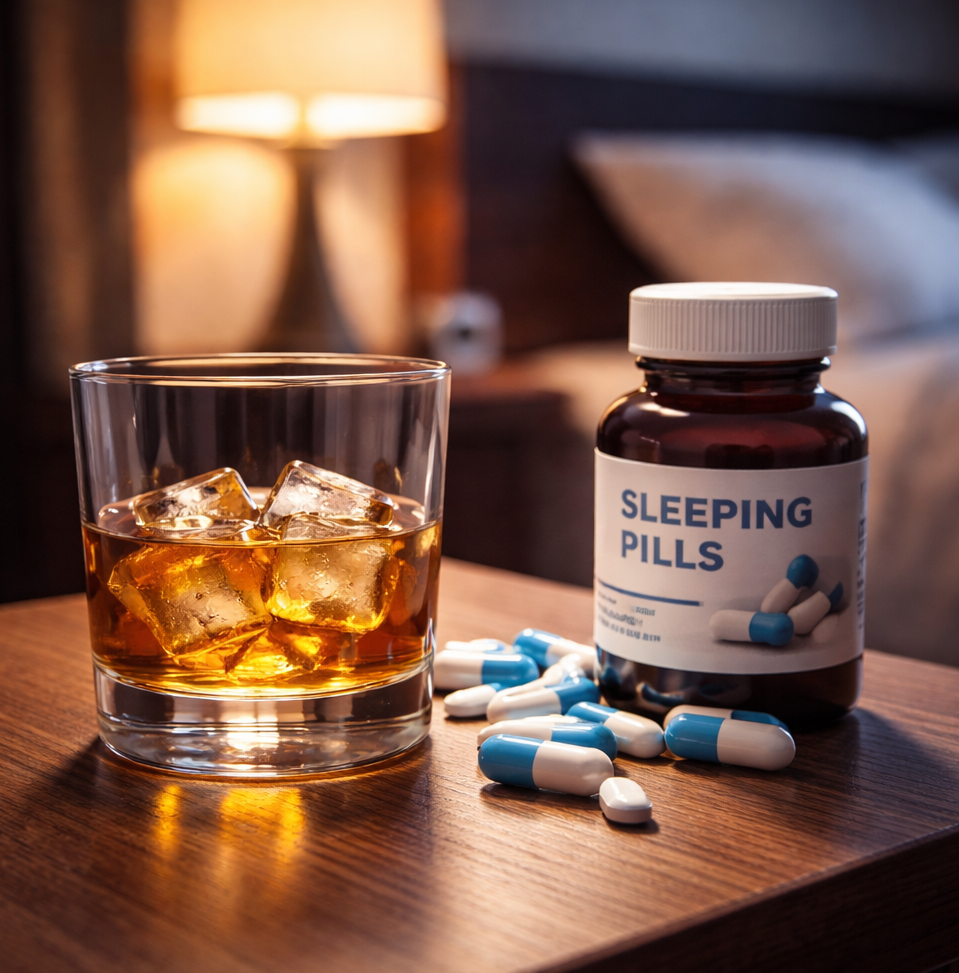
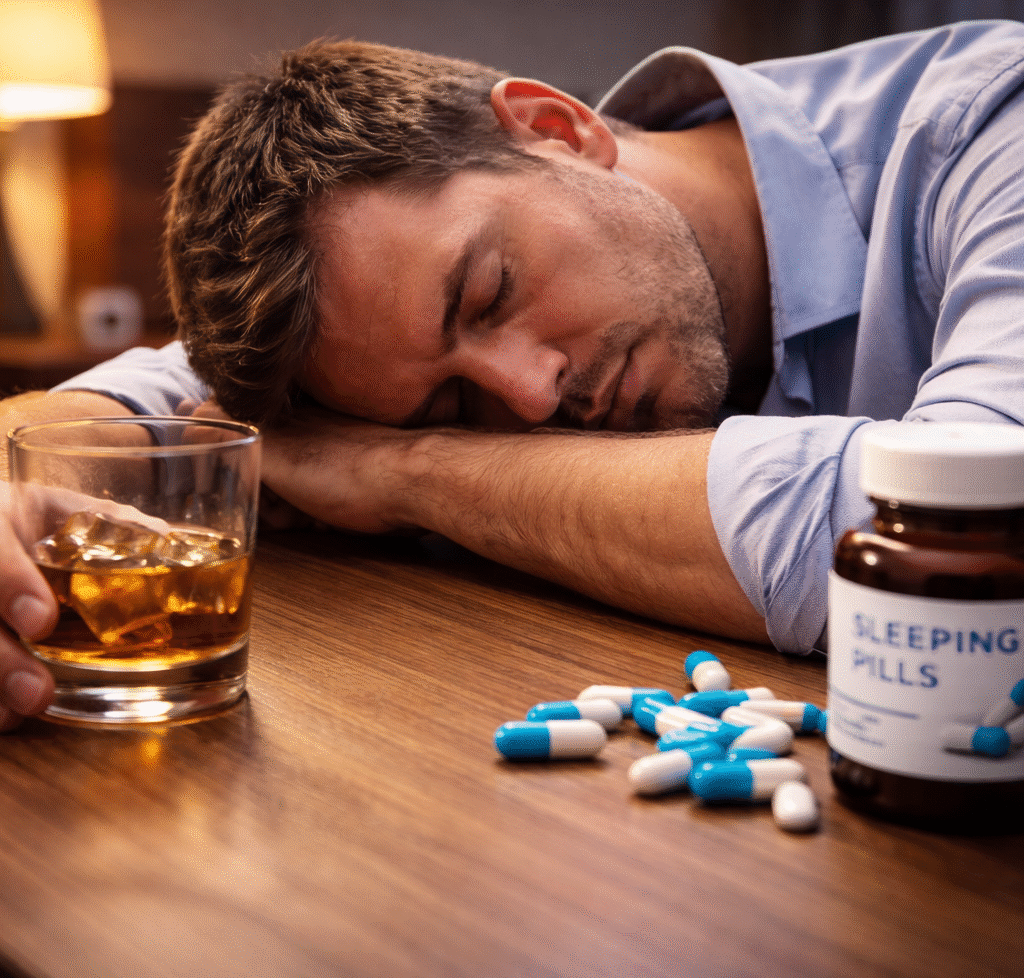
Mixing alcohol with prescription sleep medicines often makes sedation stronger and longer, and it can slow breathing, impair safe waking, and increase risks from falls, accidents, or even death. The effect is mostly due to both substances acting on the same brain systems (GABAergic inhibition), plus unpredictable differences in drug absorption and metabolism. Avoid combining them whenever possible; if you must take a sleep medicine, talk to your doctor about timing, dose, and safer alternatives.
How sleeping pills and alcohol each make you drowsy
Many prescription sleep aids, benzodiazepines, “Z-drugs” (zolpidem, zaleplon), and some older sedatives work by enhancing the brain’s GABA system. GABA is the main inhibitory neurotransmitter: when it’s boosted, neurons are less active, and you feel calmer and sleepier. Alcohol also potentiates GABA activity (and affects other systems), so both alcohol and many sleep medicines push the nervous system in the same direction. That shared action explains why the combination produces stronger sedation than either one alone.
Why alcohol makes drowsiness worse: two key mechanisms
Pharmacodynamic add-up (direct effect on the same system). Because alcohol and many sedatives both increase GABAergic inhibition, their effects add together, leading to deeper sedation, slowed thinking, and slower reflexes. This additive (and sometimes supra-additive) effect increases the risk of dangerous breathing depression and loss of protective reflexes.
Pharmacokinetic unpredictability (absorption & metabolism). Alcohol can change how quickly a drug is absorbed or cleared. For some medicines, drinking may raise peak blood levels or prolong the time the drug stays active, so a dose that’s normally safe can become excessive when combined with alcohol. The exact change depends on the drug, the amount of alcohol, and individual liver function.
Concrete risks to watch for
Oversedation and impaired cognition. More intense and prolonged drowsiness, confusion, and poor coordination—which raise fall and accident risk, especially in older adults.
Respiratory depression. When breathing slows too much, oxygen levels fall. Combining depressants can lead to dangerously slow or shallow breathing and, rarely, death. This is the most serious risk.
Complex sleep behaviors. The FDA has noted rare but serious sleepwalking, sleep driving, or other activities done while not fully awake with some insomnia drugs; alcohol increases the chance of such behaviors.
Increased overdose risk. Alcohol plus sedatives is a common pattern seen in emergency visits and fatal overdoses because their effects combine on central nervous system depression.
What the studies show
Laboratory studies and clinical reports demonstrate stronger sedation when alcohol is taken with Z-drugs like zolpidem, and with benzodiazepines; effects vary by dose and timing, but the direction is consistent—greater impairment.
Reviews of pharmacology and post-marketing data link combined use to more falls, driving accidents, hospitalizations, and some deaths—supporting conservative clinical guidance to avoid mixing.
Practical, evidence-based advice (what to do)
Don’t mix when possible. The simplest, safest rule is to avoid alcohol for at least the day you take a sedating medicine, and preferably longer if you drink heavily or take a high dose.
Timing matters, but is imperfect. Waiting several hours after drinking before taking a sleep medicine reduces risk, but “safe” timing depends on how much you drank and the drug’s half-life; there’s no single universally safe interval.
Lower-risk strategies: Prefer non-drug sleep measures first (sleep hygiene, cognitive behavioral therapy for insomnia), or short-term use of the lowest effective dose under medical supervision. Discuss alternatives with your doctors if you regularly drink alcohol.
High-risk groups: older adults, people with lung disease, those taking other sedatives or opioids, and anyone with liver problems are at much higher risk. They should be especially careful and get medical advice.
Emergency signs—when to seek help now
Get urgent medical attention or call emergency services if someone who mixed alcohol and sleeping pills becomes hard to wake, breathes slowly or irregularly, looks very pale or blue, or loses consciousness. These can be signs of life-threatening respiratory depression.
Short FAQ
Q: Is a single drink and a one-time sleep tablet dangerous?
A: Risk increases with dose and individual factors. A single small drink plus a single low dose may only cause extra drowsiness for many people, but it still raises the chance of impaired coordination and risky sleep behaviors, and it’s not advisable.
Q: Do all sleep medicines carry the same risk?
A: No. Benzodiazepines and older sedatives generally carry a higher risk when combined with alcohol than some short-acting Z-drugs, but all can be dangerous when combined with alcohol. Check your specific medicine’s label and ask your prescriber
Takeaway
Both alcohol and many sleeping pills depress the same brain systems; together they can deepen sedation, slow breathing, and produce dangerous, sometimes fatal, outcomes so avoid mixing them and talk with your clinician about safer options.
References
Alcohol-Medication Interactions: Potentially Dangerous Mixes, National Institute of Alcohol Abuse and Alcoholism, https://www.niaaa.nih.gov/health-professionals-communities/core-resource-on-alcohol/alcohol-medication-interactions-potentially-dangerous-mixes
Sleep Disorder (Sedative-Hypnotic) Drug Information, 29 June 2025, US FDA, https://www.fda.gov/drugs/postmarket-drug-safety-information-patients-and-providers/sleep-disorder-sedative-hypnotic-drug-information
Davies M. The role of GABAA receptors in mediating the effects of alcohol in the central nervous system. J Psychiatry Neurosci. 2003 Jul;28(4):263-74. PMID: 12921221; PMCID: PMC165791.
J.L. Weiner, C.F. Valenzuela, Ethanol modulation of GABAergic transmission: The view from the slice, Pharmacology & Therapeutics, Volume 111, Issue 3, 2006, Pages 533-554, https://doi.org/10.1016/j.pharmthera.2005.11.002
Schmitz A. Benzodiazepine use, misuse, and abuse: A review. Ment Health Clin. 2016 May 6;6(3):120-126. doi: 10.9740/mhc.. 2016.05.120. PMID: 29955458; PMCID: PMC6007645.
Ravinder Naik Dharavath et al, GABAergic signalling in alcohol use disorder and withdrawal: pathological involvement and therapeutic potential, Front. Neural Circuits, 20 October 2023 Volume 17 – 2023, https://doi.org/10.3389/fncir.2023.1218737
M Wallner and R W Olsen, Physiology and pharmacology of alcohol: the imidazobenzodiazepine alcohol antagonist site on subtypes of GABAA receptors as an opportunity for drug development?, British Journal of Pharmacology (2008) 154, 288–298,
https://doi.org/10.1038/bjp.2008.32
Wenyin Zhou, Xueliang Yi et al, Drug-induced respiratory depression in FDA Adverse Event Reporting System for 20 years, Hong Kong Journal of Emergency Medicine, 2025;e70033, https://doi.org/10.1002/hkj2.70033
FDA adds Boxed Warning for risk of serious injuries caused by sleepwalking with certain prescription insomnia medicines, 18 February 2022, https://www.fda.gov/drugs/drug-safety-and-availability/fda-adds-boxed-warning-risk-serious-injuries-caused-sleepwalking-certain-prescription-insomnia
FDA Drug Safety Communication: FDA warns about serious risks and death when combining opioid pain or cough medicines with benzodiazepines; requires its strongest warning, 20 September 2017, https://www.fda.gov/drugs/drug-safety-and-availability/fda-drug-safety-communication-fda-warns-about-serious-risks-and-death-when-combining-opioid-pain-or
Wilkinson CJ. The abuse potential of zolpidem administered alone and with alcohol. Pharmacol Biochem Behav. 1998 May;60(1):193-202. doi: 10.1016/s0091-3057(97)00584-4. PMID: 9610942.
Wilkinson CJ. The acute effects of zolpidem, administered alone and with alcohol, on cognitive and psychomotor function. J Clin Psychiatry. 1995 Jul;56(7):309-18. PMID: 7615484.
Sleeping Pills and Alcohol: Effects & Treatment, Alcohol.org, https://alcohol.org/mixing-with/sleeping-pills
The Effects of Mixing Zolpidem and Alcohol, Alcohol.org, https://alcohol.org/mixing-with/zolpidem