
Written By: Pharmacally Medical News Desk
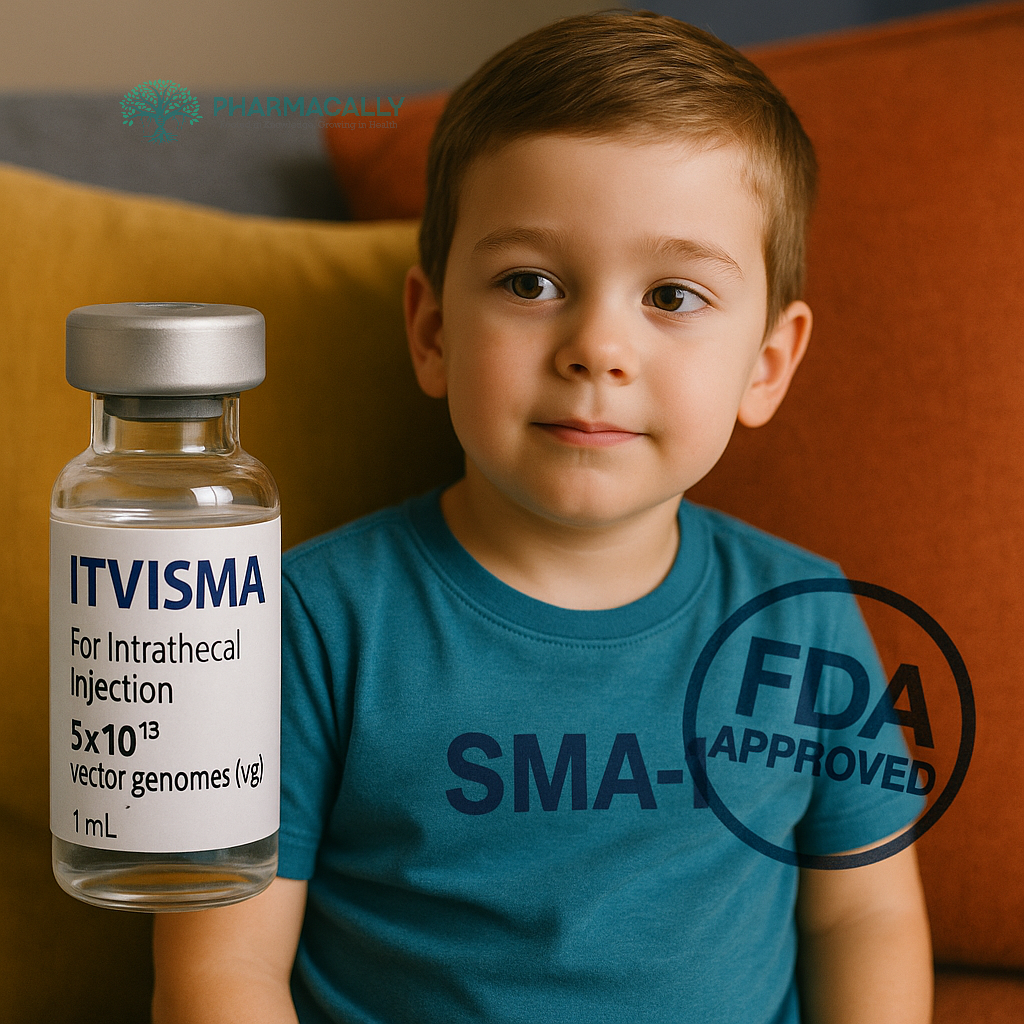
Novartis has announced that the U.S. Food and Drug Administration (FDA) has approved Itvisma (Onasemnogene Abeparvovec-brve), a gene replacement therapy for the treatment of spinal muscular atrophy (SMA) in children aged 2 years and older, teens, and adults with a confirmed mutation in the survival motor neuron 1 (SMN1) gene. This approval marks Itvisma as the first and only gene therapy available through intrathecal administration for a broad SMA population, expanding access to many patients beyond infants.
The FDA approval was primarily based on results from two Phase III clinical trials, registrational STEER (NCT05089656) and supported by the open-label STRENGTH (NCT05386680) trial. These studies demonstrated significant improvements in motor function or stabilization of motor abilities in SMA patients after a single dose of Itvisma, with effects sustained for at least 52 weeks. The therapy showed a safety profile consistent across studies, with the most common adverse events including upper respiratory tract infections, fever, and vomiting. The availability of a one-time gene therapy reduces reliance on chronic SMA treatments and may greatly improve quality of life for older children, teens, and adults living with SMA.
The FDA also confirmed that Itvisma’s efficacy and safety were supported by Phase III studies showing significant motor function improvements and stabilization in SMA patients aged 2 years and older. The active ingredient is the same as in Zolgensma (Olgesma), the intravenous form approved for children under 2, but Itvisma is administered intrathecally as a fixed dose regardless of weight. Safety profiles are comparable, with warnings for liver and heart risks retained from Zolgensma, especially in adults with preexisting conditions. This approval expands gene therapy access to older SMA patients while leveraging the established safety and efficacy data from the IV formulation.
Itvisma is an adeno-associated virus (AAV) vector-based gene therapy designed to deliver a functional copy of the human SMN1 gene directly to motor neurons through a single intrathecal injection, restoring SMN protein. This intrathecal delivery allows a fixed dose for all patients age 2 and above regardless of body weight or age, in contrast with previous intravenous SMA gene therapies. By restoring SMN protein expression in motor neurons, Itvisma addresses the genetic root cause of SMA, a neuromuscular disorder that causes progressive muscle weakness due to SMN1 gene mutations.
John W. Day, MD, PhD, Professor of Neurology and Pediatrics, and Director of the Division of Neuromuscular Medicine at Stanford University School of Medicine, said the FDA’s approval of intrathecal onasemnogene Abeparvovec is a game-changing advance expanding gene replacement therapy for SMA across age groups and opening new possibilities for neurological and genetic medicine.
Kenneth Hobby, President of Cure SMA, stated the new administration route for a single gene therapy dose means more than functional motor scale improvements it could bring greater independence and freedom in daily life.
Victor Bultó, President of Novartis US, said Itvisma’s approval helps address unmet needs across a broader SMA population with innovative one-time therapies, reducing the chronic treatment burden.
Vinay Prasad, M.D., M.P.H., Chief Medical and Scientific Officer and Director of the Center for Biologics Evaluation and Research at the FDA, stated the approval shows gene therapies’ power to treat varied SMA patients and highlights the FDA’s commitment to expediting treatments for unmet medical needs.
Itvisma is set to be released in the U.S. by December. It offers a less burdensome, transformative gene replacement approach to patients beyond infancy, who previously had limited access to gene therapy solutions. Novartis has also extended patient support program for eligible patients.
About SMA
Spinal Muscular Atrophy (SMA) is a genetic disorder caused by mutations in the SMN1 gene, leading to the loss of motor neurons and progressive muscle weakness. It affects voluntary muscles, impairing movement, breathing, and swallowing. SMA varies in severity and age of onset. SMA occurs in an estimated 4–10 out of every 10,000 live births, reflecting its status as a rare but serious genetic condition. As per FDA, before effective therapies became available, it was regarded as one of the leading genetic causes of infant mortality in the United States.
References
FDA Approves Gene Therapy for Treatment of Spinal Muscular Atrophy, 24 November 2025, US FDA, https://www.fda.gov/news-events/press-announcements/fda-approves-gene-therapy-treatment-spinal-muscular-atrophy
Novartis receives FDA approval for Itvisma®, the only gene replacement therapy for children two years and older, teens, and adults with spinal muscular atrophy (SMA), 24 November 2025, Novartis, https://www.novartis.com/news/media-releases/novartis-receives-fda-approval-itvisma-only-gene-replacement-therapy-children-two-years-and-older-teens-and-adults-spinal-muscular-atrophy-sma
Phase IIIb, Open-label, Multi-center Study to Evaluate Safety, Tolerability and Efficacy of OAV101 Administered Intrathecally to Participants with SMA Who Discontinued Treatment with Nusinersen or Risdiplam (STRENGTH), ClinicalTrials.gov ID NCT05386680, https://clinicaltrials.gov/study/NCT05386680
Efficacy and Safety of Intrathecal OAV101 (AVXS-101) in Pediatric Patients with Type 2 Spinal Muscular Atrophy (SMA) (STEER), ClinicalTrials.gov ID NCT05089656, https://clinicaltrials.gov/study/NCT05089656