
Written By: Pharmacally Medical News Desk
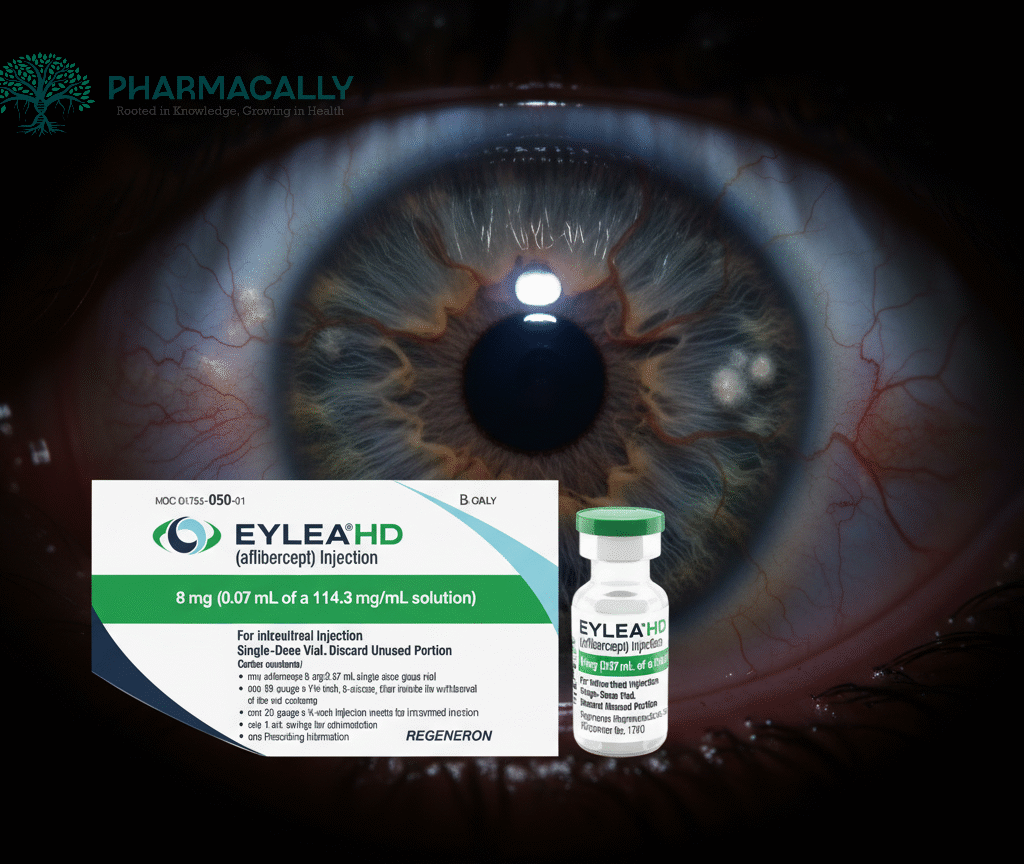
On November 19, 2025, the FDA approved EYLEA HD® (aflibercept) 8 mg for treating patients with macular edema after retinal vein occlusion (RVO), a significant milestone expanding EYLEA HD’s label and providing a new, less frequent dosing option. The approval also includes a pivotal update allowing every-4-week (monthly) dosing for some patients with all other approved indications, including wet age-related macular degeneration (wAMD), diabetic macular edema (DME), diabetic retinopathy (DR), and RVO.
Expanded Indication and Flexible Dosing
EYLEA HD 8 mg is now indicated for macular edema following RVO, joining its approvals for wAMD, DME, and DR.
The recommended dosing for RVO is monthly intravitreal injections for the first three doses, followed by dosing every 8 weeks (about once every two months), reducing treatment burden for patients.
For other indications (wAMD, DME, DR), patients can receive EYLEA HD every 8–16 weeks after initial monthly doses, though the updated label permits a return to monthly dosing if clinically warranted.
Clinical Evidence-QUASAR TRIAL
The phase 3 QUASAR trial was a large, global, double-masked, active-controlled study evaluating the efficacy and safety of aflibercept 8 mg (EYLEA HD) for patients with macular edema due to retinal vein occlusion (RVO), including central (CRVO), branch (BRVO), and hemiretinal (HRVO) subtypes. Treatment-naïve patients were randomized to receive aflibercept 8 mg injections every 8 weeks (after a loading phase of 3 or 5 monthly doses) or to standard aflibercept 2 mg injections every 4 weeks. The primary endpoint was the change in best corrected visual acuity (BCVA) from baseline at week 36, testing whether the less frequent, higher-dose regimen was non-inferior to the established monthly dosing. QUASAR met its primary endpoint, with both aflibercept 8 mg regimens showing visual acuity improvements of 17 to 19 letters, comparable to the 2 mg monthly group, but with fewer injections overall. over 88% of patients stayed on every-8-week dosing, and approximately 70% achieved dosing intervals up to every 12 weeks. Anatomic benefits were robust, with significant reductions in central retinal thickness across all RVO subtypes.
Safety Profile and Patient/Physician Instructions for EYLEA HD and EYLEA
EYLEA HD® (aflibercept 8 mg) and EYLEA® (aflibercept 2 mg) are administered by intravitreal injection into the eye and are associated with certain important safety considerations that both patients and healthcare providers must be aware of.
These therapies should not be used in patients who have an active infection in or around the eye, significant eye pain or redness, or a known allergy to any component of the injections, including aflibercept.
Injection-related risks include the potential for eye infections such as endophthalmitis, which is a serious infection inside the eye that requires urgent medical attention. Other serious but less common complications include retinal detachment (separation of the retina from the back of the eye), and rare cases of retinal vasculitis which may cause vessel blockage. Symptoms such as eye pain, redness, light sensitivity, or changes in vision after treatment should prompt immediate consultation with a physician.
Intraocular pressure (IOP) may temporarily increase within an hour after injection in some patients and sustained increased IOP has been observed with repeated dosing. Physicians typically monitor eye pressure after every injection and may prescribe medication or eye drops if needed to manage elevated pressure.
For pre-term infants receiving EYLEA for Retinopathy of Prematurity (ROP), extended monitoring for retinal health is essential because these patients can experience serious eye complications including retinal detachment and increased eye redness or pressure.
Other common side effects observed with EYLEA HD include cataracts, increased eye redness, injury to the outer eye surface, eye discomfort or irritation, bleeding at the back of the eye, blurred vision, vitreous detachment, and vitreous floaters. EYLEA shares a similar side effect profile with common effects such as eye pain, vitreous floaters, moving visual spots, and increased eye pressure. Side effects in pre-term infants are generally consistent with those seen in adults but may vary.
Patients should be advised about the possibility of temporary visual disturbances following injection and during associated eye exams. They are advised not to drive or operate machinery until vision returns to normal.
Although rare, there is a potential risk for serious systemic side effects related to blood clots, which may lead to events such as heart attack or stroke.
George D. Yancopoulos, M.D., Ph.D., co-Founder, Board Co-Chair, President and Chief Scientific Officer at Regeneron, stated that these approvals further position EYLEA HD® (aflibercept 8 mg) as a treatment of choice for certain retinal diseases and underscore Regeneron’s relentless commitment to meeting the needs of patients and retina specialists. He emphasized that EYLEA HD is the first treatment for retinal vein occlusion that can potentially cut the number of injections in half compared to existing therapies, while the new monthly dosing option across all approved indications provides physicians with greater flexibility to tailor treatment to individual patient needs.
This approval came amidst Regeneron’s ongoing efforts to resolve the FDA’s Complete Response Letter (CRL) related to manufacturing issues at its contract facility for the EYLEA HD prefilled syringe version.
About Retinal Vein Occlusion (RVO)
Retinal Vein Occlusion (RVO) is a common eye condition caused by a blockage in a vein that drains blood from the retina, leading to sudden blurry vision or vision loss in one eye. It can cause swelling and bleeding in the retina, which may result in permanent vision damage if untreated. There are two main types: Central Retinal Vein Occlusion (CRVO) and Branch Retinal Vein Occlusion (BRVO), depending on which vein is blocked. Early treatment is important to protect vision.
About Aflibercept
Aflibercept is a recombinant fusion protein used to treat several retinal conditions, including wet age-related macular degeneration and macular edema following retinal vein occlusion. Its mechanism of action involves binding and neutralizing vascular endothelial growth factor-A (VEGF-A), VEGF-B, and placental growth factor (PIGF), acting as a soluble decoy receptor. By blocking these molecules, aflibercept inhibits abnormal blood vessel growth and reduces vascular leakage in the retina, helping to control swelling and prevent further vision loss.
References
EYLEA HD® (aflibercept) Injection 8 mg Approved by FDA for the Treatment of Macular Edema Following Retinal Vein Occlusion (RVO) and for Monthly Dosing Across Approved Indications, 19 November 2025, Regeneron, https://investor.regeneron.com/news-releases/news-release-details/eylea-hdr-aflibercept-injection-8-mg-approved-fda-treatment
QUASAR, Clinical Trial Guide, VIT Buckle Academy, https://vba.vitbucklesociety.org/clinical-article/quasar
Eylea® hd (aflibercept) injection, for intravitreal use, Highlights of Prescribing Information, https://www.accessdata.fda.gov/drugsatfda_docs/label/2024/761355s006lbl.pdf
A Study to Learn How Well a Higher Amount of Aflibercept Given as an Injection Into the Eye Works and How Safe it is in People With Reduced Vision Due to Swelling in the Macula, Central Part of the Retina Caused by a Blocked Vein in the Retina (Macula Edema Secondary to Retinal Vein Occlusion) (QUASAR), ClinicalTrials.gov ID NCT05850520, https://clinicaltrials.gov/study/nct05850520
Macular edema secondary to retinal vein occlusion, Bayer, https://clinicaltrials.bayer.com/study/22153