
Written By: Pharmacally Medical News Desk
Novartis has announced positive results from its Phase III KALUMA clinical trial evaluating KLU156, also known as GanLum, an innovative next-generation malaria treatment with the potential to overcome increasing antimalarial drug resistance. The trial demonstrated that GanLum met its primary endpoint of non-inferiority compared to the current standard of care, Coartem® (artemether-lumefantrine), showing a robust PCR-corrected cure rate of 97.4% using the estimand method and 99.2% with conventional analysis, this trial marks a critical advancement in the global fight against malaria.
About GanLum (KLU156)
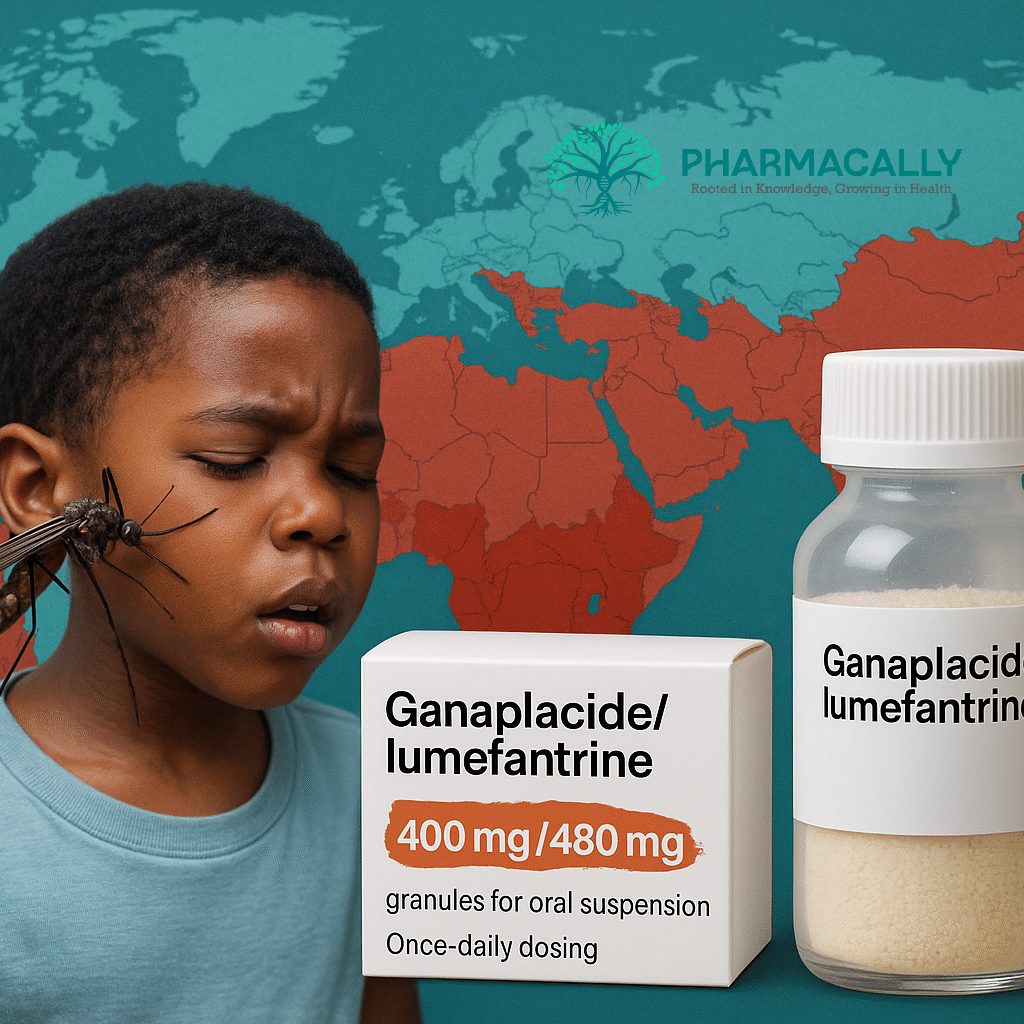
GanLum combines two compounds ganaplacide, a novel antimalarial with a unique mechanism of action, and lumefantrine, a widely used antimalarial agent redesigned into a once-daily granule formulation. Ganaplacide belongs to the imidazolopiperazine class, discovered through an extensive screening of over 2.3 million molecules at Novartis labs. It targets the malaria parasite’s internal protein transport systems essential for parasite survival within red blood cells. This novel action makes GanLum effective against resistant strains of Plasmodium falciparum, which are a growing concern for malaria control efforts globally.
KALUMA Trial
The KALUMA trial (ClinicalTrials.gov ID: NCT05842954) was a randomized, double-blind, active-controlled Phase III study conducted in 12 African countries involving 1,688 participants including adults and children with uncomplicated Plasmodium falciparum malaria. The study aimed to evaluate the efficacy and safety of once-daily KLU156 (GanLum) granules versus the standard twice-daily Coartem® (artemether-lumefantrine). The primary endpoint was PCR-corrected adequate clinical and parasitological response (ACPR) at day 28 using the estimand method. GanLum met this endpoint with a cure rate of 97.4%, demonstrating non-inferiority to Coartem. Secondary endpoints included gametocyte clearance and safety, both favorably met.
The KALUMA study not only confirmed GanLum’s high cure rate but also found it had a rapid effect on mature gametocytes the sexual stage of the parasite responsible for transmission to mosquitoes suggesting its potential to reduce malaria spread.
Safety data indicated a profile comparable to existing therapies, with adverse events consistent with malaria symptoms rather than treatment-related issues. This therapeutic advance could be the first major innovation in malaria treatment since the introduction of artemisinin-based combination therapies over 25 years ago.
As per WHO, Malaria remains a formidable public health challenge, causing an estimated 263 million cases and nearly 600,000 deaths worldwide in 2023, predominantly affecting sub-Saharan Africa’s vulnerable populations. Children under five are particularly at risk. Growing antimalarial drug resistance threatens to undermine progress, making the development of new medicines like GanLum an urgent priority. Regulatory submissions for GanLum are planned soon, supported by its Fast Track and Orphan Drug designations from the FDA, reflecting optimism for its future availability to patients.
Novartis’s commitment to malaria extends beyond GanLum. The company has provided more than 1.1 billion courses of Coartem at largely no profit and continues developing multiple novel antimalarial compounds. Partnerships with organizations like Medicines for Malaria Venture (MMV) underline the collaborative effort necessary to combat this evolving global health threat.
“GanLum could be the biggest malaria treatment breakthrough in decades, highly effective against multiple parasite forms including resistant strains,” said Dr. Abdoulaye Djimdé, Professor of Parasitology at the University of Science, Techniques and Technologies of Bamako, Mali. He emphasized the urgency as drug resistance poses a growing threat to Africa. Shreeram Aradhye, M.D., President of Development at Novartis, remarked that GanLum’s novel mechanism offers potential to both treat malaria and block transmission, aiming to fill a critical gap in care. Dr. Martin Fitchet, CEO of Medicines for Malaria Venture (MMV), called antimalarial resistance a “ticking clock” and hailed the Phase III results as a key step toward staying ahead of resistance, committing to turning this promise into real impact for patients.
In summary, the successful Phase III trial of KLU156 (GanLum) represents a potential game-changer in malaria care. By effectively killing drug-resistant parasites and possibly blocking transmission, it may help close critical gaps in treatment efficacy and contribute significantly to global malaria control and eradication efforts.
References
Novartis Phase III trial for next-generation malaria treatment KLU156 (GanLum) meets primary endpoint, with potential to combat antimalarial resistance, 12 November 2025, Novartis, https://www.novartis.com/news/media-releases/novartis-phase-iii-trial-next-generation-malaria-treatment-klu156-ganlum-meets-primary-endpoint-potential-combat-antimalarial-resistance
Efficacy, Safety and Tolerability of KLU156 in Adults and Children ≥ 5 kg Body Weight With Uncomplicated P. Falciparum Malaria (KALUMA), ClinicalTrials.gov ID NCT05842954, https://clinicaltrials.gov/study/NCT05842954
Ganaplacide-Lumefantrine SDF investigational product, RBM Case management meeting September 2024, Novartis, Available from https://severemalaria.org
Bernhards Ogutu et al, Ganaplacide (KAF156) plus lumefantrine solid dispersion formulation combination for uncomplicated Plasmodium falciparum malaria: an open-label, multicentre, parallel-group, randomised, controlled, phase 2 trial, The Lancet Infectious Diseases, Volume 23, Issue 9, 2023, Pages 1051-1061,https://doi.org/10.1016/S1473-3099(23)00209-8