
Written By: Pharmacally Medical News Desk
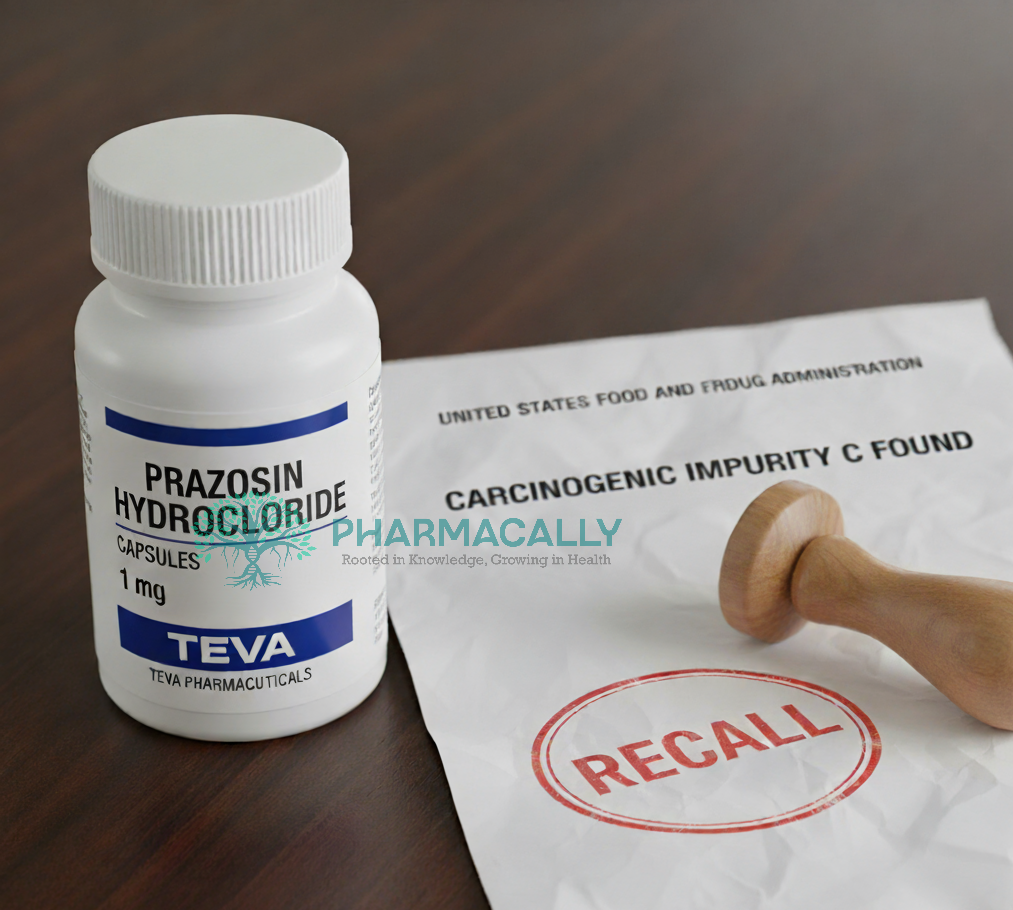
The U.S. Food and Drug Administration (FDA) has issued a significant nationwide recall of over 580,000 bottles of Prazosin Hydrochloride, a commonly prescribed medication to manage high blood pressure, due to the detection of elevated levels of a potentially carcinogenic impurity known as N-nitroso Prazosin impurity C. This impurity is part of a group of chemical compounds called nitrosamines. Nitrosamines are known to increase cancer risk when exposure occurs at excessive levels over prolonged periods, prompting urgent safety concerns.
This voluntary recall, initiated by Teva Pharmaceuticals USA alongside its distributor Amerisource Health Services, affects specific lots of Prazosin Hydrochloride capsules in 1 mg, 2 mg, and 5 mg strengths distributed nationwide. The recall was initiated following failed impurity testing confirming that the levels of N-nitroso Prazosin impurity C in these lots exceeded the acceptable intake limits as per the FDA’s Carcinogenic Potency Categorization Approach (CPCA). The FDA classifies this recall as a Class II risk.
Background of the Recall
Teva Pharmaceuticals USA, a major manufacturer of Prazosin Hydrochloride, initiated the recall after routine testing detected nitrosamine impurities in their products that exceeded the acceptable intake limits set by the FDA’s Carcinogenic Potency Categorization Approach (CPCA). The implicated impurity, N-nitroso Prazosin impurity C, is a known group of nitrosamines, which can form during drug synthesis or storage and are associated with increased cancer risk.
Why Was the Recall Activated?
The recall was triggered because the impurity levels in multiple lots of Prazosin capsules including 1 mg, 2 mg, and 5 mg doses surpassed the FDA’s safety threshold. Although nitrosamines naturally occur in some foods and water, prolonged exposure to higher than acceptable levels in pharmaceuticals raises significant health concerns, particularly regarding carcinogenicity.
Affected Products
The affected bottles involve several lots from Teva Pharmaceuticals and distribution partners, with specific lot numbers and expiration dates listed on the FDA’s official recall announcements. The products include:
Prazosin Hydrochloride 1 mg, 2 mg, and 5 mg capsules
Bottles containing between 100 and 1,000 capsules, with some lots affected by levels exceeding the CPCA limits
Table: Grouped Lot Numbers and Bottle Sizes of Prazosin Hydrochloride by Dosage Strength
Strength (mg) | Lot Numbers | Bottle Sizes (Capsules) |
1 mg | 3010544A, 3010545A, 3010567A, 3010590A, 3010601A, 3010602A, 3010603A, 3010652A, 3010670A, 3010671A, 3010678A, 3010700A, 3010701A, 3010440A, 3010672A | 100, 1000 |
2 mg | 3010398A, 3010399A, 3010400A, 3010401A, 3010439A, 3010526A, 3010527A, 3010591A, 3010343A, 3010352A, 3010353A, 3010388A, 3010468A, 3010469A, 3010629A, 3010653A, 3010654A, 3010679A, 3010702A, 3010547A, 3010461A, 3010402A, 3010610A | 100, 1000 |
5 mg | 3010403A, 3010385A, 3010404A, 3010405A, 3010510A, 3010528A, 3010354A, 3010592A, 3010605A, 3010611A, 3010612A, 3010655A, 3010703A, 3010430A, 3010613A, 3010406A | 100, 250, 500 |
Recall Classification
The recall classification by the FDA for the Prazosin Hydrochloride affected lots is a Class II recall. This classification indicates a situation where the product may cause temporary or medically reversible health issues, such as an increased risk of cancer due to carcinogenic impurities, but the likelihood of serious adverse health consequences is low. The FDA emphasizes that affected lots contain elevated levels of N-nitroso Prazosin impurity C, which exceeds the acceptable safety threshold, prompting the recall for public safety.
Health Risks and Recommendations
The FDA categorized this recall as a Class II risk, indicating that exposure may cause temporary or reversible health effects, but serious harm is unlikely. Nonetheless, consumers who use Prazosin Hydrochloride are advised not to discontinue the medication abruptly but to consult their healthcare providers for guidance.
Patients should:
Check whether their medication lot number matches the affected lots listed in the recall.
Contact their pharmacy or healthcare provider to discuss alternatives or re-confirm safe medication options.
Avoid using the recalled bottles and dispose of them properly as instructed by local health authorities or pharmacists.
Manufacturer and Regulatory Agency Response
Teva Pharmaceuticals and distributors have initiated a voluntary recall as a precautionary measure. The FDA continues to monitor the situation closely, emphasizing the importance of assessing long-term exposure risks to nitrosamines and maintaining rigorous testing standards for pharmaceuticals.
About Prazosin
Prazosin is an alpha-1 adrenergic receptor antagonist widely used to treat high blood pressure (hypertension), benign prostatic hyperplasia (BPH), and nightmares associated with post-traumatic stress disorder (PTSD). It relaxes smooth muscle in blood vessels, prostate, and other tissues, leading to vasodilation and improved urine flow in BPH cases.
References
Enforcement Report, Prazosin Hydrochloride, Capsules, USP, 2 mg, Rx only, Distributed by TEVA PHARMACEUTICALS USA, Recall No. D-0105-2026 https://www.accessdata.fda.gov/scripts/ires/?Product=216512
FDA recalls more than 580,000 bottles of blood pressure medicine after finding cancer-causing impurity, 30 Oct 2025, Livemint, https://www.livemint.com/us/trending/fda-recalls-more-than-580-000-bottles-of-blood-pressure-medicine-after-finding-cancer-causing-impurity-11761832334303.html
Determining Recommended Acceptable Intake Limits for N-nitrosamine Impurities in Pharmaceuticals: Development and Application of the Carcinogenic Potency Categorization Approach, 10 Jan 2025, US FDA, https://www.fda.gov/drugs/spotlight-cder-science/determining-recommended-acceptable-intake-limits-n-nitrosamine-impurities-pharmaceuticals
Recalls Background and Definitions, 31 July 2014, US FDA, https://www.fda.gov/safety/industry-guidance-recalls/recalls-background-and-definitions