
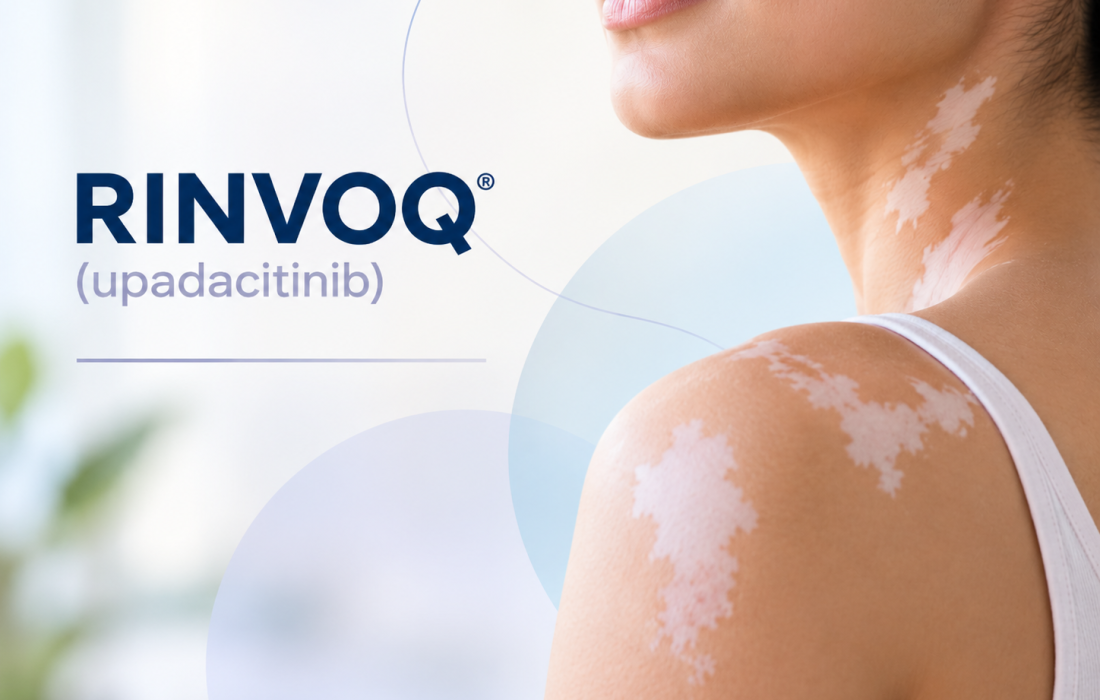
AbbVie’s RINVOQ (upadacitinib) gains FDA approval for nonsegmental vitiligo in patients aged 12 and older, supported by positive Phase 3 Viti-Up results.
Written By: Sravani Pamanji, PharmD
Reviewed By: Pharmacally Editorial Team
AbbVie announced on November 23, 2026, that the U.S. Food and Drug Administration has approved RINVOQ® (upadacitinib) 15 mg once daily for adults and pediatric patients aged 12 years and older with nonsegmental vitiligo (NSV). The approval introduces the first and only FDA-approved systemic therapy for this chronic autoimmune skin condition in the United States.
The decision is supported by findings from the Phase 3 Viti-Up clinical program, in which upadacitinib demonstrated statistically significant improvements in facial and total-body repigmentation compared with placebo at Week 48. Further improvements were observed through Week 76 among patients continuing treatment in the open-label extension.
Nonsegmental Vitiligo: Understanding the Disease and Treatment Need
Vitiligo is a chronic autoimmune condition in which the immune system targets melanocytes, the cells responsible for skin pigmentation. Nonsegmental vitiligo, the most common form, typically presents as symmetrical patches of depigmented skin across different body regions.
The disease can progress unpredictably, even after prolonged periods of stability. Beyond visible pigment loss, it can affect patients’ emotional well-being and quality of life. Existing treatments have largely focused on individual affected areas, making systemic treatment an important option for patients with more extensive disease.
Phase 3 Viti-Up Clinical Program: Study Design
The FDA approval was supported by two replicate, independent, randomized, double-blind, placebo-controlled Phase 3 studies, Viti-Up-1 and Viti-Up-2, conducted under a single clinical trial protocol (NCT06118411).
The studies evaluated upadacitinib in adults and adolescents aged 12 years and older with NSV who were eligible for systemic therapy. Participants received oral upadacitinib 15 mg once daily or placebo during the initial 48-week treatment period, followed by a 112-week open-label extension in which participants received upadacitinib.
The co-primary endpoints assessed at Week 48 were:
- F-VASI 75: At least 75% improvement in facial vitiligo from baseline.
- T-VASI 50: At least 50% improvement in total-body vitiligo from baseline.
Clinical Efficacy: Significant Repigmentation at Week 48
Both Phase 3 studies met their co-primary endpoints, demonstrating statistically significant improvements with upadacitinib compared with placebo.
In Viti-Up-1, 25% of patients receiving upadacitinib achieved F-VASI 75, compared with 6% in the placebo group. For T-VASI 50, the response rates were 19% and 6%, respectively.
In Viti-Up-2, F-VASI 75 was achieved by 23% of patients receiving upadacitinib versus 7% receiving placebo, while T-VASI 50 was achieved by 21% and 6%, respectively. All four comparisons achieved multiplicity-controlled statistical significance (p≤0.001).
An additional facial repigmentation endpoint, F-VASI 90, showed that 16% and 12% of patients receiving upadacitinib achieved at least 90% facial repigmentation in Viti-Up-1 and Viti-Up-2, respectively, compared with 2% and 3% with placebo.
Continued Repigmentation Through Week 76
Further improvements were observed among patients continuing upadacitinib during the open-label extension. At Week 76, F-VASI 75 response rates increased to 55% in Viti-Up-1 and 47% in Viti-Up-2. T-VASI 50 response rates reached 43% and 40%, respectively.
These findings were based on observed cases and were descriptive. Patients initially receiving placebo switched to upadacitinib during the extension, meaning there was no continuing placebo-controlled comparison at Week 76. Therefore, these results suggest continued improvement with treatment but do not establish a controlled estimate of long-term benefit.
Safety and Mechanism of Action
The safety profile of upadacitinib in both Viti-Up studies was generally consistent with its established profile in other approved indications, with no new safety signals reported in AbbVie’s announcement.
However, RINVOQ carries important warnings concerning serious infections, malignancies, major adverse cardiovascular events, thrombosis and increased mortality in certain at-risk populations. Patient assessment and appropriate monitoring remain important considerations.
Upadacitinib is an oral selective Janus kinase (JAK) inhibitor. Enzymatic and cellular assays demonstrate greater inhibitory potency for JAK1 than JAK2, JAK3 and TYK2. However, the relevance of inhibiting specific JAK enzymes to therapeutic effectiveness and safety is not currently known.
Clinical Interpretation
The FDA approval of RINVOQ represents an important development in nonsegmental vitiligo management, particularly for patients requiring systemic treatment. Consistent improvements across both Phase 3 studies support its efficacy in achieving facial and total-body repigmentation.
The additional F-VASI 90 findings provide evidence of substantial facial repigmentation in a subset of patients, while Week 76 results indicate that responses may continue to improve with ongoing treatment. However, the extension findings require cautious interpretation because they were descriptive and lacked a placebo-controlled comparison.
Overall, the approval introduces a new targeted systemic treatment option for adults and adolescents with NSV, addressing an important gap in the management of this chronic autoimmune disease.
References
RINVOQ® (upadacitinib) Approved as the First Systemic Therapy in the U.S. to Treat Adult and Pediatric Patients with Nonsegmental Vitiligo, AbbVie, November 23, 2026.
A Study to Assess Adverse Events and Effectiveness of Upadacitinib Oral Tablets in Adult and Adolescent Participants with Vitiligo (Viti-Up), ClinicalTrials.gov ID NCT06118411

About the Writer
Sravani Pamanji is a PharmD (LinkedIn) professional with experience in scientific writing, medical literature review, drug profile preparation, and clinical case documentation. She has contributed to scientific publication and presented at the 74th Indian Pharmaceutical Congress. Her training includes ICH GCP E6(R3), scientific research, and medication safety. She is passionate about evidence-based medical communication and accurate dissemination of clinical and pharmaceutical information.