
Oncoinvent reports favorable interim safety findings for Radspherin in its Phase 2 ovarian cancer trial, with no treatment-related serious adverse events. April 2027 efficacy results are planned.
Written By: Malavatu Satvika, PharmD
Reviewed By: Pharmacally Editorial Team
On November 17, 2026, Oncoinvent announced positive first interim safety findings from its randomized Phase 2 RAD-18-003 trial evaluating Radspherin® in patients with advanced ovarian cancer and peritoneal metastases. No serious adverse events (SAEs) were considered possibly related to Radspherin, no deaths occurred, and no adverse events led to treatment discontinuation. Following an unblinded safety review, the Independent Data Monitoring Committee (IDMC) recommended continuing the trial without protocol modification.
Treatment-Related Events Were Mild or Moderate
As of the October 30, 2026 data cut-off, 74 of a planned 102 patients had been randomized in a 2:1 ratio across 11 clinical sites in Europe and the United States to receive Radspherin plus standard of care (adjuvant chemotherapy and eligible maintenance therapy) or standard of care alone. Because randomization occurs prior to interval cytoreductive surgery, the interim safety dataset comprised 56 patients who achieved complete surgical resection (R0) and reached the post-operative assessment window 40 treated with a single 7 MBq intraperitoneal dose of Radspherin after surgery and 16 receiving standard of care alone. The remaining 18 randomized patients had either not yet undergone surgery or reached the cut-off, or did not achieve complete resection.
Among the 40 Radspherin-treated patients, 10 adverse events in five patients (12.5%) were deemed possibly related to study treatment. All 10 events were Grade 1 or 2 in severity, comprising two cases of vomiting and one case each of nausea, abdominal pain, constipation, headache, dizziness, fatigue, anemia, and decreased lymphocyte count.
The most frequently reported treatment-emergent adverse events (TEAEs) in the experimental arm were constipation, anemia, abdominal pain, nausea, and hypokalemia. Overall TEAE proportions were comparable between the two arms, with most events in the Radspherin group assessed as unrelated to treatment and consistent with underlying disease and expected post-operative recovery. However, Oncoinvent did not disclose exact arm-by-arm TEAE incidence rates, limiting precise quantitative comparison.
Independent Review Supports Trial Continuation
On November 13, 2026, the IDMC reviewed the unblinded safety dataset and recommended that RAD-18-003 proceed without modification. While this outcome confirms the absence of acute safety signals requiring dose adjustments or protocol holds at this stage, it neither establishes long-term safety nor provides evidence of clinical efficacy.
These results align with earlier clinical findings from the Phase 1 RAD-18-001 study in recurrent ovarian cancer and the Phase 1/2a RAD-18-002 study in colorectal cancer, as well as the initial six-patient safety run-in of RAD-18-003. Across prior studies, Oncoinvent observed no dose-limiting toxicities and a low rate of treatment-related SAEs at the recommended 7 MBq dose, reinforcing the tolerability profile of intraperitoneal administration.
Trial Design and Therapeutic Rationale
RAD-18-003 (NCT06504147) is a randomized, open-label, multicenter Phase 2 trial enrolling women with primary advanced, homologous recombination deficiency (HRD)-negative ovarian cancer. Following neoadjuvant chemotherapy and complete interval cytoreductive resection, eligible patients receive either a single 7 MBq intraperitoneal dose of Radspherin via an indwelling catheter 1 to 3 days post-surgery alongside standard of care, or standard of care alone. The primary endpoint is progression-free survival (PFS).
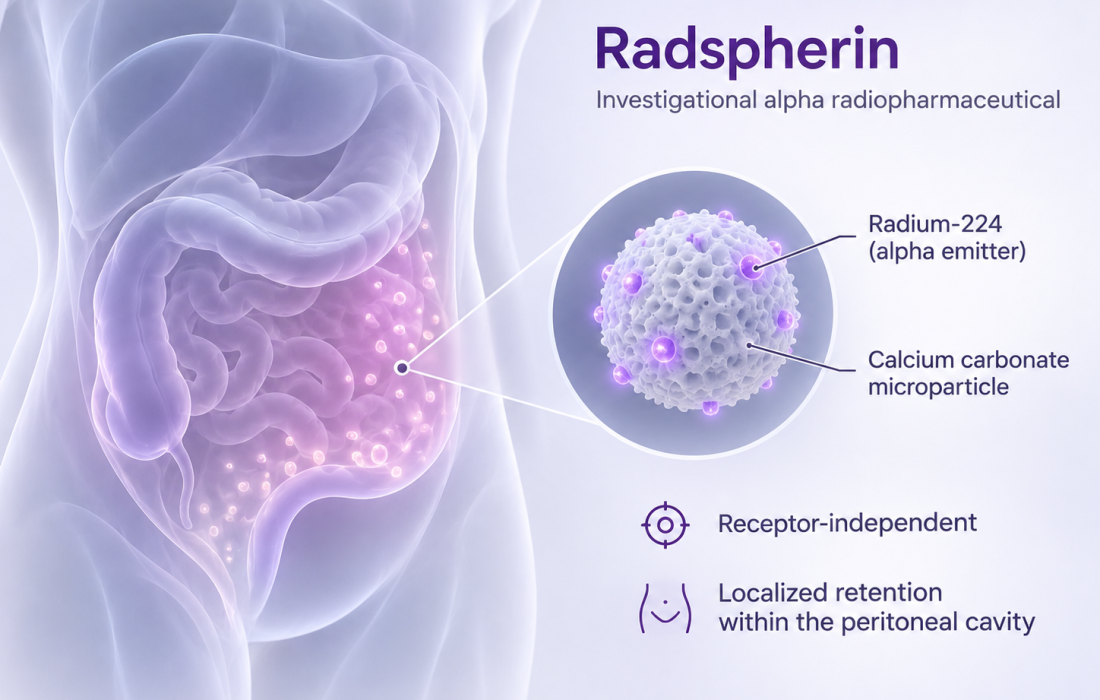
Radspherin is an investigational, receptor-independent alpha radiopharmaceutical composed of radium-224-labeled calcium carbonate microparticles. Designed for localized retention within the peritoneal cavity, the microparticles deliver short-range, high-energy alpha radiation directly to residual microscopic tumor deposits after macroscopic surgical debulking while minimizing systemic toxicity. Whether this localized radiotherapeutic mechanism translates into reduced peritoneal recurrence remains to be clinically validated.
Clinical Interpretation and Next Milestones
The interim analysis provides encouraging early tolerability data for administering Radspherin immediately following neoadjuvant chemotherapy and major cytoreductive surgery. The absence of treatment-related SAEs, fatalities, and discontinuations—paired with exclusively Grade 1–2 possibly related toxicities support continued clinical evaluation of the 7 MBq dose.
Nevertheless, the safety cohort remains modest at 56 patients (40 exposed to Radspherin). The 12.5% rate reflects only possibly treatment-related events rather than overall TEAE incidence, and comparable overall TEAE rates do not establish equivalent safety profiles. Uncommon or delayed radiation-associated toxicities could still emerge with extended follow-up.
The next key catalyst is the interim efficacy readout scheduled for April 2027, which Oncoinvent anticipates will encompass nearly all randomized participants, including approximately 40 patients with at least nine months of follow-up. Full enrollment is projected to conclude in the first half of 2027. Until comparative PFS data mature, Radspherin remains investigational and its ability to delay recurrence or improve survival outcomes cannot be determined.
References
Oncoinvent ASA. Radspherin® shows favorable safety profile in the first interim safety readout from the ongoing randomized Phase 2 trial in ovarian cancer. November 17, 2026.
A Study of Radspherin® in Patients with Primary Advanced Epithelial Cancer, With Peritoneal Metastasis That Are Homologous Recombination Proficient Scheduled to Undergo Neoadjuvant Chemotherapy and Interval Debulking Surgery, ClinicalTrials.gov ID NCT06504147

About the Writer
Malavatu Satvika (Linkedin) is a Pharm.D professional and aspiring healthcare medical writer with clinical exposure and research experience. Her interests include medical writing, drug safety, pharmaceutical research, and evidence-based healthcare communication. She has contributed to two research publications in pharmaceutical journals and has gained practical experience in prescription review, patient counselling, medication review, adverse drug reaction monitoring, drug information services, literature review, and clinical documentation through regular hospital training.
She has completed certifications in clinical research, ICH-GCP E6(R3), data management for clinical research, and congenital hypothyroidism. With a strong foundation in pharmacy, clinical practice, and scientific research, she aims to translate complex medical and pharmaceutical information into accurate, clear, and evidence-based healthcare content. She is also preparing to pursue a PhD and further develop her expertise in medical writing and pharmaceutical research.