
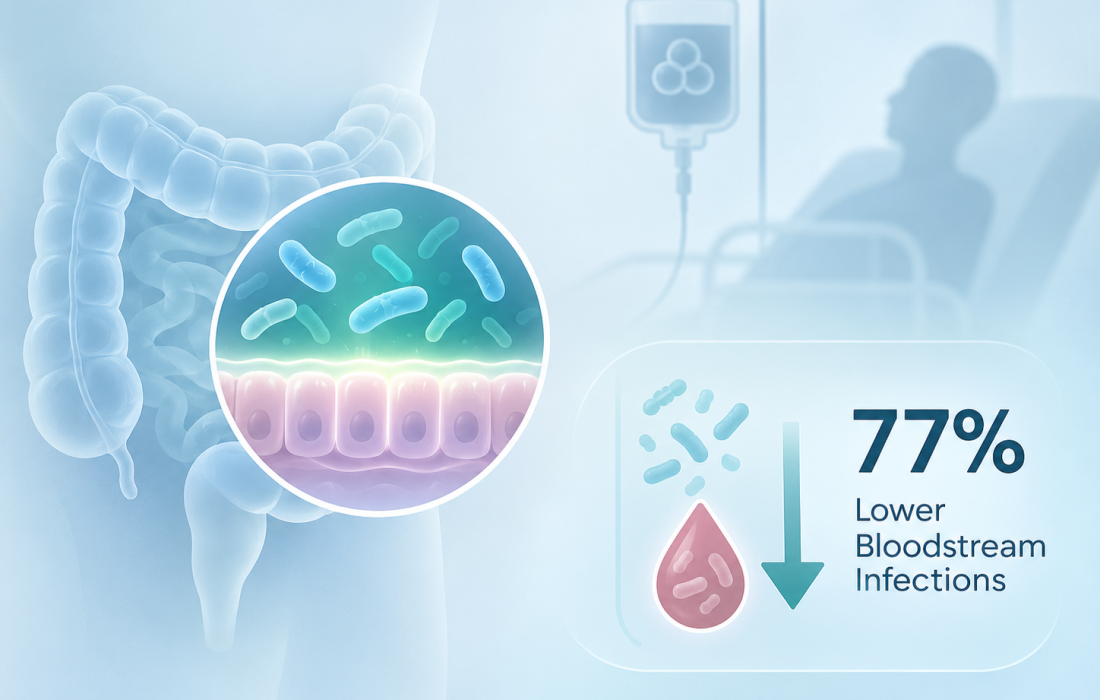
Seres Therapeutics’ SER-155 reduced bloodstream infection incidence by 77% in a Phase 1b transplant study, with lower antibiotic exposure.
Written By: Malavatu Satvika, PharmD
Reviewed By: Pharmacally Editorial Team
Seres Therapeutics’ investigational oral live biotherapeutic SER-155 was associated with a 77% relative reduction in bloodstream infections (BSIs) in adults undergoing allogeneic hematopoietic cell transplantation (allo-HCT), according to results published in Nature Medicine on November 3, 2026. The Phase 1b findings also showed lower systemic antibiotic exposure and changes in biomarkers related to gastrointestinal (GI) barrier integrity and inflammation. The results support further investigation, but do not establish efficacy in a larger transplant population.
Trial Design and Patient Population
The Phase 1b study (NCT04995653) included two cohorts. Cohort 1 was an open-label safety and pharmacology cohort involving 15 participants. Cohort 2 randomized 45 participants in a double-blind, placebo-controlled design; 34 subsequently received a transplant and were included in the reported efficacy analysis: 20 received SER-155 and 14 received placebo.
SER-155 contains 16 cultivated human-commensal bacterial strains. It is designed to restore GI colonization resistance, limit the expansion of potentially harmful pathogens, support mucosal epithelial barrier integrity and modulate inflammation. In Cohort 2, the SER-155 regimen included oral vancomycin microbiome conditioning followed by SER-155. Accordingly, the study evaluated the combined regimen, and its outcomes cannot be attributed independently to vancomycin or SER-155.
Key Results
Bloodstream infections: BSIs occurred in 2 of 20 participants receiving SER-155 (10.0%) and 6 of 14 receiving placebo (42.9%), corresponding to a 77% relative risk reduction (odds ratio 0.15; 95% CI 0.01–1.13; P=0.0423). This was the key secondary efficacy finding. Although the reported P value met the study’s significance threshold, the wide confidence interval and small number of events indicate substantial uncertainty around the estimated effect.
Systemic antibiotic exposure: Mean systemic antibiotic exposure was 9.2 days with SER-155 and 21.1 days with placebo (P=0.0494). The reduction is relevant because antibiotic exposure can further disrupt the GI microbiome. However, the study does not establish whether the shorter exposure resulted directly from fewer BSIs or from other differences in clinical management.
Febrile neutropenia and other outcomes: Febrile neutropenia occurred in 13 of 20 participants receiving SER-155 (65%) and 11 of 14 receiving placebo (78.6%). This difference was not statistically significant (P=0.4674). Other secondary efficacy outcomes, including GI infection, acute graft-versus-host disease of grade 2 or higher, and the composite of BSI, GI infection or acute graft-versus-host disease, also did not show statistically significant differences. The BSI result therefore should not be interpreted as evidence of broad protection against transplant-related infections or complications.
Microbiome and biomarker findings: Engraftment was detected for all 16 SER-155 strains, with a median of 11.5 strains detected after the first treatment course. Biomarker analyses showed a significant decrease in fecal albumin, a marker associated with GI epithelial barrier damage, alongside lower plasma biomarkers of systemic inflammation and improvements in immune-homeostasis biomarkers. These findings are consistent with the proposed biological activity, but do not prove that improved barrier integrity directly caused the reduction in BSIs.
Safety and Development Status
SER-155 was generally well tolerated, with a safety profile comparable to placebo. No treatment-related serious adverse events or infections caused by SER-155 species were reported. Diarrhea and nausea were the most common adverse events. Four participants in each cohort died during the study; none of the deaths was attributed to SER-155.
Seres reports that SER-155 has received FDA Breakthrough Therapy and Fast Track designations for development in allo-HCT and that the company has aligned with the FDA on its proposed Phase 2 protocol. The programme is Phase 2-ready, pending funding. These designations support development but do not constitute regulatory approval or confirm clinical benefit.
Clinical Interpretation
The Phase 1b study provides an encouraging signal that a microbiome-directed live biotherapeutic regimen may reduce BSI incidence and systemic antibiotic exposure in allo-HCT recipients. Strain engraftment and changes in GI barrier and inflammatory biomarkers provide translational support for the proposed approach.
The findings nevertheless require cautious interpretation. The efficacy analysis involved only 34 transplant recipients, the confidence interval around the BSI estimate was wide, and other secondary clinical outcomes were not statistically significant. In addition, because oral vancomycin conditioning was part of the SER-155 regimen, the observed effects cannot be assigned to SER-155 alone. A larger controlled Phase 2 study will be needed to test the reproducibility and clinical relevance of the BSI finding.
References
Ponce, D.M., DeFilipp, Z., Ford, C.B. et al. A live biotherapeutic product for adult allogeneic hematopoietic cell transplantation recipients: a partially randomized, placebo-controlled phase 1b trial. Nat Med (2026). https://doi.org/10.1038/s41591-026-04686-y
Seres Therapeutics Announces Publication of SER-155 Phase 1b Results in Nature Medicine Showing Reduced Bloodstream Infections in Allogeneic Hematopoietic Cell Transplantation Recipients, Seres Therapeutics, 03 November 2026

About the Writer
Malavatu Satvika (Linkedin) is a Pharm.D professional and aspiring healthcare medical writer with clinical exposure and research experience. Her interests include medical writing, drug safety, pharmaceutical research, and evidence-based healthcare communication. She has contributed to two research publications in pharmaceutical journals and has gained practical experience in prescription review, patient counselling, medication review, adverse drug reaction monitoring, drug information services, literature review, and clinical documentation through regular hospital training.
She has completed certifications in clinical research, ICH-GCP E6(R3), data management for clinical research, and congenital hypothyroidism. With a strong foundation in pharmacy, clinical practice, and scientific research, she aims to translate complex medical and pharmaceutical information into accurate, clear, and evidence-based healthcare content. She is also preparing to pursue a PhD and further develop her expertise in medical writing and pharmaceutical research.