
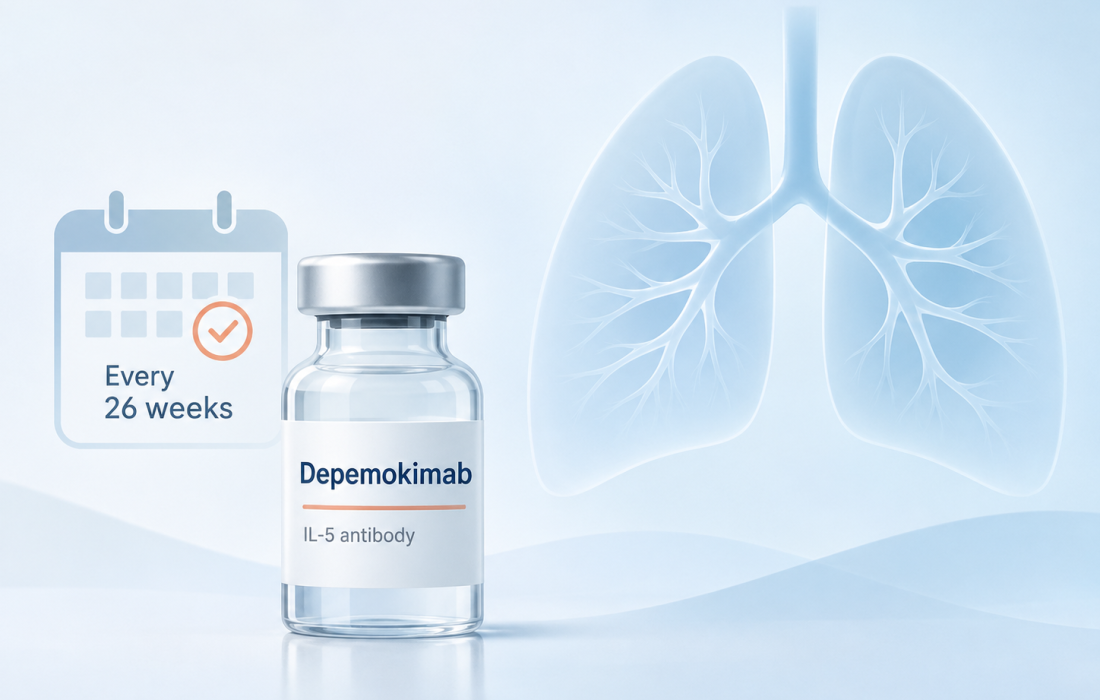
GSK reports sustained two-year efficacy and safety with twice-yearly depemokimab in severe eosinophilic asthma, based on SWIFT-1, SWIFT-2 and AGILE data.
Written By: Neha Vishwakarma, PharmD
Reviewed By: Pharmacally Editorial Team
GSK’s twice-yearly IL-5-targeting antibody depemokimab maintained reductions in asthma exacerbations and improvements in symptom control over two years in patients with type 2 asthma and an eosinophilic phenotype. The findings come from a post hoc integrated analysis of the Phase 3a SWIFT-1 and SWIFT-2 trials and their open-label AGILE extension, published in The Lancet Respiratory Medicine. The studies were funded by GSK, which markets depemokimab as Exdensur.
Addressing the Need for Longer-Lasting Asthma Treatment
Severe asthma remains difficult to control in some patients despite standard inhaled treatment. Type 2 inflammation, involving cytokines such as interleukin-4, interleukin-5 and interleukin-13, contributes to disease activity in many of these patients. Biologic therapies targeting these inflammatory pathways offer additional treatment options, although their administration schedules vary.
Depemokimab is a long-acting monoclonal antibody targeting IL-5, with enhanced binding affinity and an extended half-life that enables subcutaneous administration every 26 weeks. Its six-month dosing interval is intended to reduce treatment frequency compared with biologics requiring administration every few weeks.
The central question addressed by the integrated analysis was whether the clinical benefits observed during the initial 52-week trials could be maintained through a second year of treatment.
SWIFT-1, SWIFT-2 and AGILE Study Design
SWIFT-1 (NCT04719832) and SWIFT-2 (NCT04718103) were replicate, randomised, double-blind, placebo-controlled Phase 3a trials evaluating depemokimab in patients aged 12 years and older with severe asthma and an eosinophilic phenotype. Participants had a history of asthma exacerbations despite medium- or high-dose inhaled corticosteroids (ICS) alongside additional controller treatment.
Of 762 patients included in the pooled analysis, 502 received depemokimab 100 mg subcutaneously every 26 weeks, while 260 received placebo. Across the two trials, depemokimab reduced the annualised exacerbation rate by 54% compared with placebo (rate ratio 0.46; 95% CI 0.36–0.59).
However, neither trial demonstrated a significant between-group difference in St George’s Respiratory Questionnaire (SGRQ) scores, limiting formal statistical inference for subsequent secondary endpoints.
Patients completing the original trials could enter AGILE (NCT05243680), a 52-week, single-arm, open-label extension. Of the original 762 participants, 641 entered AGILE and 629 received at least one depemokimab dose. This included 419 patients who continued depemokimab and 210 who switched from placebo to active treatment, providing follow-up across a total period of 104 weeks.
Two-Year Efficacy Findings
In the continuous-treatment group, the annualised exacerbation rate over the integrated two-year period was 0.52 (95% CI 0.45–0.60), indicating that the reduction observed during the initial treatment period was maintained.
Patients switching from placebo also experienced improvements after initiating depemokimab. The time to first exacerbation was longer in patients receiving continuous treatment, although the difference narrowed after Week 52, when both groups received active treatment.
Improvements in patient-reported outcomes were also sustained. In the continuous-treatment group, the change from baseline in SGRQ total score reached −13.92 at Week 52 and −16.29 at Week 104. Asthma Control Questionnaire-5 (ACQ-5) scores improved by −0.81 and −0.89, respectively.
Suppression of type 2 inflammation was maintained, with blood eosinophil levels at Week 104 remaining at 17.4% of baseline. Patients switching from placebo also experienced an approximately 85% reduction in blood eosinophils after starting treatment.
Subgroup Findings Across ICS Doses and CRSwNP Status
The two-year analysis showed sustained efficacy across baseline ICS-dose groups. Annualised exacerbation rates were 0.41 among patients receiving medium-dose ICS and 0.62 among those receiving high-dose ICS.
Patients with comorbid chronic rhinosinusitis with nasal polyps (CRSwNP) had an annualised exacerbation rate of 0.45, compared with 0.54 in those without the condition. Earlier SWIFT-1 and SWIFT-2 analyses reported a 69% reduction in exacerbations among patients with CRSwNP, compared with 51% among those without it.
These findings suggest that treatment benefits were maintained across the examined subgroups. However, the relatively small CRSwNP subgroup does not establish that this condition independently predicts a greater treatment response.
Two-Year Safety Profile
Among the 419 patients in the continuous-treatment safety population, 86% experienced at least one adverse event. The most frequently reported events included COVID-19 (25%), nasopharyngitis (23%) and upper respiratory tract infections (16%).
Treatment-related adverse events occurred in 6% of patients, while serious adverse events were reported in 13%. Asthma was the only serious adverse event occurring in at least 1% of patients. Discontinuations and dose interruptions due to adverse events were each below 1%.
No treatment-related serious adverse events or fatal serious adverse events were reported. Adverse events of special interest occurred in 4%, and anti-drug and neutralising antibodies were infrequent, without an identified association with efficacy or safety.
Clinical Interpretation and Study Limitations
The findings extend the clinical evidence for depemokimab beyond the original placebo-controlled trials, demonstrating sustained exacerbation control, symptom improvements and suppression of blood eosinophils over two years. Its six-month dosing schedule may offer a practical advantage for patients facing treatment burdens associated with frequent biologic administration.
Nevertheless, the second-year findings require cautious interpretation. AGILE was open-label and lacked a placebo control, while the integrated analysis was post hoc. Extension-study participation may also have introduced selection bias, and the CRSwNP subgroup was relatively small. The findings do not establish superiority over other asthma biologics or determine the optimal sequence of biologic treatment.
GSK-funded research therefore provides encouraging evidence of sustained two-year efficacy and tolerability, while longer-term follow-up and real-world studies will be important to establish the durability of benefit and treatment adherence beyond the clinical trial setting.
Reference
Wechsler M, Pfeffer P, Bernstein D et al., Long-term safety and efficacy of twice-yearly depemokimab in type 2 asthma with an eosinophilic phenotype: 2-year integrated analysis of the phase 3a SWIFT-1 and SWIFT-2 studies and AGILE open-label extension, The Lancet Respiratory Medicine, October 2026, https://doi.org/10.1016/S2213-2600(26)00259-6
Placebo-controlled Efficacy and Safety Study of GSK3511294 (Depemokimab) in Participants with Severe Asthma with an Eosinophilic Phenotype (SWIFT-1), ClinicalTrials.gov ID NCT04719832
A Study of GSK3511294 (Depemokimab) in Participants with Severe Asthma with an Eosinophilic Phenotype (SWIFT-2), ClinicalTrials.gov ID NCT04718103
An Open-Label Extension Study of GSK3511294 (Depemokimab) in Participants Who Were Previously Enrolled in 206713 (NCT04719832) or 213744 (NCT04718103) (AGILE), ClinicalTrials.gov ID NCT05243680
About the Writer
Neha Vishwakarma (LinkedIn) is a Pharm.D professional with experience in clinical pharmacy, pharmacovigilance, and clinical research. She has hands-on experience in ADR assessment, ICSR processing, medication safety, and clinical data evaluation. Her research background in surgical site infections and antibiotic use supports her focus on evidence-based healthcare writing.