
Zamto-cel significantly improved event-free survival over R-GemOx in transplant-ineligible patients with relapsed or refractory large B-cell lymphoma in the Phase 2 DALY 2-EU trial
Written By: Anshu Gupta, PharmD
Reviewed By: Pharmacally Editorial Team
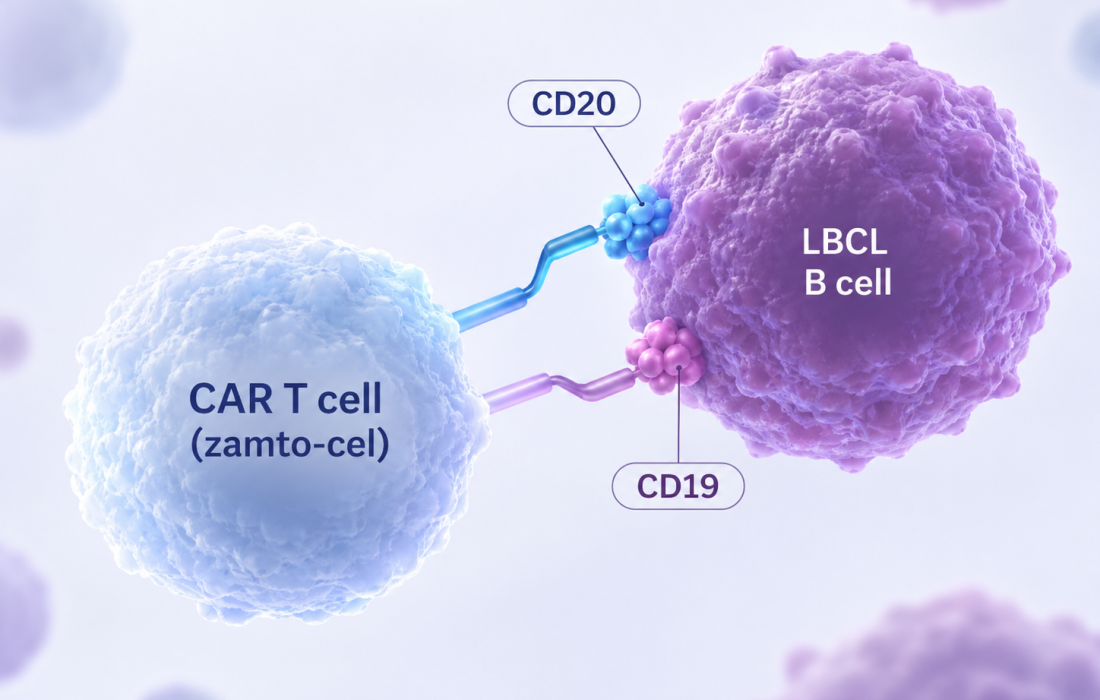
Zamtocabtagene autoleucel (zamto-cel), an investigational autologous CAR T-cell therapy targeting both CD20 and CD19, significantly improved event-free survival (EFS) compared with rituximab, gemcitabine and oxaliplatin (R-GemOx) in transplant-ineligible patients with relapsed or refractory (r/r) large B-cell lymphoma (LBCL). In the Phase 2 DALY 2-EU trial, median EFS was 6.21 months with zamto-cel versus 2.53 months with R-GemOx, corresponding to a 61% reduction in the risk of an EFS event or death.
LBCL is an aggressive form of non-Hodgkin lymphoma that can progress or relapse despite first-line chemoimmunotherapy. For patients who are ineligible for high-dose chemotherapy and autologous stem-cell transplantation, second-line treatment remains challenging. Although CD19-directed CAR T-cell therapies have established a role in relapsed or refractory LBCL, evidence in transplant-ineligible patients remains limited. Zamto-cel uses a tandem CAR construct designed to recognise both CD20 and CD19 on malignant B cells.
Published in The Lancet Oncology, the DALY 2-EU findings provide randomised Phase 2 evidence supporting dual CD20-CD19-directed CAR T-cell therapy in this patient population. However, the trial did not demonstrate a statistically significant overall survival benefit, and its R-GemOx comparator does not capture all newer treatment options. Longer follow-up and comparisons with contemporary regimens will be important to define zamto-cel’s place in second-line treatment.
Dual CD20-CD19-Targeted CAR T-Cell Therapy
Zamto-cel is a tandem CAR T-cell therapy designed to recognise two antigens expressed on B cells: CD20 and CD19. Its dual-targeting approach provides an alternative to conventional CAR T-cell therapies directed exclusively against CD19.
The treatment involves a single intravenous infusion of fresh, non-cryopreserved autologous CAR T cells at a target dose of 2.5 × 10⁶ cells/kg, capped at a body weight of 100 kg. The product is manufactured using a closed automated system with a fixed 12-day manufacturing process.
DALY 2-EU Trial Design
DALY 2-EU (NCT04844866) was an open-label, multicentre, randomised Phase 2 study conducted across 45 centres in 12 European countries. Eligible participants were adults with histologically confirmed second-line r/r LBCL who were ineligible for transplantation, had previously received anthracycline-based chemoimmunotherapy containing an anti-CD20 monoclonal antibody and had an Eastern Cooperative Oncology Group (ECOG) performance status score of 2 or lower.
Between October 14, 2021, and July 16, 2024, 219 patients were screened and 168 were randomised. The primary comparison included 82 patients assigned to zamto-cel and 78 assigned to R-GemOx. Eight additional patients were assigned to the Pola-BR comparator arm.
Patients assigned to zamto-cel received a single intravenous infusion following lymphodepleting chemotherapy, while the R-GemOx group received up to eight 14-day treatment cycles.
The primary endpoint was event-free survival (EFS), assessed by a masked independent review committee. EFS included disease progression, failure to achieve a partial or complete response by week 8 resulting in new antilymphoma treatment, or death from any cause.
Efficacy Findings
At a median follow-up of 17 months, zamto-cel demonstrated significantly longer EFS than R-GemOx. Median EFS was 6.21 months (95% CI, 3.84–13.77) compared with 2.53 months (95% CI, 1.97–3.35), respectively (HR 0.39; 95% CI, 0.27–0.58; p<0.0001), representing a 61% relative reduction in the hazard of an EFS event.
The six-month EFS rate was 54% with zamto-cel versus 21% with R-GemOx, while the 12-month rates were 41% and 12%, respectively.
The benefit extended to progression-free survival (PFS). Median PFS reached 8.51 months with zamto-cel compared with 3.35 months with R-GemOx (HR 0.43; 95% CI, 0.28–0.65; p<0.0001).
Zamto-cel also produced a higher best objective response rate (72% versus 45%) and complete response rate (54% versus 14%). However, the difference in median duration of complete response was not statistically significant.
Overall survival (OS) data remained immature. Median OS was 17.81 months with zamto-cel and 15.28 months with R-GemOx (HR 0.77; 95% CI, 0.48–1.23; p=0.17), showing no statistically significant difference between the groups.
Safety and Tolerability
Grade 3 or higher treatment-emergent adverse events occurred in 83% of patients receiving zamto-cel and 86% receiving R-GemOx. Serious treatment-emergent adverse events were reported in 41% and 66%, respectively.
Cytokine release syndrome (CRS) was the most common adverse event associated with zamto-cel, occurring in 78% of treated patients. Grade 3 or higher CRS occurred in 5%, including one grade 5 event. Immune effector cell-associated neurotoxicity syndrome (ICANS) occurred in 11%, with grade 3 events reported in 1%.
Prolonged grade 3 or higher cytopenias occurred in 13% of zamto-cel recipients, while grade 3 or higher infections were reported in 18%, compared with 13% in the R-GemOx group.
Two treatment-related deaths (3%) occurred in the zamto-cel group, attributed to CRS and haemophagocytic lymphohistiocytosis. One treatment-related death (1%) occurred in the R-GemOx group.
Clinical Interpretation
The DALY 2-EU findings provide randomised evidence that dual CD20-CD19-directed CAR T-cell therapy can improve EFS and PFS over R-GemOx in transplant-ineligible patients with second-line r/r LBCL. The delivery of zamto-cel to 76 of 82 assigned patients, with a median vein-to-vein time of 15 days, also highlights the feasibility of fresh CAR T-cell manufacturing in this population.
However, the results require careful interpretation. The trial did not demonstrate a statistically significant OS benefit, and the follow-up remains insufficient to establish long-term remission durability. Furthermore, R-GemOx was selected as the comparator when the study was designed but is no longer considered the current standard of care following the emergence of newer treatment approaches.
Overall, zamto-cel represents a promising dual-targeting CAR T-cell strategy, although further follow-up and comparative studies are needed to establish its long-term benefit and position in the evolving second-line treatment landscape.
Reference
Borchmann P, van Meerten T, Iacoboni G et al., Zamtocabtagene autoleucel, a tandem CD20–CD19-directed CAR T-cell therapy, for second line treatment of large B-cell lymphoma in patients ineligible for transplantation (DALY 2-EU): primary analysis of an open-label, multicentre, randomised phase 2 study, The Lancet Oncology, 27, 1403-1419, https://doi.org/10.1016/S1470-2045(26)00290-1
Efficacy and Safety of MB-CART2019.1 vs. SoC in Lymphoma Patients (DALY 2-EU), ClinicalTrials.gov ID NCT04844866

About the Writer
Anshu Gupta (LinkedIn) is a PharmD professional and healthcare writer with interests in clinical research, pharmacovigilance, regulatory affairs, and medical writing. She has presented research at academic conferences and completed certifications in Good Clinical Practice (GCP), ICH-GCP, and drug safety. Passionate about clinical trials and evidence-based medicine, she is committed to translating scientific evidence into accurate, reliable, and accessible healthcare content.